
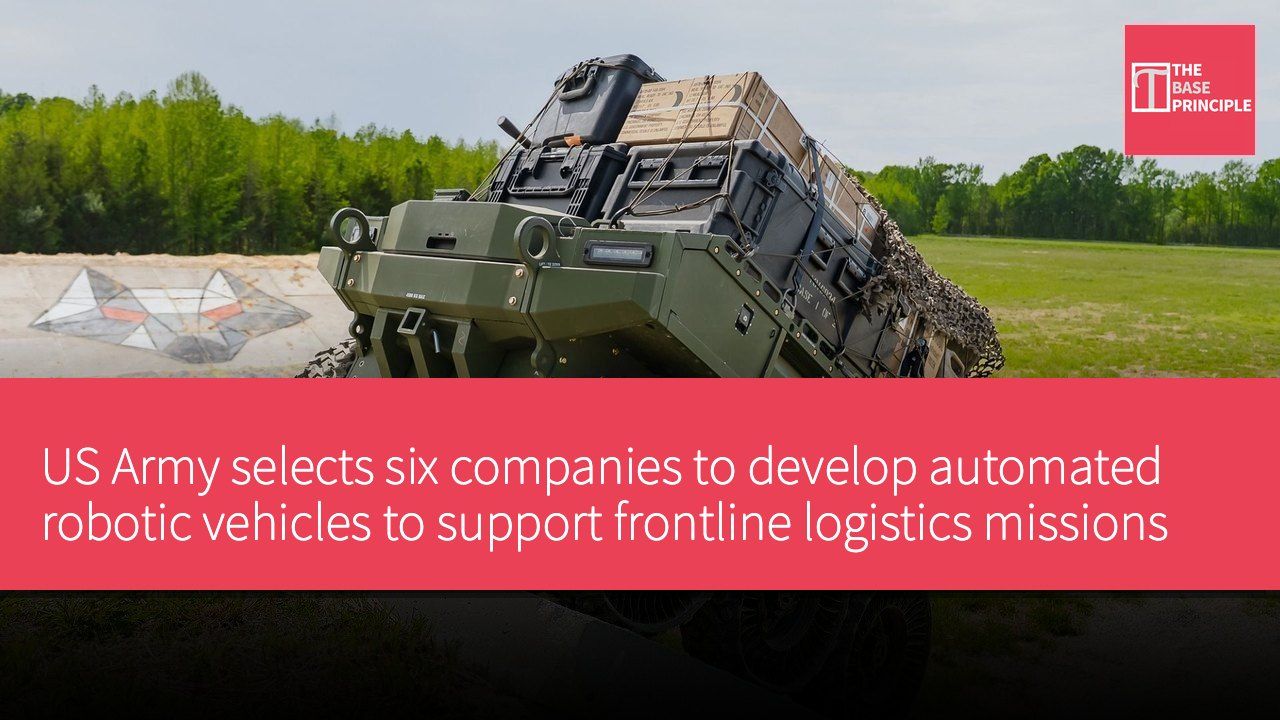
- The US Army selects six companies to develop automated robotic vehicles for logistics missions.
- BLADE's Hunter WOLF is a mature unmanned ground vehicle with production capability.
- The Army will evaluate different autonomous logistics and casualty evacuation methods; no single vehicle has been selected.
- If prototype vehicles prove effective, autonomous vehicles will become a key part of battlefield logistics.
The US Army has selected six companies to develop production-ready robotic vehicles to automate one of the battlefield's most dangerous logistics tasks: delivering supplies and evacuating casualties near the front lines. BLADE (formerly HDT) is among the six companies chosen to participate in the Army's Infantry Last Tactical Mile (ILTM) program. The company submitted its Hunter WOLF unmanned ground vehicle, a six-wheel diesel-electric hybrid designed to support light and infantry units. The ILTM program focuses on the area between logistics units and the forward line of own troops (FLOT), where soldiers delivering ammunition and supplies, or carrying casualties back, may be exposed to enemy fire.
BLADE's technical maturity
BLADE describes the Hunter WOLF as a mature design, calling it a technology readiness level 9 (TRL 9) system ready for production. TRL 9 is the highest level in the US military's technology readiness assessment, indicating the system has been validated in an operational environment. The company says the vehicle can autonomously transport up to 2,800 pounds (approximately 1,270 kilograms) of cargo. Its six-wheel configuration is designed to handle difficult terrain, including dense forests, 60% grades, and 40% side slopes. The vehicle can also provide power to other equipment and accept different payloads depending on mission requirements, allowing the same platform to be used for logistics resupply or casualty evacuation, not just a single mission.
"The Hunter WOLF has been designed, manufactured, and field-validated to a high degree of maturity, ready to support warfighters in challenging environments right now," said Tom Van Doren, president of BLADE's robotics division. The six companies selected by the Army will compete for the next-generation robotic infantry system; other participants include Maren-Go, Overland AI, Forterra, Hendrick's Motorsports, and American Rheinmetall.
Evaluation and future plans
The Army selected these companies through prototype other transaction agreements. According to Defence Blog, participating companies are expected to deliver production-representative prototypes for demonstration and operational evaluation with Army units in early 2027. The evaluation results aim to help the Army determine requirements and inform potential production decisions for the next-generation autonomous infantry support system.
The program has therefore not selected a single vehicle for Army-wide use, but is instead a competitive prototype effort to evaluate different autonomous logistics and casualty evacuation methods. BLADE enters the competition with a vehicle already used in military exercises and evaluations. According to the company, the Hunter WOLF has been in service since 2017 and was upgraded in 2025. The vehicle has participated in more than 60 field exercises, and BLADE says the platform has supported the US Marine Corps, Australian, and Ukrainian forces.
The vehicle has also recently undergone US Army evaluation. In May, BLADE delivered Hunter WOLF vehicles to the 10th Mountain Division at Fort Polk, where soldiers received training on operation and maintenance with different mission configurations under the Army's Ground Vehicle Autonomous Transport program.
The company also reported evaluations in 2026 with the 10th Mountain Division and 101st Airborne Division, as well as an event with the 82nd Airborne Division at Fort Polk, Louisiana. For the ILTM program, the Army will evaluate whether systems like the Hunter WOLF can reliably perform resupply and casualty evacuation missions in the difficult terrain and contested conditions facing infantry units. If the prototypes can prove they reduce the need for soldiers to undertake these dangerous logistics tasks, autonomous ground vehicles could become an increasingly important part of how the Army moves supplies and casualties across the battlefield's last tactical mile.
Battlefield application prospects for autonomous robotic vehicles
The US Army's program underscores the growing emphasis on applying automation technology to battlefield logistics. As the warfighting environment evolves, traditional logistics support faces mounting challenges, and autonomous robotic vehicles like the Hunter WOLF offer a potential solution. These vehicles can not only deliver supplies in hazardous environments but also reduce risk to soldiers and improve operational efficiency. Future evaluations will help determine the viability of these technologies and further drive the development of military automation.