
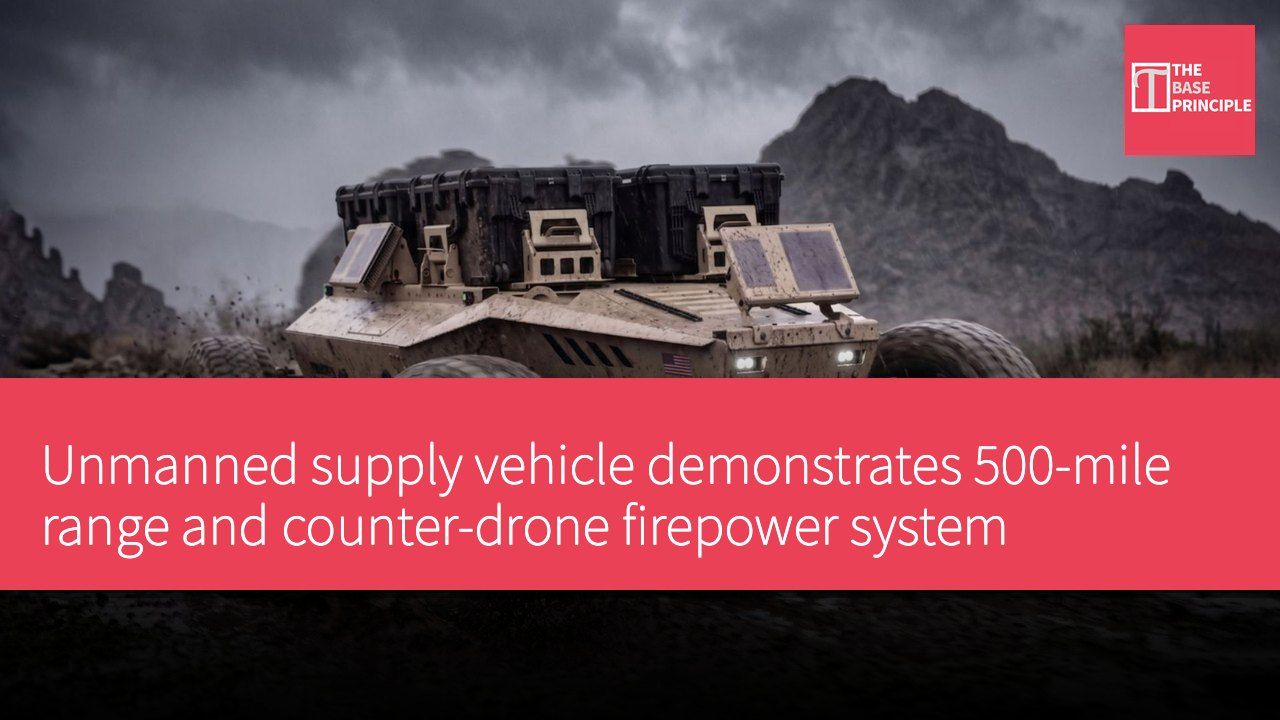
- Unmanned off-road vehicle designed specifically for dangerous military supply transport.
- Razorback can carry 4,000 lbs with a driving range of approximately 500 miles.
- The vehicle integrates a counter-drone turret for enhanced defensive capability.
- Forterra focuses on autonomous technology, systems that operate without a driver.
Delivering military supplies in areas of active firefighting places drivers in direct danger. Forterra and Hypercraft are showcasing an unmanned off-road vehicle at the U.S. Army's annual conference in Washington, designed specifically for these missions. The platform combines Hypercraft's Razorback unmanned ground vehicle with Forterra's AutoDrive autonomous driving system. In addition, it is equipped with a counter-drone turret from 9 Mothers, integrating autonomous resupply and drone defense into a single vehicle.
The companies view contested logistics as the primary mission, although no military customers, contracts, or pricing for the combination have been announced. Forterra, formerly known as Robotic Research, focuses on developing autonomous technology rather than manufacturing vehicles. AutoDrive combines software, sensors, and compute to enable existing vehicles to operate without a driver.
The unmanned Razorback has a payload capacity of 4,000 lbs (approximately 1,814 kg) and is Hypercraft's first complete vehicle developed in Provo, Utah. The company initially built electric powertrains for commercial vehicles before expanding into defense and launching the Razorback earlier this year. According to Hypercraft data, the vehicle measures over 13 feet long (approximately 4 meters) and can carry a maximum of 4,000 lbs (approximately 1,814 kg).
Razorback Technical Specifications
The company reports the vehicle's driving range at approximately 500 miles (approximately 800 km) and it can provide up to 38 kW of power for external equipment. Its design accommodates third-party sensors, radios, weapons, and mission payloads. Hypercraft has already demonstrated a Razorback equipped with Fortem Technologies counter-drone radar.
"We are developing for contested logistics and other missions where the driver is the most exposed person on the battlefield," Forterra Chief Growth Officer Scott Sanders told Tectonic. He added: "The combination of Razorback and AutoDrive provides a system that can traverse more complex terrain and power the platform in ways traditional unmanned ground vehicles cannot."
Sanders noted that Razorback was designed for autonomy from the start, making integration straightforward. He contrasted this approach with unmanned ground vehicles converted from manned trucks, where self-driving equipment is installed after production. To date, the system has been integrated into more than 50 vehicle types, participated in over 1,100 missions, and secured contracts for more than 258 systems. Applications include the Polaris Ranger 1500 utility vehicle used in Ukraine and the U.S. Army's Ford F-250 pickup.
AutoDrive also supports the Oshkosh Joint Light Tactical Vehicle used by the U.S. Marine Corps for the ROGUE-Fires anti-ship missile launcher.
Counter-Drone Turret Capabilities
The Razorback on display at AUSA is equipped with the Edda counter-drone turret developed by 9 Mothers, based in Austin, Texas. The turret weighs approximately 50 lbs (approximately 23 kg). Edda can detect the sound of small drone rotors, track targets using a camera, and fire shotgun rounds. It is designed to engage drones approximately 7 inches in diameter (approximately 18 cm) at distances of 33 to 328 feet (approximately 10 to 100 meters). In August of this year, the U.S. Army tested the turret in a live-fire exercise at Fort Bragg, North Carolina, where it was mounted on a self-driving
Ford F-250 equipped with Forterra technology.
Forterra said its partnerships prioritize operational requirements and production scalability, with autonomous driving demanding coordination among vehicles, sensors, compute, communications, and operators. The Razorback pairing integrates these elements to address contested resupply missions.
Prospects for Autonomous Technology in Military Applications
Autonomous technology is gaining increasing attention in the military domain, particularly for dangerous resupply missions. Razorback's design not only improves transport efficiency but also reduces the risk of personnel exposure to danger. Combined with counter-drone systems, this type of vehicle can play a significant role in complex operational environments, indicating the future direction of military logistics. As technology advances, the application scope of unmanned vehicles will continue to expand, providing stronger support for military operations.