
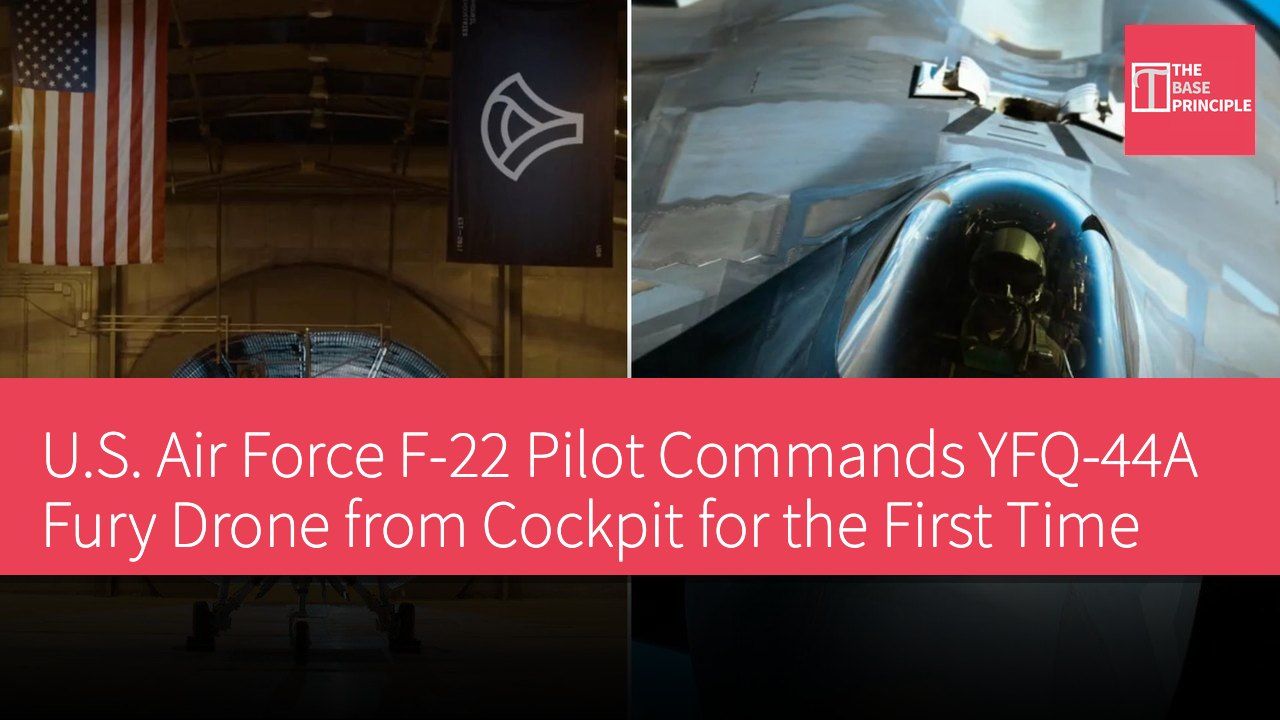
- F-22 pilot commands YFQ-44A drone during flight for the first time.
- This test advances the autonomous combat capabilities of unmanned aerial vehicles.
- YFQ-44A Fury is a product of Anduril's Collaborative Combat Aircraft program.
- Future CCAs may be equipped with various sensors and weapon systems.
A U.S. Air Force F-22 Raptor pilot has commanded a YFQ-44A Fury drone during flight for the first time, marking a significant step toward the future of manned fighter jets directing autonomous drones in combat missions. The demonstration took place earlier in October 2026, pairing the stealth fighter with Anduril's Fury Collaborative Combat Aircraft (CCA). During this test, the F-22 pilot did not remotely control the drone through individual commands but instead sent high-level tactical instructions that were interpreted and executed by the drone's autonomous software.
This test advances the Air Force's goal of transforming unmanned aerial vehicles into autonomous wingmen that can accompany manned fighter jets, thereby extending their operational range and providing additional combat capabilities without the need to assign a pilot to each aircraft.
Advancing Drone Autonomous Combat Capabilities
According to The War Zone, the F-22 and YFQ-44A took off from Edwards Air Force Base in California and rendezvoused in the air. The pilot then transmitted updated mission plans to the drone via a tactical data link. The Air Force described the human pilot as a "fourth wingman" in the air, issuing tactical commands while the onboard software of the Fury was responsible for executing those commands. The demonstration included dynamic flight maneuvers and simulated combat missions. The pilot did not manually control every action of the drone but showcased how a human can command a semi-autonomous platform while the software handles execution details.
The Air Force and Anduril did not disclose the complete cockpit configuration used during the demonstration. Previous studies on drone control interfaces have explored tablet-like displays and supporting hardware that allow pilots to convey mission instructions without significantly disrupting their primary flying tasks. The long-term goal is for a fighter pilot to command multiple collaborative combat aircraft; however, managing multiple autonomous wingmen will require further software development, testing, and operational procedures.
The YFQ-44A Fury is a product of Anduril's involvement in the Air Force's Collaborative Combat Aircraft program, which aims to develop unmanned aerial vehicles capable of operating alongside traditional fighter jets. The aircraft is designed to serve as a low-cost complement to manned fighter jets. Depending on the final configuration and mission, future CCAs may be equipped with sensors, electronic warfare equipment, or weapons, aiding in task allocation within larger formations. The Air Force has selected Anduril's YFQ-44A and General Atomics' YFQ-42A as part of the first phase of the program.
The service is advancing both designs simultaneously, developing the necessary technologies, tactics, and support systems to deploy autonomous aircraft.
Broader Initiative for F-22 Testing
The Fury has already demonstrated other capabilities. In July 2026, the Air Force announced that a YFQ-44A successfully launched an AIM-120 air-to-air missile during live-fire testing against digital targets. This test validated another step in integrating the aircraft with weapon systems, but it was separate from the recent F-22 control demonstration. The F-22 testing is part of a broader initiative to integrate autonomous aircraft into future aerial combat. The Air Force hopes that CCAs will increase the number of aircraft available for missions while providing pilots with additional options for situational awareness, targeting, and engagement.
The service is also addressing practical challenges, including how to deploy and maintain drones, how pilots will manage their workload, and how commanders can trust that autonomous aircraft will perform predictably in complex environments.
This demonstration shows that a fighter pilot can issue tactical commands to a specially designed CCA during flight, laying the groundwork for further testing. The next challenge is to transform this capability into a reliable operational system, potentially allowing manned fighter jets to command multiple unmanned aircraft as part of a coordinated combat formation.
Future Prospects of Fighter and Drone Collaboration
This demonstration marks a significant advancement for the U.S. Air Force in autonomous drone operations. Through the command of the F-22 pilot, the drone was able to execute missions in complex combat environments, which not only extends operational reach but also enhances combat efficiency. In the future, as technology continues to develop, pilots may be able to command multiple drones simultaneously, which could change the landscape of aerial combat and potentially enhance overall combat capability. The Air Force's long-term goal is to achieve more efficient combat formations, which requires ongoing efforts in software development and operational procedures.