
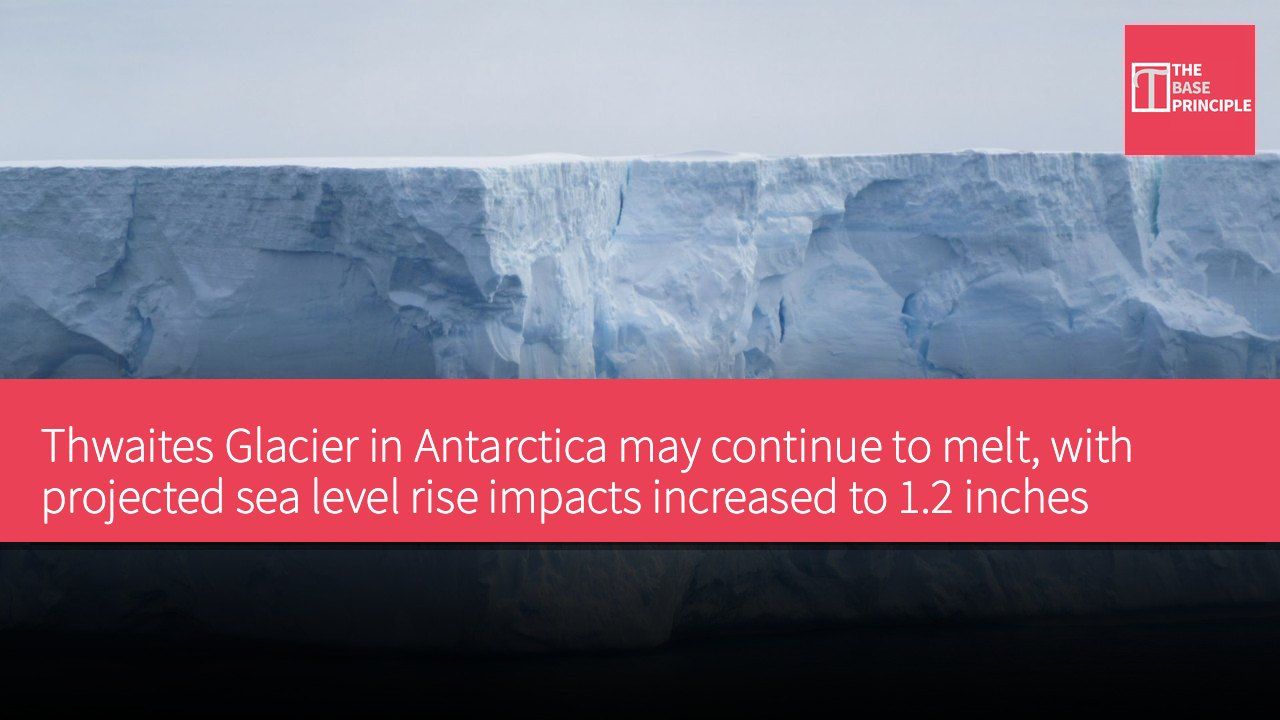
- Thwaites Glacier may continue to lose ice over the coming generations.
- The glacier's contribution to sea level rise could be twice previous estimates.
- Research shows limited potential for reducing ocean melting.
- Scientists are exploring intervention measures to stabilize the glacier and reduce future losses.
Thwaites Glacier in Antarctica, dubbed the "Doomsday Glacier," may continue to lose ice over the coming generations, even if the rate of ocean melting suddenly decreases. Recent research also indicates that the glacier's contribution to sea level rise by 2100 could be about twice that estimated by some previous models. These findings highlight two related challenges: past changes have pushed the glacier into a potentially irreversible state of retreat, while new models suggest scientists may have underestimated how warm seawater reaches the glacier's base.
Thwaites Glacier, located in West Antarctica, is one of the largest sources of ice loss in the region. If the glacier were to completely collapse, global sea levels could rise by about 65 centimeters (approximately 26 inches), although this represents a long-term risk rather than a prediction for this century. The glacier's vulnerability partly stems from its interaction with the ocean: much of the ice sits on bedrock below sea level, while its floating ice shelf helps regulate the speed at which ice flows into the ocean. Relatively warm seawater can melt the underside of these ice shelves, and as the shelves thin, they provide less resistance to the ice behind them, allowing the glacier to retreat inland and supply more water to the ocean.
New Models Show Accelerated Glacier Retreat
A study published on October 12, 2026, in Nature Communications investigated how seawater penetrates the glacier's broad transition zone where it begins to float. Researchers found that representing this area as several kilometers wide rather than a narrow boundary helped their models replicate the retreat and thinning observed from 1996 to 2023. In a constant climate scenario, the model predicts that by 2100, Thwaites Glacier could contribute up to 30 millimeters (approximately 1.2 inches) to global sea level rise, about twice the average of earlier predictions.
The study also found that in some simulations, the glacier could detach from its stable underwater ridge as early as 2038.
An independent study led by the British Antarctic Survey published in Geophysical Research Letters explored an extreme hypothetical scenario: what if ocean-driven melting completely stopped? Researchers ran three independent glacier models over a 150-year simulation. In the simulations, the neighboring Pine Island Glacier began to thicken and advance, but Thwaites Glacier continued to lose ice throughout the period, albeit at a reduced rate. This result suggests that Thwaites is still responding to past environmental changes.
Its retreat has altered the glacier's geometry and its relationship with the seabed, meaning that merely reducing ocean melting may not restore its previous state over a century-long timescale.
The Importance of Emission Reductions
Importantly, the zero-melting scenario is an extreme modeling experiment, not a realistic prediction. The study did not establish that every future change is irreversible or that Thwaites must accelerate toward total collapse. Currently, there is no proven technology capable of restoring Thwaites Glacier to its historical state. The latest findings point to two priorities: reducing the warming that drives ocean melting and preparing for potentially unavoidable sea level rise. Reducing greenhouse gas emissions remains crucial, as ongoing ocean warming could exacerbate the ice loss that has already begun.
Researchers from the British Antarctic Survey emphasize that without emission reductions, future losses could worsen. Scientists are also exploring more direct intervention measures, including underwater curtains designed to limit warm water flow to vulnerable ice shelves, as well as other proposals to stabilize the glacier. For coastal communities, these impacts extend beyond Antarctica. Rising sea levels increase the risk of flooding, erosion, and storm surge damage, making adaptation planning increasingly important even if emissions decrease. The Doomsday Glacier is not a countdown to a single catastrophic event, but a warning that changes to the planet's largest ice sheets may continue even after triggering conditions improve.
Scientists may not be able to reverse all the ice loss that has already begun, but limiting further warming can still influence the extent of future ice loss and the eventual magnitude of sea level rise.
The Future of Thwaites Glacier and Global Impacts
The ongoing melting of Thwaites Glacier is increasingly evident in its impact on global sea level rise. As research shows its contribution may have been underestimated, this raises higher demands for risk management in coastal communities. Despite the challenges of reducing ocean melting, scientists are still seeking effective intervention measures to stabilize the glacier. This is not only a warning for Antarctica but also a microcosm of the global impacts of climate change, underscoring the urgency of reducing greenhouse gas emissions.