
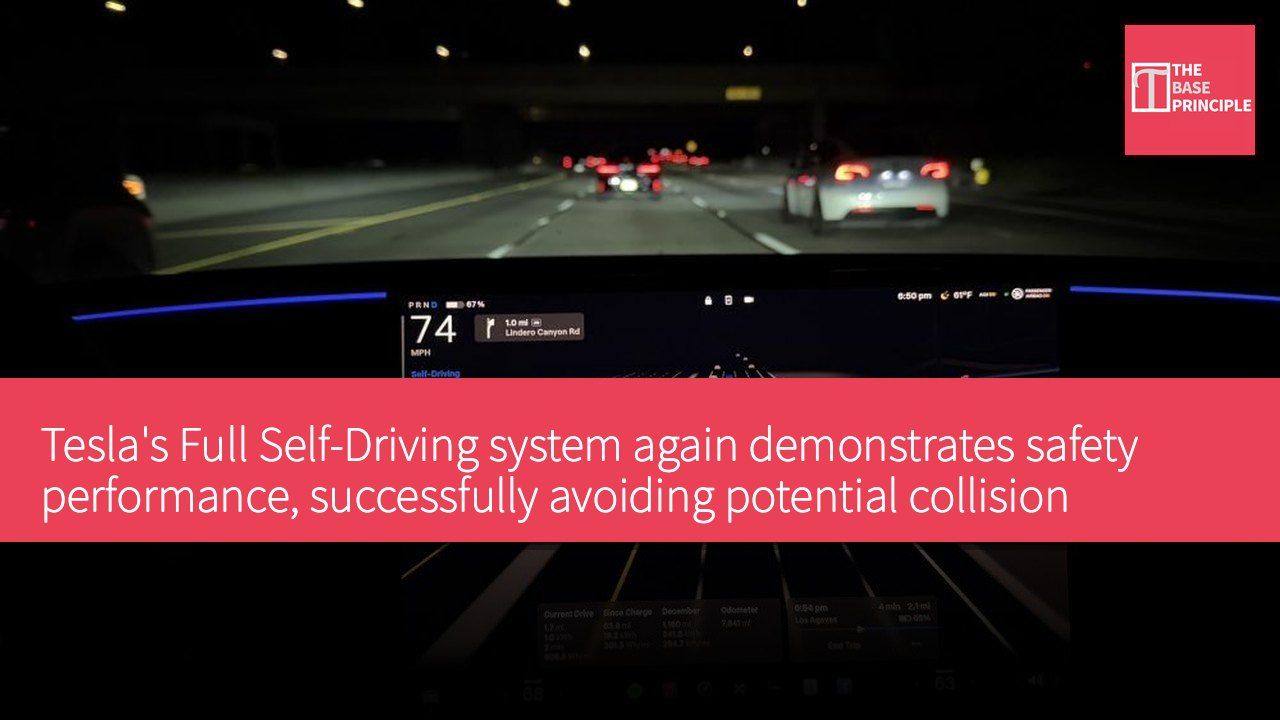
- Tesla demonstrates a case where the Full Self-Driving system successfully avoided a potential collision.
- FSD can brake in time when facing a vehicle running a red light, ensuring safety.
- Tesla's autonomous driving system's reaction speed surpasses humans, enhancing safety performance.
- The collision rate under FSD supervision is significantly lower than manual driving, demonstrating its safety.
Tesla is showcasing another Full Self-Driving (FSD) safety case before its 2,480 萬 followers. On Tuesday morning, Tesla's main account shared a dashcam video titled "FSD Supervision Prevents T-Bone Collision." The video comes from a user, TheNewGrid, who described the situation at a stop sign: "I saw a car approaching the stop sign, thought they would stop, my car started, then stopped in the middle of the intersection as that car sped through.
"If I were driving manually, this would have resulted in a collision." The key to this video is that when the other vehicle ran the stop sign, FSD had already begun crossing the intersection. The car did not continue forward but instead braked hard in the middle of the intersection, yielding to the crossing vehicle. According to the owner's own account, they initially shared the same assumption as the system—that the other driver would stop—and would not have corrected in time.
Tesla FSD Safety Performance
This video is part of Tesla's recent push to emphasize safety messaging. On Saturday, the company shared a video from "Selling Sunset" star Jason Oppenheim, who traded in his Bentley for a Model Y and said he purchased FSD-equipped Teslas for ten employees. Tesla AI head Ashok Elluswamy subsequently stated that Tesla's autonomous driving system "reacts faster than humans when others cut into its path."
On Monday, a Cybertruck user shared footage of FSD crossing three lanes from a red light to clear the way for an approaching ambulance from behind.
FSD Supervision Approval Status
The video's release coincides with Tesla's rollout of the automatic collision avoidance feature in FSD v14.3.9, which can automatically engage FSD when a head-on collision is imminent or the driver appears distracted. In September, Elluswamy said version 15 would bring "earlier hazard prediction, faster reaction times, and overall significantly better safety and collision avoidance capabilities," a version linked to all-weather robotaxi operations. The safety messaging extends beyond social media. Tesla states that the collision rate under FSD supervision on European roads over 一億公里 is 4.1 倍 lower than manual driving, and it has presented these data to regulators.
Currently, eight EU countries have approved FSD Supervision, with Croatia being the latest, but an EU-wide vote originally scheduled for 10 月 6 日 has been postponed to December at the earliest.
FSD Supervision remains a Level 2 system, with the driver bearing responsibility at all times. Even heavy users find reasons to intervene. Teslarati's Joey Klender said he uses FSD in approximately 76% of his driving and on Tuesday listed five common issues that still prompt him to take over. As this video demonstrates, it captures the moment when the software catches a human about to make a mistake.
Tesla FSD System Safety and Challenges
Tesla's Full Self-Driving system continues to demonstrate its superiority in safety, effectively predicting and avoiding potential collision risks. This not only highlights technological progress but also reflects growing consumer trust in autonomous driving technology. However, FSD remains a Level 2 system, requiring the driver to bear ultimate responsibility. This means that even with excellent system performance, drivers must stay alert and be ready to intervene at any moment—a major challenge in the current development of autonomous driving technology.