
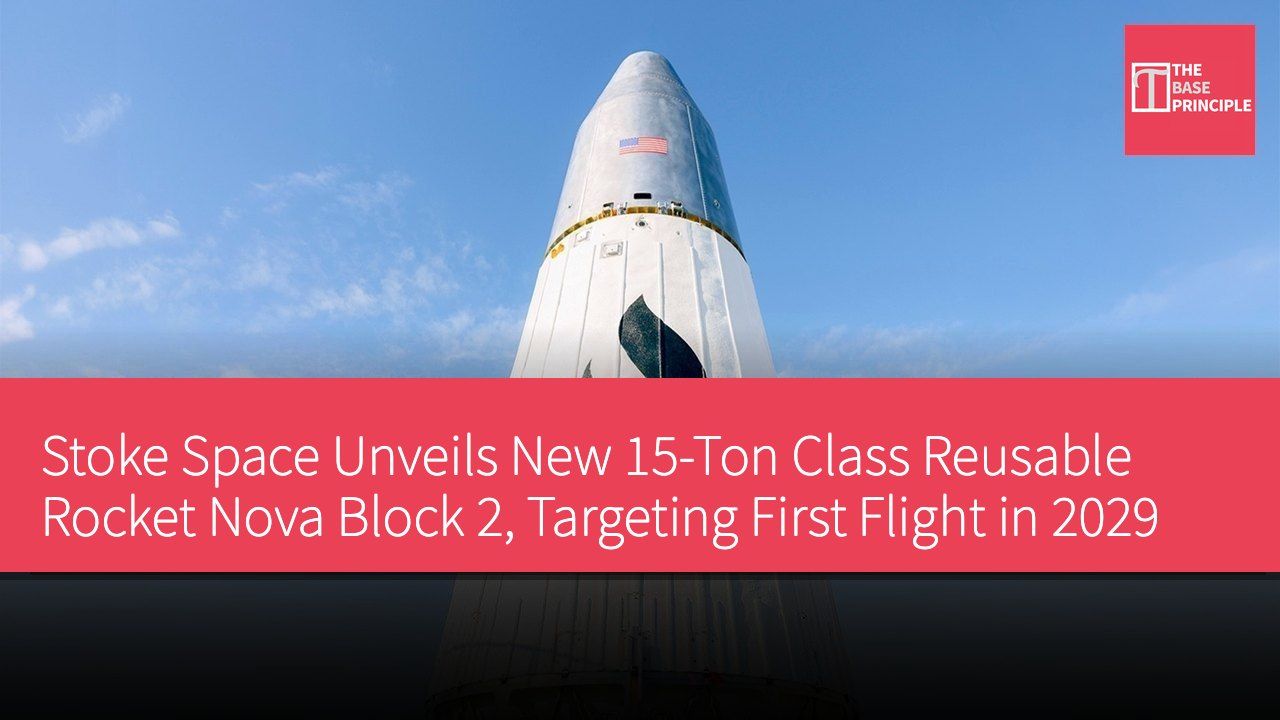
- Nova Block 2 is a high-capacity reusable rocket targeting its first flight in 2029.
- Both rockets are designed for full reusability, enhancing payload capacity and reducing costs.
- Block 2 boasts a 15-ton payload capacity, significantly increasing Pathfinder's lift capability.
- Full reusability is seen as an inevitable trend in the industry, offering cost advantages.
Stoke Space is preparing for its first orbital launch attempt and has now revealed its second, larger rocket that has been under silent construction for years. The Nova Pathfinder, located in Kent, Washington, is the company's first orbital launch vehicle and is currently undergoing integration and verification testing, with its maiden flight expected in early 2027. Nova Block 2, a high-capacity rocket designed to carry more payload, debuted this week and is targeted for its first launch in 2029.
Both rockets are part of Stoke's Nova series, designed from the ground up for complete, rapid reusability across two stages.
Rocket Design and Technical Features
Stoke's co-founder and CEO, Andy Lapsa, stated that a mature transportation system is built upon fully reusable launch vehicles. He called this the only path to achieving the lowest cost and increasing flight frequency.
The first stage of the vehicle is powered by seven of Stoke's Zenith engines, burning methane and liquid oxygen. Its upper stage uses a single Andromeda engine, which features a ring of 24 thrust chambers. This ring is directly integrated into an actively cooled metallic heat shield to withstand the challenges of atmospheric reentry. In its fully reusable configuration, Pathfinder is designed to deliver 3 tons of payload to low Earth orbit. If flown as an expendable vehicle, that capacity increases to 7 tons.
Stoke has conducted structural and operational testing on Pathfinder's first stage at its facility in Moses Lake, Washington, about 175 miles from the company's factory in Kent. Both stages still need to undergo ground test launches before actual flight preparations begin.
Lapsa described Pathfinder as a tool to translate Nova's broader promise into flight-proven capability. He stated that the rocket is specifically designed to incorporate the most challenging rapid reuse technologies into an integrated vehicle as early as possible.
Block 2's Payload Capacity
Nova Block 2 expands on nearly every architectural aspect. Its first stage is powered by 14 Zenith engines, exactly double the seven engines of Pathfinder. Its upper stage completely abandons Pathfinder's shared turbopump design, opting instead to run 12 independent engines, each with two thrust chambers. This independent engine layout provides significant redundancy advantages for Block 2's upper stage: reportedly, the stage can continue flying even if one engine fails completely.
With these upgrades, Block 2's fully reusable payload capacity reaches 15 tons, capable of fitting within a 5-meter payload fairing. This is approximately a fivefold increase in Pathfinder's reusable lift capacity. This capacity positions Block 2 in a competitive middle ground, able to lift masses between Rocket Lab's Neutron and Relativity Space's Terran R.
Clay Fisher, General Partner at Spark Capital, described full reusability as an inevitable outcome for the industry's future. He stated that it offers higher-order cost and service advantages over partially reusable rockets.
Stoke defines Block 2 as a direct extension of the lessons learned from Pathfinder, rather than a clean-sheet design effort. Lapsa stated that Pathfinder has enabled the company to learn quickly, reduce risk, and prove the most difficult elements of the fully reusable architecture in actual flight. He said that Block 2 further extends these lessons into the higher capacities and launch frequencies increasingly demanded by customers.
The Future of Reusable Rocket Technology
As space technology advances, the design of fully reusable rockets has become a major trend in the industry. Stoke Space's Nova Block 2 represents the latest progress in this direction, expanding payload capacity and increasing launch frequency to meet the growing demands of the market. This not only lowers launch costs but also enhances the flexibility of payloads, which is significant for both commercial spaceflight and scientific exploration. The industry generally believes that the maturation of this technology will change the operational model of future space missions, promoting more frequent and economical space activities.