
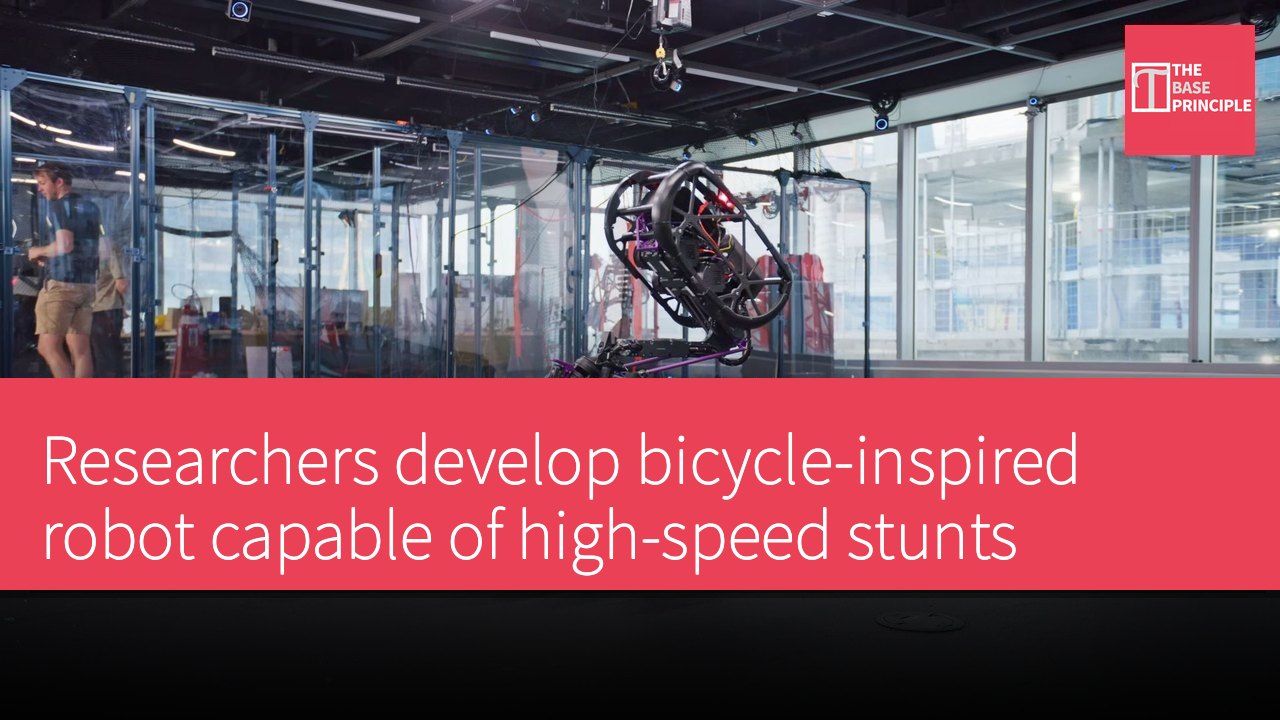
- The UMV is a bicycle-inspired robot capable of performing acrobatic maneuvers at high speed.
- The robot uses reinforcement learning for training, enabling it to traverse obstacles.
- The UMV's design reduces mechanical complexity, requiring only five actuated degrees of freedom.
- Future work will focus on improving hardware and reducing reliance on external systems.
Researchers have developed a bicycle-inspired robot that can perform acrobatic maneuvers at high speed while maintaining balance. The robot, called the Ultra Mobility Vehicle (UMV), uses a moving reaction mass to control stability and execute complex movements. The robot can perform jumps, wheelies, flips and other maneuvers, drawing inspiration from mountain bikes and stunt bikes. Researchers used reinforcement learning to train the machine, enabling it to traverse obstacles and execute dynamic movements.
At the Robotics and AI Institute, the UMV was designed as a bicycle-based robot aimed at combining fast wheeled locomotion with the agility of legged machines. The 51-pound (23.5 kilogram) robot can travel at 8 meters per second (about 18 miles per hour) and can balance on its rear wheel, hop laterally, perform wheelies and front flips. Its design leverages a movable reaction mass and reinforcement learning to achieve these motions, requiring only five actuated degrees of freedom (DoF), reducing mechanical complexity compared to traditional legged robots.
UMV Design and Structure
The UMV consists of three main structural components: the head, neck, and bicycle frame. Unlike a conventional bicycle, its head houses most of the robot's mass, including compute hardware, batteries, and a powerful jumping actuator. A spatial linkage connecting the head to the bicycle frame allows the robot to shift its mass and change direction during motion. The linkage comprises the neck and two links that work in concert to control the head's position relative to the bicycle. Two actuators drive the primary motion, while another pair enables lateral motion through the linkage. These mechanisms help the robot generate the forces needed for jumping and maintain balance during wheelie operations.
Two additional actuators control steering and rear-wheel drive, enabling conventional bicycle-like motion. The entire system uses five actuated degrees of freedom, allowing it to perform a range of dynamic maneuvers without reaction wheels, kickstands, or other dedicated static stabilization mechanisms.
Application of Reinforcement Learning
Researchers used reinforcement learning (RL) to train the UMV to perform different maneuvers in simulation, then transferred the learned control policies to the physical robot. Training used NVIDIA Isaac Lab and the Proximal Policy Optimization algorithm. During training, the simulation varied parameters including mass distribution, friction, motor strength, control latency, and sensor noise. This domain randomization aims to help the learned policies handle differences between simulation and real-world conditions.
Researchers developed four primary control policies for driving, wheelies, jumping, and flipping. These policies command the robot's joint motions through low-level proportional-derivative controllers. The resulting behaviors transfer from simulation to hardware without additional training. The robot can balance while moving forward or backward, pivot in place around the rear wheel, and execute a tracking standstill with minimal motion. When hopping on the rear wheel, it can strafe in different directions, overcoming the directional limitations of conventional wheeled platforms.
In one experiment, the UMV autonomously approached a 1-meter-high platform, jumped onto it, drove across the surface, then jumped down. It repeated this process 15 times, demonstrating consistent jump trajectories during ascent. The robot can also perform a front flip by jumping and tucking its body. This motion reduces its rotational inertia, allowing it to rotate faster. During this process, its pitch angular velocity reached approximately 17 radians per second, with the robot completing the rotation and landing successfully in under half a second.
Future Development Directions
Researchers tested the system in the lab using motion-capture equipment to improve state estimation. Future development will focus on more robust hardware, improved batteries and motor actuators, and onboard sensors to reduce reliance on external motion-capture systems. The team believes the technology has potential applications in urban delivery and off-road long-range reconnaissance, particularly where speed, agility, and obstacle clearance are critical.
Potential Applications and Challenges of UMV Technology
The UMV's design combines the rapid motion of a bicycle with the agility of a robot, demonstrating superior performance in dynamic environments. The application of reinforcement learning enables the robot to learn in simulation and transfer effectively to physical operation, which is crucial for future automation technologies. As the technology advances, researchers plan to improve hardware and batteries, which will make the UMV more reliable and unlock greater potential in areas such as urban delivery and off-road reconnaissance.