
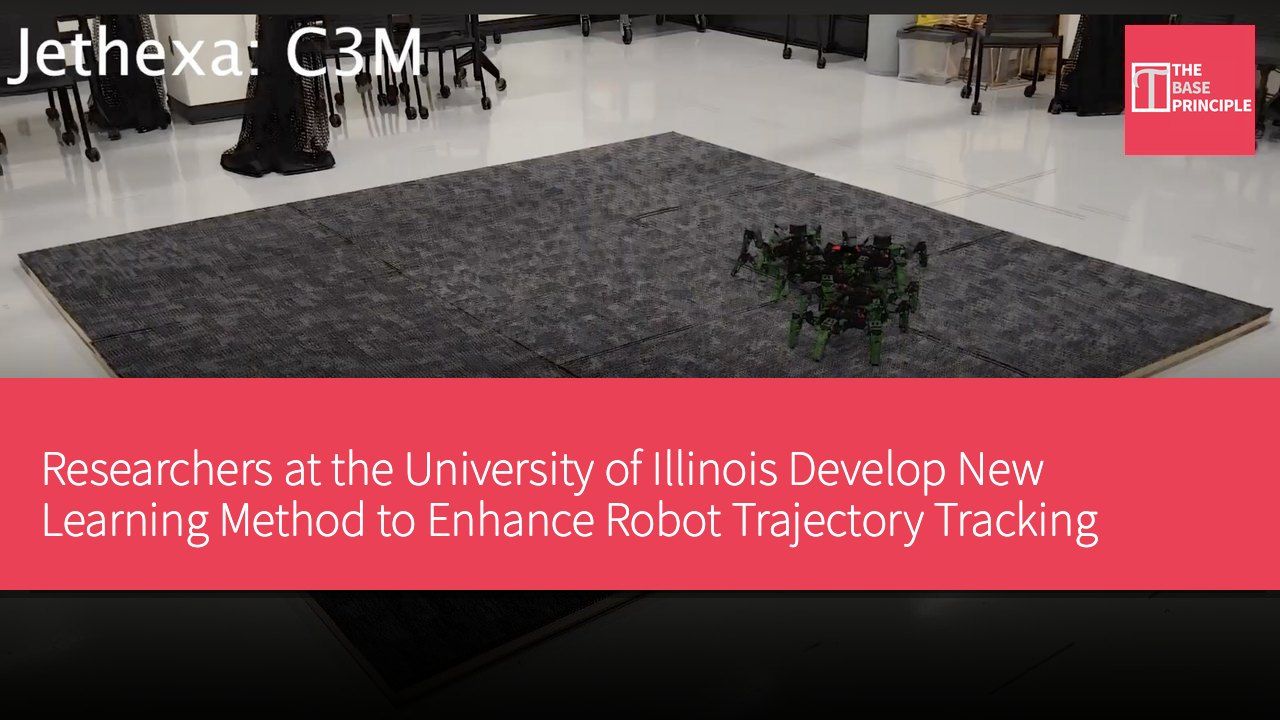
- The contraction-aware reinforcement learning method developed by researchers can improve robot tracking performance by up to 15%.
- CARL combines reinforcement learning with contraction theory, providing stability guarantees and mathematical bounds.
- The method has been tested on various robotic platforms, demonstrating superior performance compared to existing methods.
- Researchers note that this technology can be applied in hazardous environments such as wildfire management.
Researchers at the University of Illinois Urbana-Champaign have developed a learning method that helps robots improve their task execution capabilities while maintaining stability. This method combines reinforcement learning with control theory, providing stability guarantees and improving tracking performance by up to 15% compared to existing methods. The method, called contraction-aware reinforcement learning, is designed for various forms of mobile robots, including wheeled, aerial, and hexapod platforms. Researchers state that this method reduces the risk of instability and costly damage during operation, making the deployment of learning-based robotic systems more practical.
The reinforcement learning method helps robots navigate along desired paths while maintaining stability. The so-called contraction-aware reinforcement learning (CARL) combines reinforcement learning with contraction theory to improve control performance and provide mathematical guarantees that describe the behavior of tracking errors. Researchers tested the method on three different robotic platforms: a wheeled TurboBot 3 Burger, a flapping aerial drone, and a hexapod Jethexa robot. Experimental results show that CARL improved tracking performance by up to 15% compared to existing methods when tested on physical machines.
Advantages of Contraction-Aware Reinforcement Learning
Reinforcement learning allows robots to develop control strategies through repeated interactions with their environment. The system learns from feedback, adjusting its actions to improve performance and achieve goals. However, reinforcement learning alone does not guarantee that robots will remain stable while executing learned policies. A robot may learn an effective way to complete a task but still exhibit unpredictable behavior or deviate excessively from its intended trajectory. CARL addresses this challenge by combining reinforcement learning with contraction theory, a mathematical framework used to analyze the stability of dynamic systems. This method enables reinforcement learning to serve as the primary controller for robots while providing bounds on the growth of tracking errors.
According to the research team, while small tracking errors may still occur, the method establishes mathematical bounds on their size. This provides a way to combine the adaptability of learning-based control with the stability requirements of physical robotic systems. The method is designed to help robots achieve their goals without allowing deviations from their expected behavior to become excessively large.
Potential Applications in Hazardous Environments
The researchers first evaluated CARL in computer simulations before transitioning to physical experiments in the Aerospace Engineering Flight Laboratory. They tested the technique on three robots with different motion mechanisms: a wheeled TurboBot 3 Burger, a flapping aerial drone, and a hexapod Jethexa robot. This allowed the team to examine the performance of the control method across different types of robotic dynamics. A significant challenge in transferring learned control strategies from simulation to physical machines is the gap between simulation and reality.
The actual physical characteristics of the robot may differ from the values used in the simulated environment to train its controller.
For example, the simulation may represent the robot as weighing 1 kilogram (2.2 pounds), while the actual robot weighs 1.2 kilograms (2.6 pounds). These differences can affect the robot's response to control commands and its ability to follow planned trajectories. The researchers reported that CARL outperformed existing methods in handling these uncertainties. Its improved tracking performance was observed not only in simulations but also in real-world tests, indicating that the technology can maintain its advantages outside of computer-generated environments.
Researchers noted that wildfire management is a potential application for this technology. Robots deployed in hazardous environments can help locate hotspots, gather information, or deliver supplies to first responders. In these situations, reliable movement and predictable control are crucial, as unexpected deviations could impact the robot's ability to complete designated tasks. The researchers have made the method publicly available, with implementation code published on GitHub.
Practical Value of Contraction-Aware Reinforcement Learning
Contraction-aware reinforcement learning (CARL) not only provides theoretical stability guarantees but also demonstrates superior performance across different robotic platforms in practical tests. The development of this method is crucial for enhancing the reliability of robots in complex environments, particularly in applications requiring precise control, such as wildfire management. With the technology now publicly available, it may promote further exploration of practical applications and advance the field of robotics.