
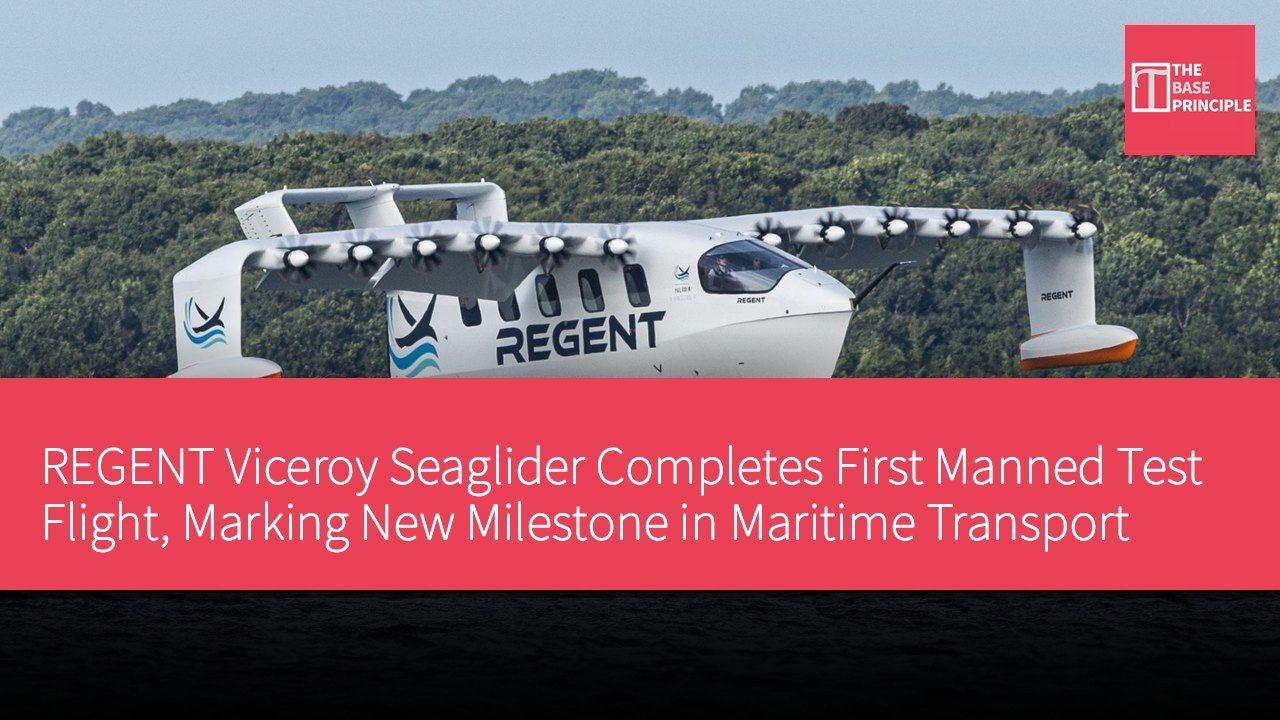
- REGENT's Viceroy Seaglider has completed its first manned test flight, marking a significant advancement.
- The vehicle can depart from a dock and transition to flight, offering a new mode of maritime transport.
- The test validated the Viceroy's performance, preparing it for commercial operations.
- Future plans include a version that can carry 12 passengers and reduce operational noise.
REGENT's Viceroy Seaglider has completed its first manned flight, with two pilots testing the vehicle over Narragansett Bay in Rhode Island in 2026. The company claims this is the "world's first" manned "flying boat" flight. During the 30-second test, the prototype flew at an altitude of about 33 feet (10 meters) above the water for a distance of 1,956 feet (596 meters). This flight marks a significant advancement for REGENT as it prepares for the final maritime testing phase of the Viceroy.
The company is developing this vehicle as a new mode of maritime transport that can depart from a dock like a boat and then transition to flight. Its 2026 testing program combines real-world water trials with simulation work to improve the vehicle's performance in preparation for commercial operations.
Viceroy's New Approach to Maritime Transport
The manned test follows earlier efforts to boost the Viceroy's speed on hydrofoils. These trials helped the prototype prepare to shift from water travel to flight. In the latest test, the vehicle demonstrated its ability to lift cleanly off the water and maintain stable flight close to the surface. REGENT stated that the test results validated key technologies needed for the next stage of development. REGENT's co-founder and Chief Technology Officer, Mike Klinker, said, "Completing this flight test validates years of rigorous engineering and operational work and gives us the confidence to move into full-scale production."
"We demonstrated today that the flying Seaglider is as smooth and safe as our design intended. I can't wait to board it and share the experience with others, bringing our vision of maritime mobility to life."
The Viceroy uses an electric hybrid propulsion system, designed to go through multiple phases of motion. Its journey begins as a traditional boat, then accelerates onto hydrofoils. At higher speeds, the craft rises above the water and uses aerodynamic lift to fly in ground effect. This allows it to stay close to the surface while enjoying a flight experience similar to that of an aircraft. The Viceroy is 55 feet (16.8 meters) long with a wingspan of 65 feet (19.8 meters). REGENT designed this platform to operate between ports without the need for traditional airport infrastructure.
The vehicle is designed to achieve a range of 160 nautical miles, about 184 miles (300 kilometers), with a cruise speed of 160 knots, equivalent to about 184 miles per hour (300 kilometers per hour). Its cargo configuration can carry up to 3,500 pounds (1,600 kilograms). Future plans include a passenger version that can accommodate 12 passengers and two crew members. REGENT claims that the vehicle's all-electric powertrain produces no emissions during operation. The company also claims that its operational noise can be 30 decibels lower than that of traditional aircraft or helicopters.
Commercial Prospects of Manned Flight
The successful manned flight brings the Viceroy program closer to commercial and defense applications. REGENT plans to use the remaining maritime tests to further evaluate the vehicle and refine its operational performance. The company states that its combined testing and simulation approach aims to reduce pre-production operational risks. With the first manned flight completed, the Viceroy has entered a critical phase as REGENT works to bring its Seaglider technology into regular maritime service.
Item Specifications Length 55 feet (16.8 meters) Wingspan 65 feet (19.8 meters) Range 160 nautical miles (about 184 miles / 300 kilometers) Cruise Speed 160 knots (about 184 miles per hour / 300 kilometers per hour) Cargo Capacity 3,500 pounds (1,600 kilograms) Passenger Capacity 12 passengers and 2 crew members
Market Potential and Challenges of the Viceroy Seaglider
The successful manned test flight of the Viceroy Seaglider brings new possibilities to the field of maritime transport. The vehicle's design, which allows it to operate both on the water's surface and through aerodynamic flight, gives it potential advantages in intercity travel. As environmental awareness grows, the zero-emission electric powertrain also aligns with future sustainability needs. However, the commercialization of this technology still faces challenges such as pre-production operational risks and market acceptance, especially in the highly competitive maritime transport market.