
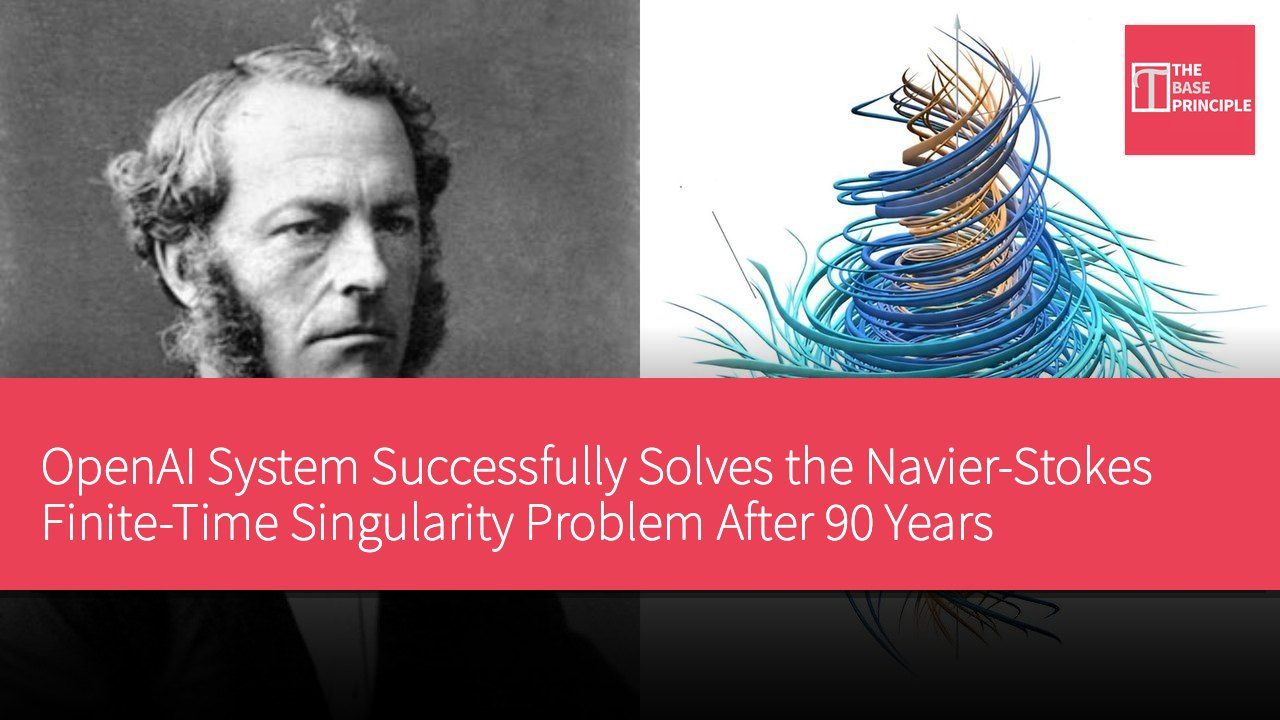
- OpenAI has discovered a finite-time singularity in the three-dimensional Navier–Stokes equations.
- This result could potentially solve one of the seven Millennium Prize Problems in mathematics.
- Researchers used a large network of agents to conduct competitive research on multiple versions of the problem.
- OpenAI does not intend to apply for the Millennium Prize but will share the proof to demonstrate advancements in mathematical capabilities.
OpenAI recently announced that its internal system has discovered a finite-time singularity in the three-dimensional Navier–Stokes equations, potentially solving one of the seven Millennium Prize Problems in mathematics. The result describes a fluid that starts smooth and stationary, then collapses inward in a vortex. The core stretches and accelerates until the velocity becomes infinite, yet the total energy of the system remains finite. This combination makes the proposed solution quite remarkable. Despite the presence of viscosity, the equations still produce their own collapse, which typically smooths out sharp changes in fluid motion.
Imagine a rotating column of fluid being pulled tighter and longer as it spins. The central region keeps shrinking, concentrating the motion into an increasingly smaller area. Eventually, the velocity grows explosively within a finite time. OpenAI states that the surrounding mathematics exert enough control to keep the fluid's energy finite. The challenge lies in making this behavior emerge naturally from the equations. Researchers cannot simply introduce an infinite external force to create the singularity. As the collapse approaches, acceleration, pressure gradients, momentum transfer, and viscosity all grow dramatically.
These factors also cancel each other out with sufficient precision to leave a smooth external force. This balance gives the result its physical character. The singularity arises from the fluid's own dynamics, a scenario the Navier–Stokes equations have failed to prove for generations.
How Researchers Explored the Problem
In 1934, Jean Leray showed that generalized solutions exist, but mathematicians have never determined whether smooth solutions must remain smooth. OpenAI did not arrive at this result through a single model but instead built a large network of agents and gave different teams different versions of the problem. The work began on September 1st, when researchers heard rumors about the solution to a major mathematical problem. The teams pursued competitive results, including possible collapse. The company tweeted: "We have shared a solution to the Navier-Stokes Millennium Prize Problem, a deep problem on the frontier of mathematics."
The proof was generated by a group of agents using a next-generation model more capable than GPT-6 Astra.
At its peak, the Navier–Stokes effort involved about 10,000 contemporaneous agents. They could run code in isolated environments and read cached internet data. An early result helped guide the search for the fluid singularity. Nearly 100 agents spent about 50 hours solving the regularity problem for the unforced version of the Euler equations. Researchers fed this result into the Navier–Stokes effort, with Codex helping to integrate useful ideas between agent groups. These agents reached their result on September 5th, about 88 hours into the project.
Subsequently, GPT-6 Astra spent another 17 hours formalizing and checking the proof in Lean. The Navier–Stokes work involved 2.7 million messages and about 130 billion output tokens.
OpenAI's Proof and Future Outlook
OpenAI does not intend to apply for the $1 million Millennium Prize. It has released the proof and its Lean formalization to demonstrate advancements in mathematical capabilities. Mathematicians still need to review the argument and determine whether it meets every requirement of the official problem. OpenAI also disclosed the independent work of Levent Alpöge and NYU mathematician Tristan Buckmaster on the forced Euler equations. If the proof withstands expert scrutiny, it will show that machine-guided mathematical search can reveal a mechanism that researchers have not yet discovered.
The vortex tightens, stretches, and accelerates until the equations can no longer keep its speed finite.
The Potential of Machine Learning in Mathematical Research
OpenAI's discovery demonstrates the potential of machine learning in solving complex mathematical problems. Traditional mathematical research often relies on human intuition and experience, but this breakthrough shows that through the collaboration of agent networks, it is possible to uncover problems that humans have failed to solve. This could not only change the mathematical community's understanding of fluid dynamics but also drive research in other fields, highlighting the importance of machine learning technology in scientific exploration.