
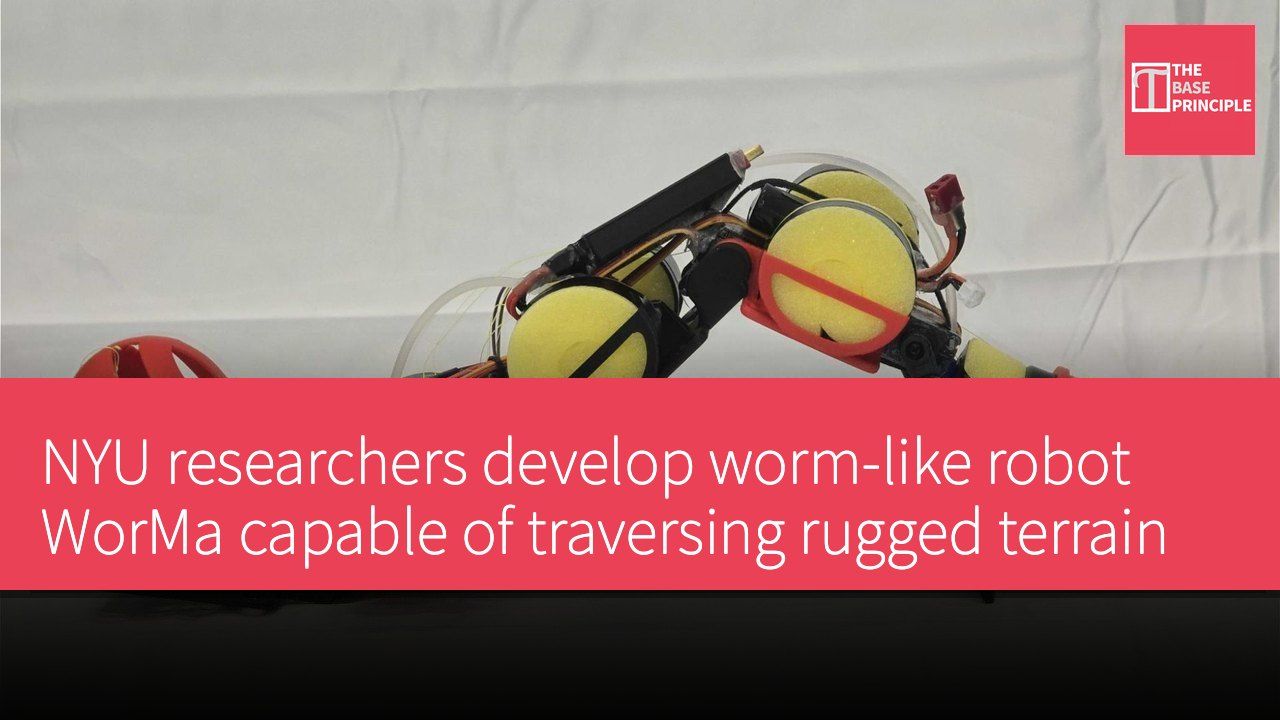
- WorMa is a worm-like robot capable of traversing rugged terrain.
- The robot alters its gait across different terrains by shifting its center of gravity.
- WorMa can clear steps roughly 6 inches high and shows improved swimming performance.
- Researchers plan to develop faster pumps and sensor-based control systems.
Researchers at New York University have developed a worm-like robot named WorMa designed to tackle rugged coastal terrain. The robot can move across rocks and slopes, then enter and exit water. Its design draws inspiration from how worms adapt their locomotion to changing environments. The robot was developed to address terrain that traditional wheeled or legged robots struggle to traverse.
Hydraulic center-of-gravity shifting, developed by researchers at NYU's Tandon School of Engineering, powers WorMa, an amphibious worm-like robot that changes its mode of locomotion across different terrains by shifting its center of gravity. Rather than switching between entirely distinct gaits or mechanically reconfiguring its body, the robot uses water as movable ballast. Pumps transfer water between tanks in its head and tail, allowing WorMa to redistribute mass and adjust its interaction with the ground or water.
WorMa can handle transitions between surfaces that typically challenge conventional robots. The five-segment, four-jointed robot measures roughly 20 inches (about 50 centimeters) long and weighs slightly over 2.2 pounds (about 1 kilogram). Its body contains latex water bladders in the head and tail, while a pump in the middle section moves approximately 10.6 ounces (about 300 grams) of water between them. The technology relies on altering the robot's center of gravity rather than adding specialized mechanical components for each environment.
How WorMa moves
Shifting water toward the head increases force applied through the front contact point, giving the robot greater traction when climbing inclines. In testing, the head-heavy configuration enabled WorMa to climb slopes as steep as 19.5 degrees, while other weight distributions caused it to slide backward. This configuration also reduced the robot's cost of transport by at least 33% compared with other tested options. The same center-of-gravity shifting mechanism produces different effects in water. Moving water toward the tail improves swimming performance by altering mass distribution. In tests, the tail-heavy configuration increased WorMa's swimming speed by up to 26% and improved efficiency by 52% compared with weight concentrated in the head.
WorMa uses a more complex sequence to overcome steps. It first concentrates water in the head to maintain traction, then the pump shifts water to the tail, causing the front to rise and allowing the tail to propel the robot toward the obstacle. Once the head contacts the step edge, water shifts back to the head, helping the robot anchor and push forward. Through this sequence, WorMa can clear steps roughly 6 inches (about 15 centimeters) high. According to the team, the same principle helps the robot exit water. With its mass concentrated in the head, WorMa can generate enough force at the front to pull itself up a bank.
Other tested configurations failed to generate sufficient traction to complete this transition.
Potential applications and future development
The researchers demonstrated the robot traversing a course containing flat ground, steps, slopes, and open water. WorMa adjusted its mass distribution in each segment while maintaining its basic undulatory gait. "This design means the robot doesn't need to be redesigned every time the terrain changes," said Nana Obayashi, an assistant professor at Tandon, in a statement. "That could be critical for environmental monitoring or infrastructure inspection, where a robot might need to cross dry ground, obstacles, and water in a single mission." The approach could simplify amphibious robot design by replacing multiple specialized mechanisms with a single adjustable mass-shifting system.
The researchers are also developing faster pumps and sensor-based control systems to let WorMa detect terrain changes and automatically redistribute weight. This could ultimately make the robot more dynamically adaptable in environments such as coastlines, wetlands, and flooded areas.
WorMa's impact on robotics
WorMa's design breaks through traditional robots' limitations on rugged terrain, using center-of-gravity shifting technology to enable flexible adaptation across different environments. This innovation not only enhances the robot's locomotive capabilities but also simplifies the design process, reducing the need for multiple specialized mechanisms. As the technology advances further, WorMa could play a greater role in fields such as environmental monitoring and infrastructure inspection, demonstrating its potential across diverse applications.