
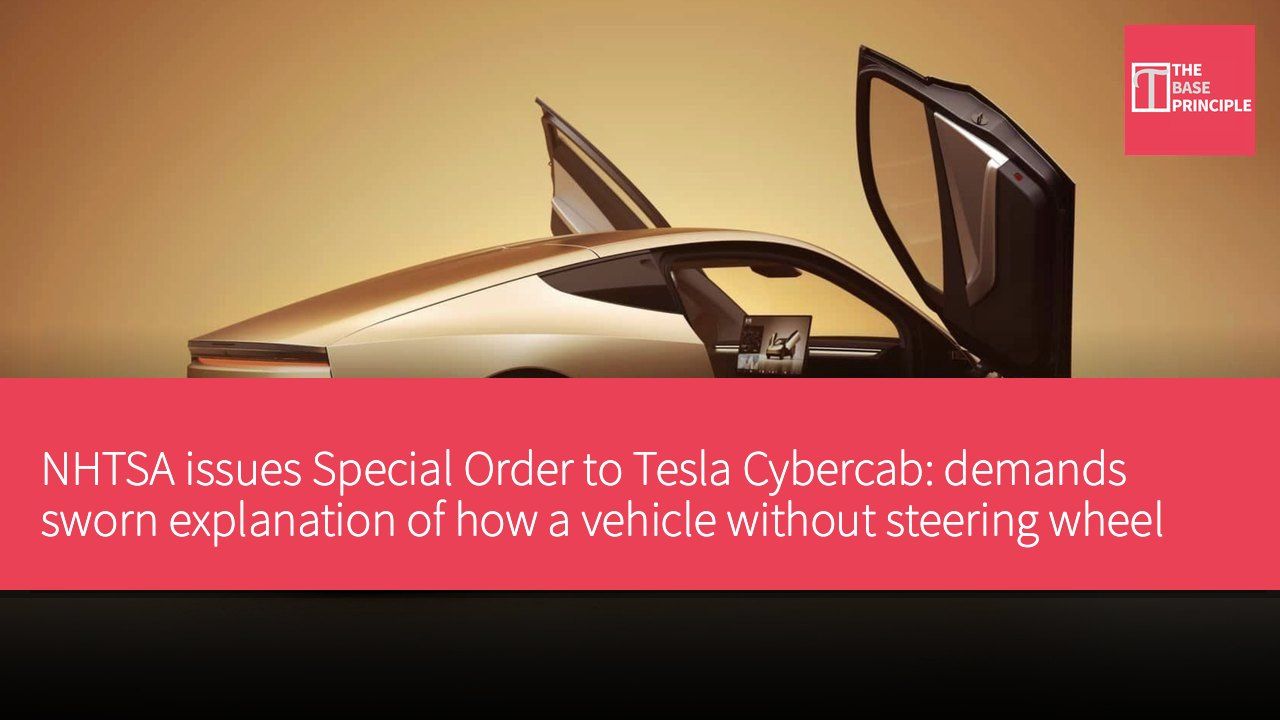
The U.S. National Highway Traffic Safety Administration (NHTSA) issued a formal Special Order to Tesla on September 10, 2026, requiring the company to provide a sworn explanation of how the Cybercab — without a steering wheel, pedals or rear-view mirrors — complies with the Federal Motor Vehicle Safety Standards (FMVSS) written for human drivers. Reports indicate the response deadline is September 30; failure to respond fully and honestly could expose the company to civil penalties of up to roughly USD 139 million.
The background is that, after Tesla began commercial Cybercab passenger service in Austin around September 3, NHTSA first opened Audit Query AQ26002; the Special Order represents an escalation, shifting the matter from a routine inquiry to a legal order carrying a sworn-declaration requirement. The U.S. operates a self-certification regime in which manufacturers themselves certify compliance with applicable FMVSS, with NHTSA auditing afterward; Tesla has asserted that the Cybercab complies with all applicable standards.
The service brakes shall be activated by means of a foot control.
— FMVSS No. 135
One focal point is FMVSS No. 135: service brakes must be activated by means of a foot control, yet the Cybercab has no foot control. NHTSA's stated public position is that a manufacturer whose vehicle lacks foot-controlled braking cannot self-certify compliance with that standard. Other standards cited include No. 101 (controls and telltales), 102, 108 (which relies on steering-wheel self-centering to cancel turn signals), 111 (mirrors) and 126.
An NHTSA rulemaking from 2022 noted that volume production and sale of vehicles operated solely by an ADS would "likely" require further amendments to the FMVSS, or the holding of a Part 555 exemption; Tesla does not currently hold such an exemption. A point of comparison: Amazon's Zoox received a temporary Part 555 exemption in July — covering standards including 135 and 111 — capped at 2,500 vehicles per year through 2028. Tesla, by contrast, has chosen the self-certification route and has already begun charging passengers. The matter now awaits Tesla's sworn response and any subsequent enforcement action.