
- A new U.S. fuel agreement will advance the development of small nuclear reactors for military and space applications.
- Centrus Energy will supply HALEU to Antares Nuclear.
- HALEU enables compact reactor designs, making it especially suitable for use at remote locations.
- The contract supports Centrus in expanding its HALEU production capacity to meet market demand.
A new U.S. fuel agreement is expected to bring compact nuclear reactors to sites where conventional energy is hard to use, including military installations and space. American nuclear fuel supplier Centrus Energy will supply high-assay low-enriched uranium (HALEU) to advanced microreactor developer Antares Nuclear under a multi-year contract. Deliveries are expected to begin before the end of the century. The agreement also includes an advance payment from Antares, which will support Centrus in expanding its HALEU production in the United States.
Military Applications for Small Nuclear Reactors
For Antares, the deal addresses a critical need for deploying small nuclear reactors in military installations and space applications. The company has been selected to participate in U.S. Army, Air Force and Space Force programs, including efforts to demonstrate nuclear energy at military facilities and reactors for space.
HALEU, which contains more uranium-235 than conventional low-enriched uranium, with enrichment levels between above 5% and below 20%, makes compact reactor designs possible. Advanced reactor developers use this fuel because it supports smaller, more energy-dense reactor designs. For microreactors, this is particularly useful when size, weight and fuel durability become critical. Those requirements become even more stringent when reactors are intended for remote military sites or space missions. Antares CEO and co-founder Jordan Bramble said: "Fuel supply is one of the practical questions every advanced reactor developer has to answer."
"This contract provides Antares with a reliable U.S. source of HALEU for the reactors we are deploying for a range of defense and space customers," he said.
Centrus's Expansion Plans
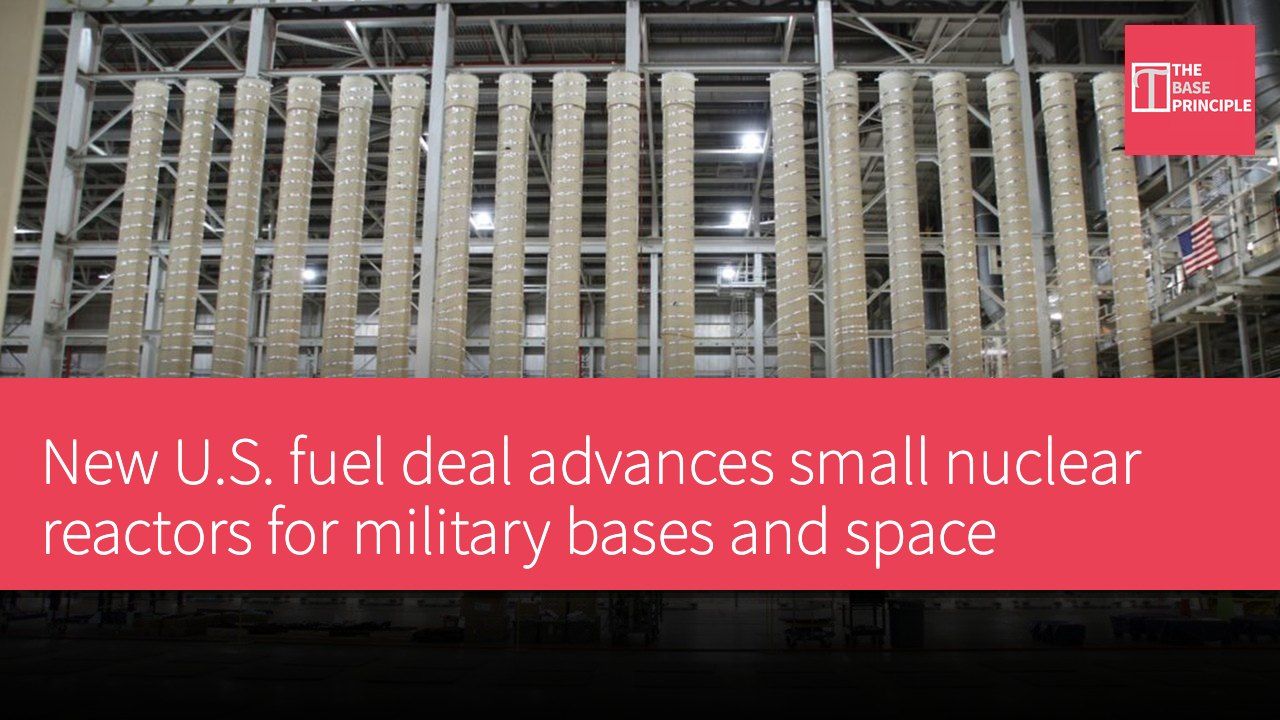
Antares is developing compact reactors for critical missions on Earth and beyond. The company was recently selected to take part in the U.S. Army's Janus program at Fort Bragg, North Carolina, as well as the U.S. Air Force's advanced nuclear power program at Joint Base San Antonio in Texas. The contract also provides Centrus with customer backing as it expands its own enrichment capabilities. The company produces HALEU at its American Centrifuge plant in Piketon, Ohio, described as the only licensed HALEU production facility in the Western world.
Centrus launched a billion-dollar-plus expansion plan last year to ramp up production of both HALEU and conventional low-enriched uranium. The company says committed orders are supporting the push toward commercial-scale output.
"This contract is another demonstration that demand for HALEU is real and accelerating, and that Centrus is well positioned to meet it," said Centrus President and CEO Amir Vexler. "Committed orders from Antares and others are supporting our progression to commercial-scale production, an expansion that is already underway. We look forward to supporting Antares's continued growth and success." A U.S. source for the fuel also carries important significance for Antares's national security work.
Centrus says both its enrichment technology and its manufacturing supply chain are U.S.-sourced, allowing the fuel it produces to support a range of national security applications. Centrus's AC100 centrifuges are designed to achieve so-called "unobligated" enrichment, meaning the uranium produced can be used for U.S. national security missions without foreign-use restrictions.
Antares achieved initial criticality for its Mark-0 microreactor in 2026 under the U.S. Department of Energy's Reactor Pilot Program. The company plans to produce electricity from the advanced reactor in 2027 and to begin initial production deployments at U.S. military installations in 2028.
The Potential of Small Nuclear Reactors in Defense and Space
The development of small nuclear reactors carries important implications for military and space missions, because they can deliver a stable energy supply in locations that are hard to reach with conventional energy sources. The use of HALEU not only raises the energy density of the reactor but also reduces the amount of fuel required, which is especially critical for applications in remote areas. In addition, Centrus's expansion plan shows a response to demand in the nuclear energy market and underscores U.S. autonomy within the nuclear fuel supply chain, an important factor for national security.