
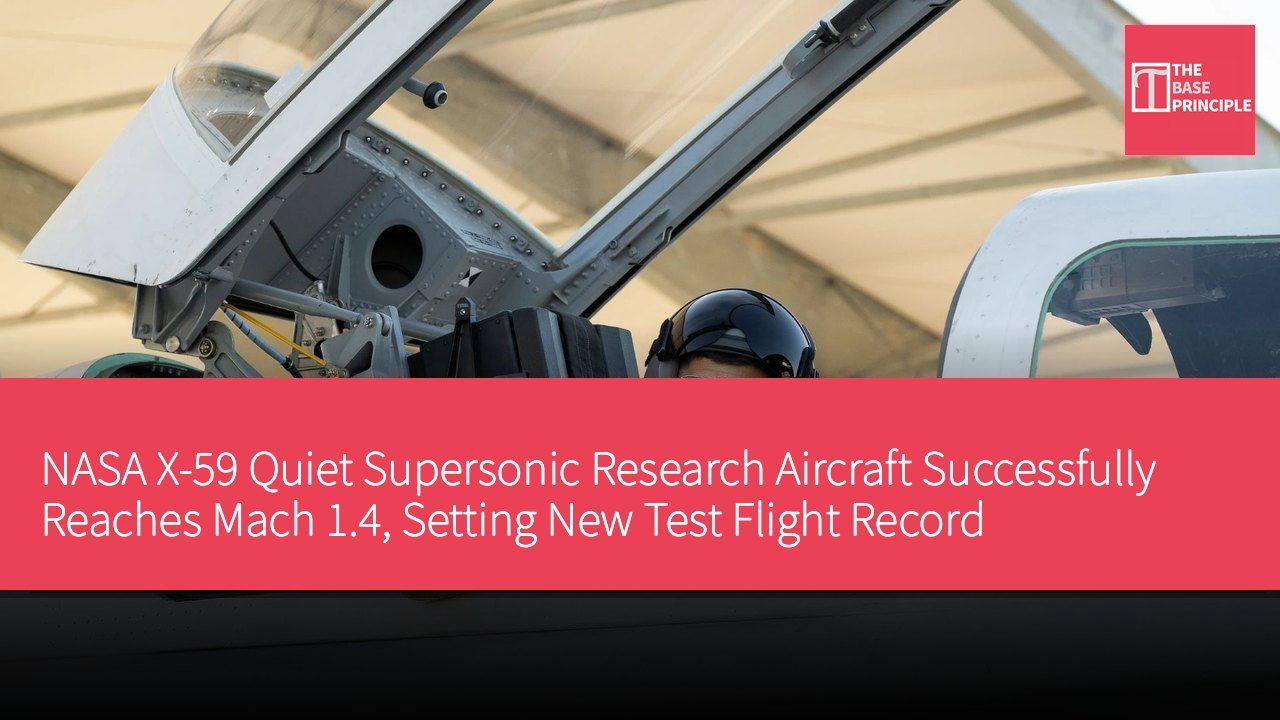
- NASA's X-59 successfully reached Mach 1.4, marking an important test flight record.
- Test pilot Lippert and his team spent months preparing to ensure a successful maiden flight.
- The X-59 is designed to reduce the noise impact of supersonic flight, paving the way for the future of commercial aviation.
- NASA will use the research findings to advocate for the lifting of the commercial supersonic flight ban.
Test pilot Mike Lippert has pushed high-performance aircraft to their limits over nearly 11 years. However, one milestone in his career remained unachieved: he had never flown an X-plane. Finally, he got that opportunity on October 21. Lippert soared over the Mojave Desert in California, taking the controls of NASA's X-59 Quiet Supersonic Research Aircraft for the first time, fulfilling a lifelong dream. This flight represents a significant victory for both the pilot and NASA's mission to reshape the future of commercial aviation.
Lippert took off from NASA's Armstrong Flight Research Center in Edwards, California, and flew for a full hour. During the flight, the sleek research jet cruised at a maximum speed of Mach 1.4 at an altitude of 55,000 feet. Lippert recalled, "After completing the high-altitude test point, we experienced a brief descent and deceleration, at which point I could see out the window that I was flying supersonic and piloting an X-plane, traversing the high desert of Mojave."
“This is indeed a special moment.”
The Pilot's Preparation Process
Although the X-59 had flown before, it took months to prepare Lippert for his maiden flight. He was not alone in this endeavor. Working closely with fellow NASA test pilots Nils Larson and Jim “Clue” Less, Lippert spent countless hours in ground simulators mapping out every potential variable. In August, he conducted his first engine run in the cockpit, honing communication processes with the mission control team.
This meticulous ground preparation paid off, as Lippert successfully executed complex maneuvers to test the aircraft's handling and system integrity.
For Lippert, this achievement is a blend of emotion and technical accomplishment. He stated, "This flight is very special to me. Since I can remember, I have dreamed of doing what I did today, testing a truly unique aircraft and working with this outstanding test team."
The aircraft successfully returned to the skies following routine maintenance checks and a comprehensive systems review. This ground check occurred after its most intensive operational phase, during which the crew completed six flights in just three days. Engineers, based on this momentum, approved the aircraft for its next major milestone. The X-59 features a unique needle-shaped nose designed to disperse shockwaves and reduce the need for a forward-facing windshield. Pilots like Lippert utilize an external visual system (XVS) to navigate, which streams a virtual 4K forward view to internal cockpit displays.
Interestingly, the aircraft is constructed from recycled parts of established fighter jets, such as the cockpit canopy and ejection seat from the T-38, along with the landing gear from the F-16. These measures help shorten development time and costs. A General Electric F414 engine powers the experimental aircraft, generating 22,000 pounds of thrust with the aid of an afterburner to propel its supersonic research flight.
Societal Impact of the Research
The primary objective of NASA's Quesst mission is to conduct test flights of the X-59 and measure public responses to quiet supersonic sounds over various communities in the United States. Researchers plan to share these acoustic study results with aviation regulatory bodies to establish data-driven noise standards. This evidence could ultimately persuade authorities to lift the long-standing ban on commercial supersonic flight.
Item Specifications Maximum Speed Mach 1.4 Flight Altitude 55,000 feet Engine General Electric F414 Thrust 22,000 pounds
Impact of X-59 Testing on Commercial Aviation
The successful testing of the X-59 is not only a technical breakthrough but also has significant implications for the future of commercial aviation. As the noise issues associated with supersonic flight are gradually addressed, this may prompt aviation regulators to reconsider the ban on commercial supersonic flight. The design and test results of this aircraft will provide valuable data for the future development of aviation technology and could potentially reshape the landscape of global air transport.