
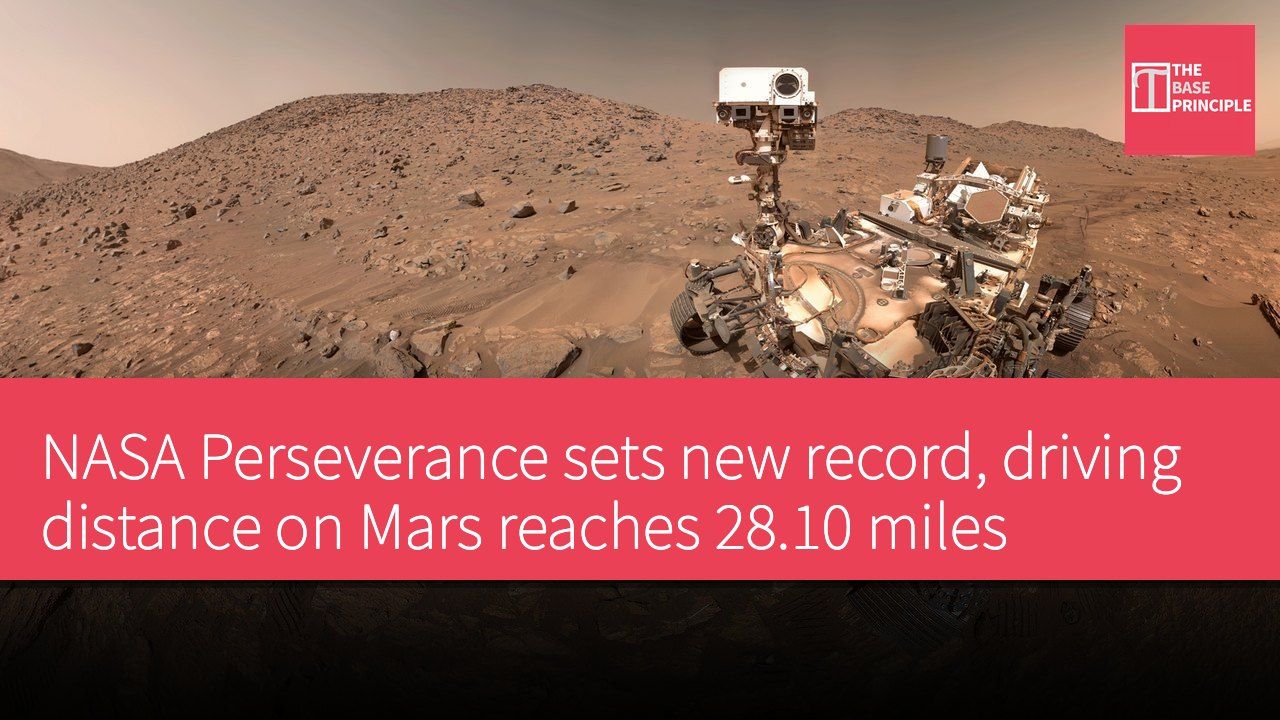
- Perseverance sets new record for longest distance driven on Mars, reaching 28.10 miles.
- AutoNav autonomous navigation system significantly improves Perseverance's driving efficiency.
- NASA recently approved Perseverance's first mission extension, which will continue exploring Jezero Crater.
- Perseverance has collected 29 rock and soil samples, searching for evidence of ancient life.
NASA's Perseverance rover has set a new record for the longest distance driven on another planet, reaching 28.10 miles (approximately 45.22 kilometers), surpassing the record held for years by Opportunity. The six-wheeled rover crossed this milestone on the 2,006th Martian day of its mission on Oct. 11, exceeding Opportunity's 28.06 miles (approximately 45.16 kilometers), a feat that took about five and a half years compared to Opportunity's nearly 15 years.
Most of Perseverance's progress comes from its AutoNav autonomous navigation system, which can identify obstacles and plan driving paths. NASA says the system has guided more than 90% of the total driving distance, while Opportunity's early autonomous navigation system accounted for only about 5%. Perseverance can drive up to 1,351 feet (approximately 412 meters) in a single Martian day. Its navigation software processes approximately 600,000 measurement points each time it surveys the terrain, compared to just 20 measurement points used by NASA's first Mars rover, Pathfinder.
AutoNav uses onboard cameras to capture images of the surrounding terrain, build a three-dimensional map of potential hazards, and select safe paths — paths that engineers on Earth would choose. The system enables Perseverance to make driving decisions autonomously without waiting for detailed commands from mission control. NASA describes this process as "thinking while driving." This record-setting drive covered 299.6 feet (approximately 91.31 meters), pushing the rover past Opportunity's previous record. "The original mission required driving no more than 12.4 miles.
NASA Approves Mission Extension
"We have already far exceeded that figure, and with all mobility systems fully operational and favorable extended ground life test results, we expect Perseverance to continue adding to this record in the coming years," said Steven Lee, NASA's Perseverance rover project manager.
NASA recently approved Perseverance's first mission extension, which began in October and will continue exploring the rim of Jezero Crater until approximately the end of 2028. The rover is currently driving in an area called Lac de Charmes, targeting Idubi, where scientists hope to identify evidence of ancient hydrothermal systems. These systems involve the interaction of heated water with surrounding rock, which could provide clues about environments that once supported microbial life.
Perseverance's Scientific Discoveries
While exploring Jezero Crater, Perseverance has collected 29 rock and soil samples, including from its former lakebed, ancient river delta, and crater rim. Some rocks in the area are approximately 4 billion years old. NASA says this terrain may preserve a wealth of geological evidence lost on Earth due to erosion and plate tectonics. The rover previously identified potential biosignatures in a rock named Cheyava Falls. This discovery remains a possible indicator of ancient life, not proof that life existed on Mars.
Perseverance has also surpassed the Apollo 17 lunar rover and the former Soviet Union's Lunokhod 2. NASA's earlier Mars rovers set a series of milestones. Pathfinder drove about 330 feet (approximately 100 meters), Spirit drove 4.8 miles (approximately 7.7 kilometers), and Curiosity has driven more than 23.65 miles (approximately 38.07 kilometers). After Lac de Charmes, Perseverance is expected to continue south to Rainbow Falls, a 328-foot-wide (approximately 100-meter-wide) slab of ancient crust exposed by the impact that formed Jezero Crater.
NASA is also improving the rover's navigation software to reduce unnecessary steering and use orbital maps during drives to help determine its position. The agency hopes future improvements will allow the rover to operate longer each day, expanding the range of Martian terrain it can investigate.
The Significance of Perseverance's Exploration for Mars Research
Perseverance's success lies not only in its breakthrough driving distance, but also in the advancement of its autonomous navigation technology, demonstrating the potential for future exploration missions. This technology enables the rover to make autonomous decisions in the harsh Martian environment, significantly improving exploration efficiency. Moreover, in-depth study of Jezero Crater will help scientists understand ancient environments and their influence on life, which is of great significance for the search for extraterrestrial life.