
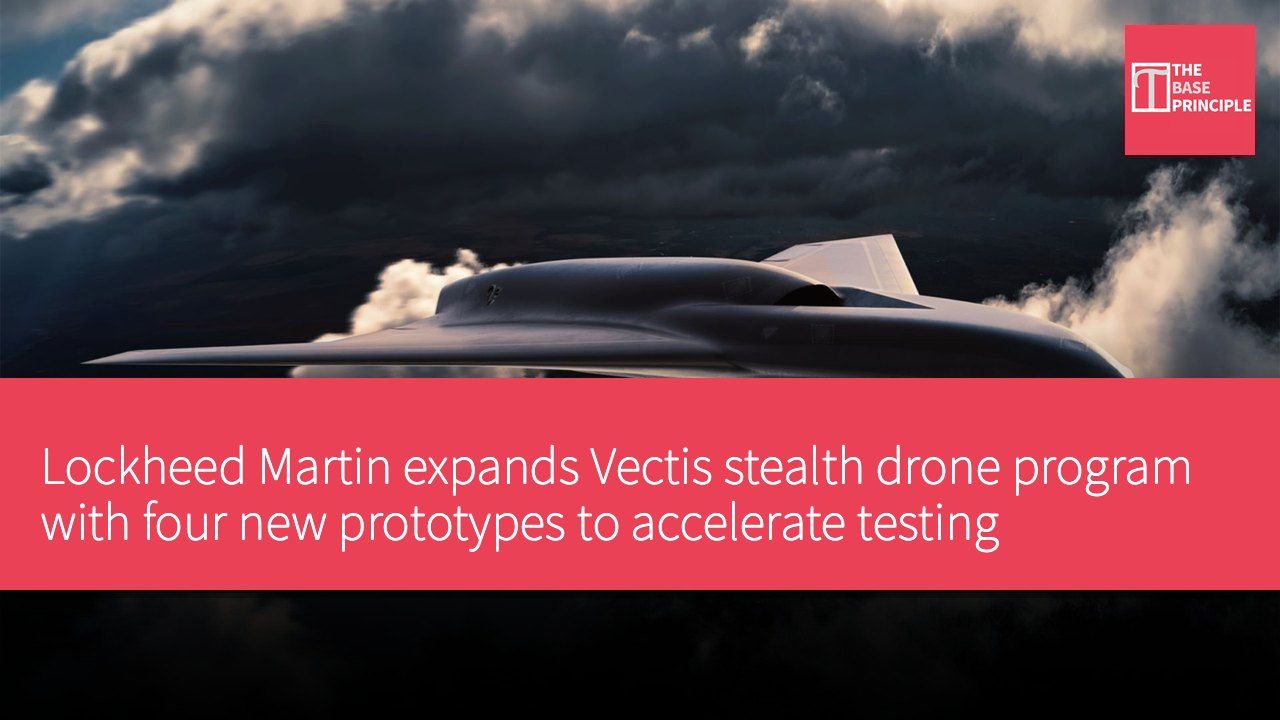
- Lockheed Martin expands the Vectis program with four new prototypes to accelerate testing.
- Vectis is a large Group 5 stealth drone supporting multiple mission types.
- Its design features a submerged inlet that reduces aerodynamic drag and eases maintenance.
- Skunk Works uses minimal-tool determination assembly to lower production costs.
Lockheed Martin is expanding its Vectis stealth drone program and plans to develop four additional prototypes on top of aircraft already in production. The company announced the investment at the Air & Space Forces Association conference in National Harbor, Maryland. The new aircraft will help Lockheed accelerate flight testing and validate how Vectis can be built quickly and affordably. The prototype is expected to make its first flight by the end of 2027. Lockheed Martin Advanced Development Programs head Ron Fehlen said work on the additional aircraft is already underway and that more specifics will be shared soon.
Vectis drone's versatility
Lockheed describes Vectis as a large Group 5 stealth drone designed to support multiple mission types. Depending on customer needs, the unmanned aircraft can be configured for air-to-air combat, air-to-ground operations, and intelligence, surveillance and reconnaissance missions. Though Fehlen did not name specific potential customers, he said Vectis is more aligned with the Collaborative Combat Aircraft program than with the larger Mass program. Collaborative Combat Aircraft are designed to operate alongside crewed fighters. "There's no reason to say this is one customer versus another," he said.
Vectis is roughly 34 feet long with a wingspan of about 38 feet. That puts the tailless aircraft's length on par with the MQ-9 Reaper, while its wingspan is similar to that of the F-35 fighter. Lockheed also wants to offer the aircraft at a cost that can compete within the Collaborative Combat Aircraft market. Fehlen said the company is targeting a unit cost at "the competitive price point of a Collaborative Combat Aircraft."
Innovations in production approach
One notable design feature of Vectis is the submerged inlet on top of the fuselage. According to Fehlen, the design helps reduce aerodynamic drag while lowering the risk of debris entering the aircraft. This protective measure can simplify maintenance, especially when operating in austere locations where the runway and surrounding environment may contain material that can damage engines. The company showed a full-scale model of Vectis at the conference and released new imagery showing the first prototype being assembled. Lockheed has not disclosed how much it has invested in the program.
Skunk Works uses a manufacturing approach called minimal-tool determination assembly to streamline manufacturing and cut costs. Fehlen likened the approach to assembling furniture from IKEA, since it allows parts to be joined with fewer tools and less manual work. "It's a technology that truly enables greater affordability and speed by reducing the amount of hand labor required and improving first-pass yield," he said. He added: "We've already seen, in many cases, an 80% reduction in the labor hours to build the airplane."
Development has also moved quickly. Fehlen said the team went from initial design to wind-tunnel verification in just two months, completed its first digital build within six months, and released the first production article within eight months.
How Lockheed Martin is boosting drone production efficiency
Lockheed Martin is using innovative production methods in the Vectis program to boost manufacturing efficiency and reduce costs. Through its minimal-tool determination assembly technique, the company can significantly cut assembly labor hours, which is critical for advancing drone development quickly. In addition, Vectis's design features, such as the submerged inlet, further enhance its combat capability and ease of maintenance. Together, these factors strengthen Lockheed's competitiveness in the drone market, particularly as demand for Collaborative Combat Aircraft continues to grow.