
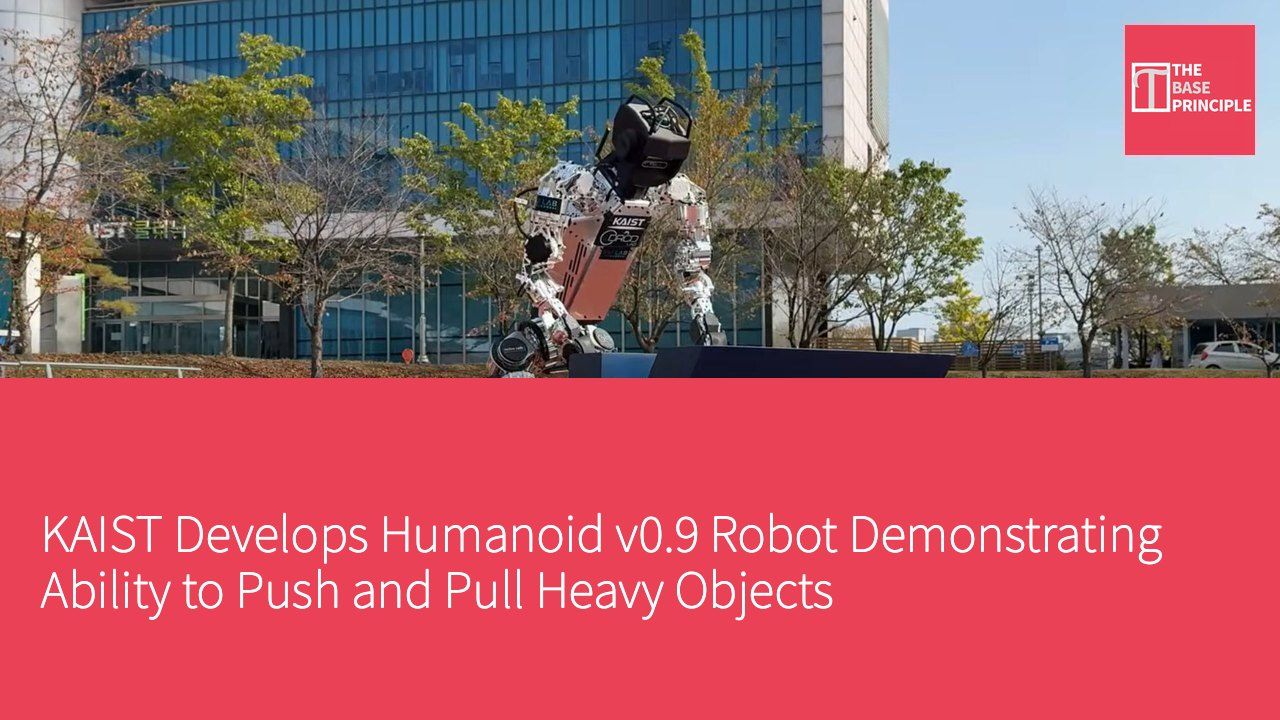
- KAIST's Humanoid v0.9 can push and lift heavy objects, showcasing its operational capabilities.
- The robot uses visual feedback to arrange objects into the letters "KAIST," demonstrating coordination skills.
- This robot combines deep reinforcement learning and human demonstrations to develop interactive skills.
- The demonstration did not provide sufficient information to determine the robot's maximum sustained lifting capacity.
Researchers at the Korea Advanced Institute of Science and Technology (KAIST) showcased an updated version of their humanoid robot, demonstrating its ability to handle heavy objects using visual feedback. According to a demonstration released on October 19, the Humanoid v0.9 robot can push weights of up to 77.2 pounds (35 kilograms) and lift loads of up to 44.1 pounds (20 kilograms). This demonstration highlights the research team's efforts to improve humanoid robot operational capabilities through learning-based control methods and visual feedback. Recently, KAIST researchers demonstrated a humanoid robot capable of advanced lower limb movements, including high-speed running and Michael Jackson's iconic Moonwalk.
KAIST's Humanoid v0.9 combines full-body movement and object manipulation, demonstrating the ability to push objects weighing up to 77.2 pounds (35 kilograms) and lift loads of up to 44.1 pounds (20 kilograms). In the demonstration, the robot utilized built-in visual feedback to arrange objects into the letters "KAIST." The robot was developed by KAIST's Dynamic Robot Control and Design Laboratory (DRCD Lab) in collaboration with RAILAB, integrating motion, manipulation, and learning-based control.
The latest video, titled "Full-Body Movement and Manipulation of KAIST Humanoid v0.9," focuses on how the robot coordinates its body and arms while interacting with objects.
Coordination in Robot Manipulation
This approach does not treat walking and manipulation as separate tasks but combines them, allowing the robot to move its body while exerting force. According to the research team, coordinated actions are crucial because pushing or lifting an object alters the forces acting on the humanoid robot's body. Pushing heavy objects requires the robot to maintain balance while exerting force, while lifting an object necessitates the robot to support the weight and control its posture throughout the process. The robot's built-in visual feedback provides information about the objects and their positions during these interactions. In the demonstration, the robot used this feedback to arrange the objects into "KAIST."
This task combines visual perception and physical interaction, requiring the robot to adjust its actions while handling objects.
The ability to push and lift represents two different aspects of its operational performance. The force required to move an object during pushing depends on factors such as friction and the surface on which the object is located. In contrast, lifting requires the robot to directly support the weight of the object. Therefore, these figures should not be viewed as interchangeable indicators of load capacity. The demonstration established the range of loads handled but did not provide sufficient information to determine the robot's maximum sustained lifting capacity or its performance under different operational conditions.
Learning Methods and Skill Development
KAIST stated that the robot's interactive skills were developed through deep reinforcement learning and learning from human demonstrations. These methods provide different pathways for developing robot behaviors, allowing researchers to train control policies through experiential learning and use demonstrations to guide task execution. Deep reinforcement learning trains control policies through repeated interactions with the environment and performance feedback. In the field of humanoid robots, this approach aids in developing coordinated actions that consider the robot's body dynamics and interactions with external objects. Learning from human demonstrations offers another way to develop skills by using examples of how tasks should be performed.
KAIST's update combines these learning methods with built-in visual feedback to support object manipulation. However, the current demonstration did not specify the training setup, the division of responsibilities between learning methods, or the precise control architecture used during execution. It also did not show whether the robot could reliably perform the same tasks under different objects, surfaces, and environmental conditions. The latest update builds on KAIST's earlier Humanoid v0.7 platform, which emphasized high-speed movements and actions similar to Michael Jackson's Moonwalk.
The v0.9 demonstration shifts the focus to physical interactions, showcasing how the platform combines movement with exerting force on external objects.
Technical Breakthroughs of KAIST Humanoid v0.9
KAIST's Humanoid v0.9 robot demonstrated advanced capabilities in pushing and lifting objects, marking significant progress in robotics technology. By combining visual feedback and deep reinforcement learning, the robot can not only perform complex actions but also maintain balance during physical interactions, which is crucial for future robotic applications. However, the current demonstration still lacks a detailed assessment of the robot's operational stability and adaptability in different environments, which poses a key challenge for future development.