
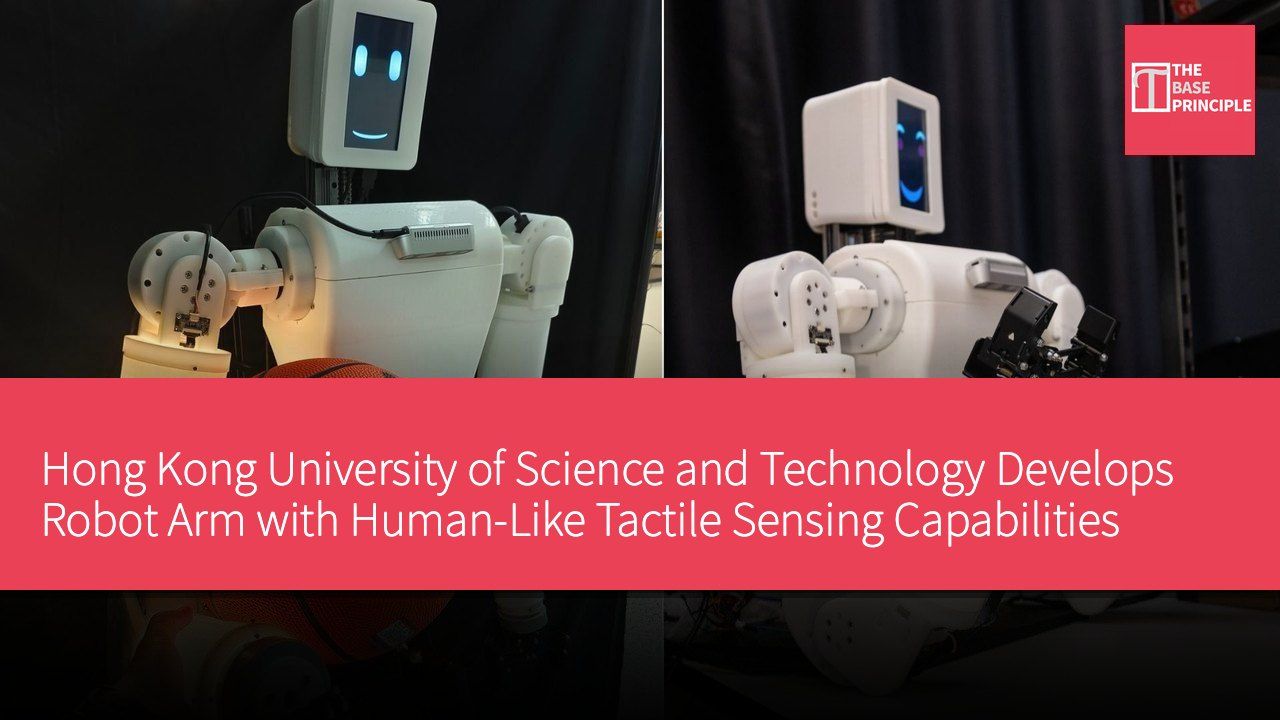
- The EmArm robotic arm can adjust its posture and manipulate objects in real-time.
- The system features high-precision motion control and full-arm tactile sensing capabilities.
- Optical sensing reduces complex electrical wiring, enhancing sensing accuracy.
- The technology can be expanded to other robotic parts, improving safety and adaptability.
Researchers at the Hong Kong University of Science and Technology have developed a robotic arm capable of replicating certain aspects of human tactile perception. Named EmArm, the robotic arm integrates flexible optical tactile skin into a rigid mechanical structure, enabling it to detect contact on both the upper and lower arms. By combining tactile feedback with information about its own movements, EmArm can adjust its posture, manipulate objects, and avoid obstacles in real-time. The system is also capable of distinguishing between different types of touches, including stroking and tapping, supporting adaptive operation research for embodied intelligent robots.
The robotic arm combines full-arm tactile sensing with high-precision motion control. The tactile skin covers an area of over 71,000 square millimeters on the upper and lower arms. The small cameras, measuring less than one millimeter, capture skin deformations caused by contact and analyze the force distribution applied to the arm. This approach allows EmArm to detect physical interactions over a larger range than traditional robotic hand sensors. The system achieves a spatial resolution of 0.085 millimeters, with a two-point discrimination threshold of 18.2 millimeters, which describes the minimum separation required to distinguish between two contact points.
High-Precision Motion Control and Tactile Sensing
The robotic arm integrates tactile sensing with precise motion control throughout its structure. The tactile skin covers an area of over 71,000 square millimeters on the upper and lower arms. The small cameras, measuring less than one millimeter, capture skin deformations caused by contact and analyze the force distribution applied to the arm. This approach allows EmArm to detect physical interactions over a larger range than traditional robotic hand sensors. The system achieves a spatial resolution of 0.085 millimeters, with a two-point discrimination threshold of 18.2 millimeters, which describes the minimum separation required to distinguish between two contact points.
The optical sensing method also reduces the need for complex internal electrical wiring within the tactile surface. According to the research team, the system is resistant to electromagnetic, light, temperature, humidity, and sound interference. In experiments involving five types of environmental interference, EmArm maintained a sensing accuracy of up to 97.9%.
Challenges of Structural Strength and Motion Precision
Integrating a flexible sensing layer into a rigid robot may affect its structural strength and motion precision. EmArm addresses this challenge by combining flexible tactile skin with a mechanical framework designed for high-load operations. Tests show that the system achieves repeatability accuracy comparable to traditional robotic arms, while also withstanding over 15 kilograms of pressure load and 7.35 Newton-meters of torsional load. These capabilities allow the arm to combine contact detection with controlled motion without significantly compromising its mechanical performance.
EmArm uses a perception-action loop to convert tactile measurements into motion commands. This framework combines proprioception, providing information about the arm's joint positions, with tactile data describing external contact. Its algorithms extract features such as contact location, area, force, and the number of contact points. These measurements are subsequently used by the motion control system to adjust the arm's posture and applied force. In one demonstration, the robot held a basketball positioned off its center of gravity. By continuously processing tactile and joint angle information, the robot adjusted its posture and force to stabilize the sphere.
Obstacle Avoidance and Interaction Response
The system also demonstrated obstacle avoidance capabilities. When a human hand entered its path, even if the obstacle could not be visually detected, the arm could recognize contact through tactile sensing, stop its movement, assess whether the obstacle was temporary or permanent, and replan its trajectory. Researchers tested EmArm in scenarios involving artificial intelligence and robot interactions with five types of touch behaviors, including stroking, pinching, poking, scratching, and hitting. The system achieved a classification accuracy of 99.8% for these interactions and generated corresponding responses representing happiness, sadness, curiosity, shyness, or anger.
Researchers suggest that this technology could be expanded to robotic legs, torsos, and other body parts. This integration could help humanoid robots operate more safely in industrial environments, homes, and medical assistance scenarios, especially when visual detection alone cannot identify contact or navigate obstacles.
How EmArm Enhances Robotic Tactile Abilities
The design of EmArm combines flexible optical tactile skin with a rigid structure, enhancing the robot's tactile perception capabilities. This novel integration not only improves sensing accuracy but also enables physical interactions in visually constrained situations. Research shows that the system can effectively identify various touch behaviors and respond accordingly, demonstrating its broad potential for practical applications. As the technology continues to develop, EmArm may play a significant role in industrial, home, and medical fields, particularly in environments requiring precise tactile feedback.