
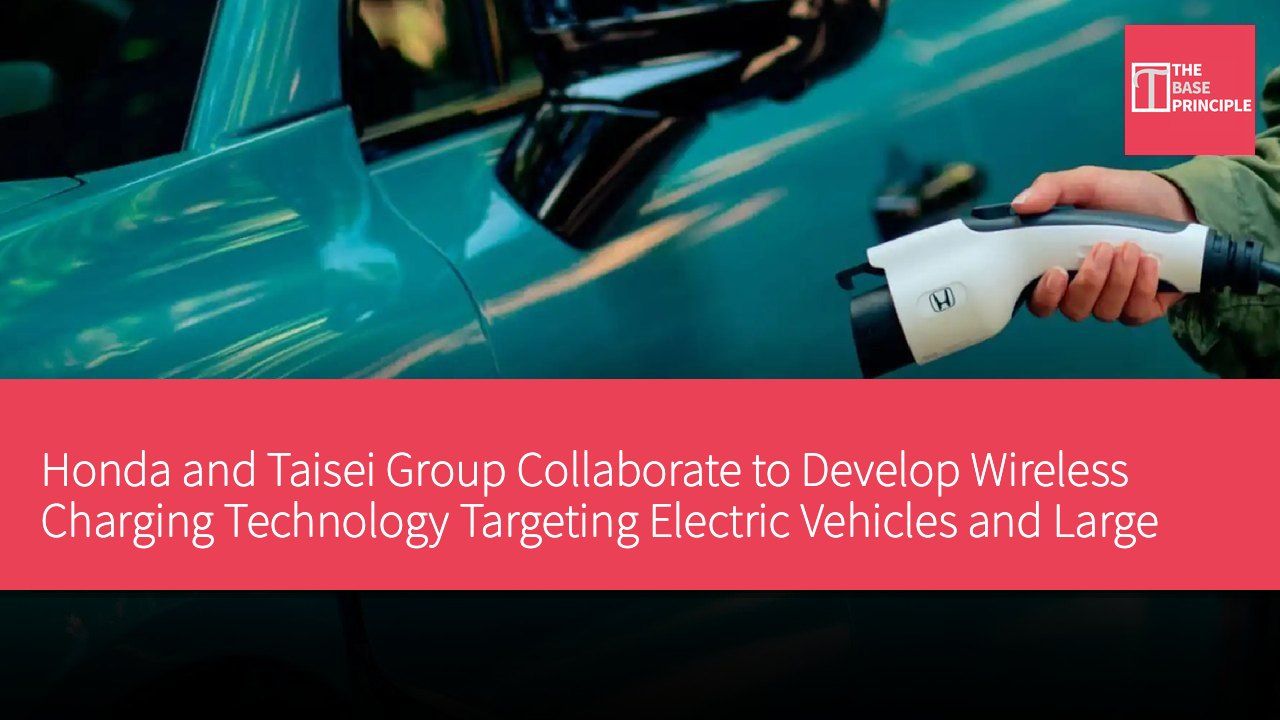
- Honda collaborates with Taisei Group to develop wireless charging technology for large commercial trucks.
- The system consists of a DC power source, power transmission units, and receiving units, aimed at enhancing the convenience of electric vehicles.
- The technology has been tested in Saitama, Japan, confirming its ability to withstand the traffic loads of heavy vehicles.
- The three companies plan to construct a test road by the end of 2026 to conduct multiple performance tests.
Honda and two companies from the Taisei Group stated that they have developed a core road technology capable of wirelessly charging electric vehicles while in motion, primarily targeting large commercial trucks, with plans to begin public road demonstration tests in Japan starting in the fiscal year 2027 (from April 1, 2027). This magnetic coupling wireless power transmission road system was developed by Honda in collaboration with Taisei Construction and Taisei Rotec. Honda expressed hope that dynamic wireless power transmission (DWPT) would enhance the convenience of electric vehicles, reducing the frequency with which drivers need to charge at home or at charging stations, initially focusing on logistics and transportation, where the greatest benefits are anticipated.
System Components and Functions
The system consists of three main components: a DC power source on the ground, a set of power transmission units embedded in the road (connected via DC), and a receiving unit on the vehicle. Taisei Construction is developing the DC power source, Honda is responsible for constructing the transmission system within the road and the receiver on the vehicle side, while Taisei Rotec focuses on developing construction methods. The three companies are jointly designing the road surface structure, durability testing, upgrade methods, and DC distribution testing.
These units and the road surface must be able to withstand heavy vehicles weighing approximately 20 tons. Honda stated that it has optimized the internal structure of the embedded units so that the road can endure the long-term traffic loads of heavy commercial vehicles. Road tests conducted at Taisei's Future Technology Field in Saitama, Japan, confirmed the effectiveness of the technology and the necessary road surface structure and construction methods for public road testing of large vehicles.
Testing and Demonstration Plans
Honda stated that its embedded units will combine inverters and coils into a single DWPT unit for the first time, based on research conducted on publicly disclosed units up to September 2026. This design achieves DC power distribution and works in conjunction with the ground DC power source, supporting rapid and stable high-power transmission. The DC distribution also simplifies the wiring of the embedded components, reducing the number of parts and installation work. These units are designed to be milled into existing road surfaces and embedded, taking into account uneven milled surfaces for easier upgrades during future repaving.
Starting at the end of 2026, the three companies will construct a test road at Taisei's T-FIELD/TAMRA site. They plan to conduct loading tests equivalent to 1 million wheel loads, based on actual vehicles with 49 kilonewtons (approximately 11,000 pounds-force) per wheel, along with DWPT performance tests and electromagnetic field leakage checks. Subsequent work will verify the reliability of high-power commercial vehicles under performance levels of up to 150 kilowatts and at high speeds. The three companies will also participate in the DWPT demonstration project, the Tateyama Project, conducted by East Nippon Expressway Company (NEXCO East) on the Tateyama Expressway in Chiba, Japan, which will launch in the fiscal year 2027.
Honda will showcase the results of its DWPT at the Japan Mobility Show in Chiba from October 13 to 16 and at the ITS World Congress in Gangneung, South Korea, from October 19 to 23.
Future Potential of Wireless Charging Technology
The collaboration between Honda and the Taisei Group to develop wireless charging technology marks an innovation in electric vehicle charging methods. As the demand for electric vehicles rises, traditional charging methods face challenges, and wireless charging technology can effectively address the frequency of charging issues, enhancing user experience. The successful implementation of this technology will have a significant impact on the logistics and transportation industry, particularly in the operational efficiency of large commercial vehicles. Future testing and demonstration projects will further validate the feasibility of the technology and promote its application on a broader scale.