
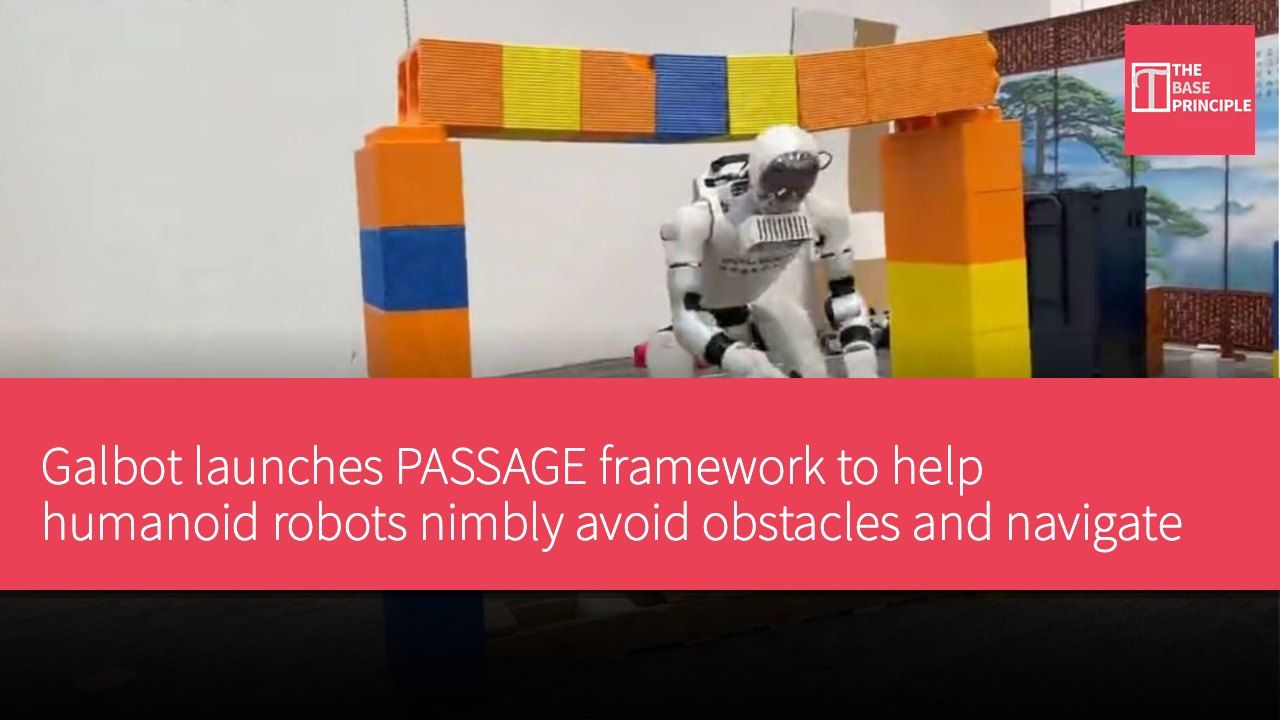
- The PASSAGE framework helps humanoid robots adapt movements to traverse cluttered environments.
- The system combines environmental perception, motion planning, and whole-body control.
- Research shows robots achieve high success rates in simulated trials.
- PASSAGE focuses on humanoid robot applications in various human-designed spaces.
Galbot has launched PASSAGE, a research framework designed to help humanoid robots traverse cluttered environments by adapting their movements. The system enables robots to select different traversal methods, including stepping over objects, ducking under obstacles, and turning sideways through narrow gaps. The framework combines environmental perception, motion planning, and whole-body control, helping humanoid robots maintain balance while smoothly navigating complex environments and reaching their destinations. Recently, Galbot's humanoid robot completed more than 100 rallies in an autonomous tennis match, successfully tracking the ball, adjusting its position, and returning various shots.
PASSAGE enables humanoid robots to navigate cluttered environments by adapting their whole-body movements. The system allows robots to select appropriate actions, such as stepping over objects, ducking under overhead obstacles, or turning sideways through narrow gaps. The framework addresses a key challenge in robotics: coordinating the robot's movements with its understanding of the surrounding space. When assessing whether they can pass through an opening, humanoid robots must consider not only their feet, but also ensure their head, shoulders, arms, and torso can clear surrounding objects. Even if a robot's legs have a clear path, it may still collide with low ceilings or narrow doorways.
Perceiving the environment, understanding spatial constraints, and coordinating whole-body motion are critical for humanoid robots to integrate into human society, and these remain major challenges in robotics.
How the PASSAGE framework works
To address this problem, the Galbot team introduced PASSAGE, a framework that combines environmental perception, motion planning, and whole-body control. According to the project page, the system uses a planner to generate short-term motion sequences and a controller to execute those sequences while reacting to surrounding geometry. The framework integrates action selection and execution into a unified planning-control approach, rather than relying on separate policies for different obstacle types, enabling it to combine actions to negotiate various spatial constraints.
The research team collected 100 hours of human motion data covering 1,500 virtual scenarios. Operators demonstrated obstacle traversal through virtual reality and inertial motion capture, providing examples of how people adjust their bodies to navigate confined spaces. The system uses this data to link human movements to the environmental conditions in which they occur. During robot operation, LiDAR provides information about the surroundings, helping the framework account for obstacles and available space. According to project documentation, PASSAGE runs on an Nvidia Jetson AGX Orin computer, without requiring pre-built maps or external computation.
This setup enables the system to process environmental information and coordinate movements on the robot itself.
Success rates in simulated trials
The research paper reports a 98.67% success rate across 750 simulated trials covering 150 previously unseen scenarios. The metric measures whether the robot reached its destination, not whether it avoided every obstacle. When success required completing the task without contacting obstacles, the reported success rate fell to 70.3%. This gap highlights the challenge of coordinating a humanoid robot's entire body through tight spaces. The team also tested PASSAGE on a Unitree G1 humanoid robot in 50 previously unseen physical layouts.
Researchers reported that the robot successfully completed all 50 trials without falling or requiring safety intervention, and without contacting obstacles in 45 of the layouts.
These results come from a limited research evaluation and do not establish reliability across all real-world environments. PASSAGE focuses on capabilities humanoid robots may need to operate in furnished rooms, factories, and other spaces designed for humans. Adapting posture to fit available space could help robots navigate environments where fixed gait patterns fall short. However, the published results also show that reaching a destination and moving through it without contact remain distinct challenges. The project page lists the framework's code as forthcoming, which will allow further assessment of its broader applicability and performance in other environments.
Technical challenges in humanoid robot navigation
The launch of the PASSAGE framework marks a technical advance in humanoid robot navigation in complex environments. By combining environmental perception with whole-body control, the system can simulate human movements in confined spaces, which is critical for improving robot practicality. Although simulated trials show high success rates, robots in real-world environments still face variable obstacles and spatial constraints. Therefore, further field testing will help validate its reliability and promote the application of humanoid robots in daily life.