
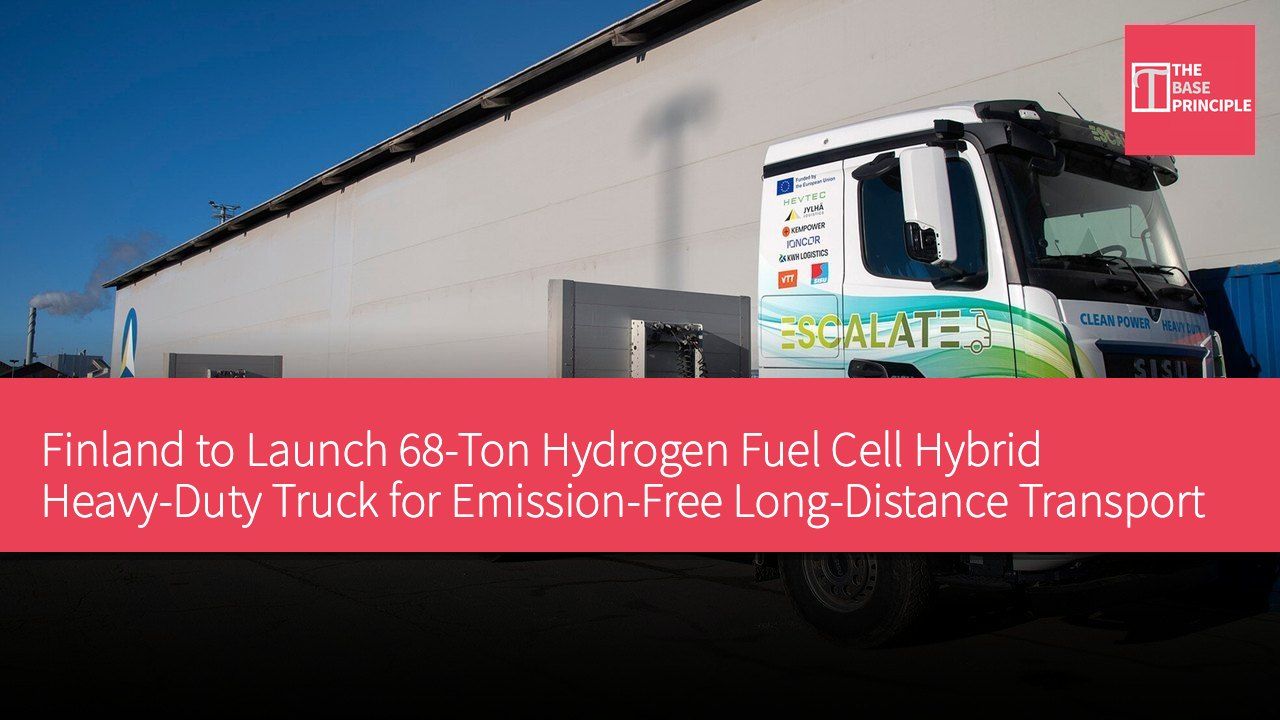
- Finland will launch hydrogen fuel cell heavy-duty trucks for emission-free transport trials by the end of 2026.
- The truck is equipped with a 650 kWh battery and a hydrogen fuel cell with a maximum output of 120 kW.
- The test route will run from Vuosaari Port to Jyväskylä, covering 540 kilometers daily.
- The study will assess energy use and cost-effectiveness, as well as optimize the charging station network.
A heavy-duty truck primarily powered by electricity, with a hydrogen fuel cell serving as a rapid charging alternative, will begin regular freight operations in Finland by the end of 2026. This initiative aims to demonstrate the feasibility of emission-free long-distance trucking under real-world conditions, according to the VTT Technical Research Centre of Finland. The model, SISU Escalate, manufactured by Sisu Auto, will undergo a six-month monitoring period using vehicle data and digital twins to support the EU's goal of achieving emission-free heavy-duty road freight.
The truck is equipped with a 650 kWh battery, with the hydrogen fuel cell providing auxiliary power at a maximum of 120 kW. Due to the presence of hydrogen tanks and the battery pack, the chassis is longer compared to standard trailer units. Petri Kananen, head of development at Sisu Auto, stated that this truck serves as a testing platform rather than a market product. The data collected will help establish an energy management system and optimize driving patterns to extend the battery's range. He noted, "Hydrogen fuel is, after all, a more expensive fuel."
Truck Technology and Operational Details
The truck will operate daily between Vuosaari Port in southern Finland and Jyväskylä in the central region, covering 540 kilometers (336 miles) and managed by Jylhä Logistics, handling regional deliveries in the Helsinki area. Charging stations are located at both ends of the route, with plans to build a megawatt charging station along the route. The truck will utilize Finland's first hydrogen refueling station, located in Jyväskylä. Logistics company Rauanheimo tested an all-electric version in spring 2026. IONCOR provides the battery system, Kempower supplies the MCS charging infrastructure, and Hevtec is responsible for the vehicle-side charging solutions and integration of the electric powertrain.
Finland and Sweden allow a total weight of up to 76 tons (approximately 84 tons) for heavy-duty trucks, while most of Europe has a limit of around 40 tons (44 tons). In this pilot, the total weight limit is set at 68 tons (approximately 75 tons). Mikko Pihlatie, a research professor at VTT, stated that the SISU Escalate operates in the most challenging environment among four trucks in the EU-funded ESCALATE project, being the heaviest and longest of the group.
Research Goals and Challenges
Researchers will track how weather and other factors affect energy consumption, the limitations encountered, and the amount of electricity and hydrogen fuel used by the truck. Pricing data for hydrogen and charging will help estimate how much energy needs to be loaded and its location, comparing the results with diesel trucks to assess cost-effectiveness. Pihlatie noted that these findings will aid in developing the charging station network and optimizing energy use. Juuso Kelkka, a senior manager at IONCOR, mentioned that this pilot presents a demanding setup, involving the use of a modular battery platform on heavy-duty trailers under harsh winter conditions and operating on long-distance routes.
He pointed out that this truck can demonstrate that lithium-ion batteries are a viable solution even under these conditions.
Practical Application Challenges of Hydrogen Fuel Cell Technology
This trial in Finland is not only a practical application test of hydrogen fuel cell technology but also an exploration of emission-free long-distance transport. The design and operation of the truck take into account local climate conditions, and data collection during long-distance travel will assess its energy efficiency and cost-effectiveness. This data will be crucial for the future development of logistics and energy management systems, especially in the context of advancing the EU's emission-free goals. The success of this research will contribute to the broader establishment of hydrogen fuel infrastructure.