
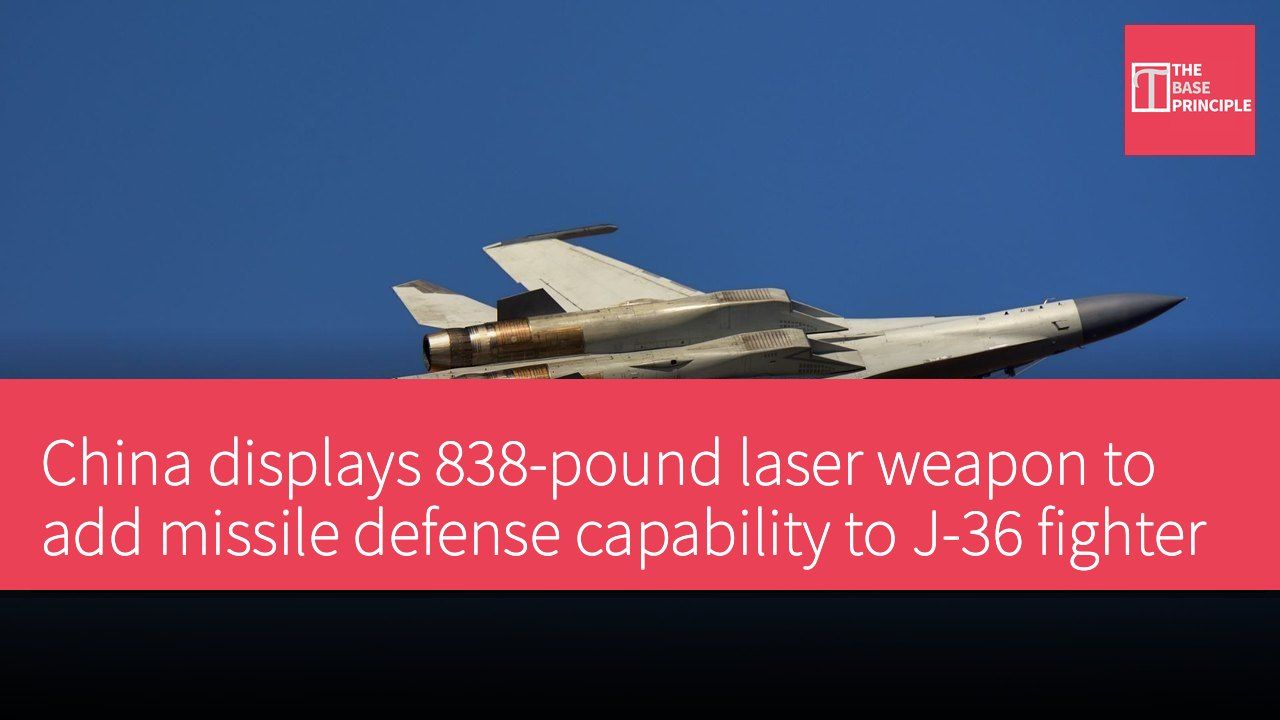
- A laser weapon displayed by China could boost the J-36 fighter's missile defense capabilities.
- The system weighs under 838 pounds and may include several components.
- The laser could be used to attack incoming missiles or jam their seekers.
- The U.S. Air Force's SHiELD program has faced similar challenges and failed to install a laser system.
China may be developing a high-energy laser weapon for its J-36 fighter to boost its missile defense capabilities. A research arm of Aviation Industry Corporation of China (AVIC) displayed a fighter jet laser tracking and targeting system at an international defense electronics exhibition in Beijing. The system was shown alongside images of a large tailless aircraft linked to China's sixth-generation fighter program. According to information shown at the China International Defense Electronics Exhibition, the system weighs under 838 pounds. The exhibition was held September 15 to 17, and several technical details in the display remained undisclosed.
One of the power figures was shown as "*00kW," potentially indicating an output of at least 100 kilowatts. The poster also obscured the system's dynamic tracking accuracy, a metric critical for airborne laser systems because even small aiming errors can deflect the beam off target.
Features of the J-36 fighter
Chinese military aviation researcher Andreas Rupprecht confirmed that the aircraft shown in the display is the J-36. The three-engine aircraft first appeared in Chengdu in December 2024. Defense analyst Mark Cazalet reached a similar conclusion after analyzing the display, suggesting that the J-36 may have sufficient space, payload capacity and power to support a high-energy laser system. Larger airframes can provide more room for equipment, cooling hardware and electrical systems. This makes directed-energy weapons practical on platforms beyond fighters.
Bombers, transport aircraft and airborne early warning planes could also employ similar technologies, using lasers to defend themselves against incoming threats.
Potential applications of laser weapons
The 838-pound figure, however, leaves a major question unanswered. It is unclear which components AVIC included. Cazalet said the figure may encompass the laser source, beam director and cooling system. The display did not provide a detailed equipment breakdown or electrical requirements. Airborne lasers face demanding engineering conditions. Aircraft vibration, turbulence and rapid maneuvers can constantly disturb the beam, and tracking systems must compensate for these motions and maintain extremely precise aim. The challenge grows as the aircraft and target move at high speeds. Cazalet noted that physical damage typically requires relatively short engagement ranges.
Lasers can theoretically reach longer distances when attacking or disabling optical sensors, making missile defense a possible mission.
Technical challenges amid international competition
Lasers could be used to attack incoming missiles or disrupt their seekers before impact. The concept carries particular significance for U.S. airpower. The United States is developing long-range air-to-air weapons including the AIM-174B, AIM-260 and AIM-424. China has studied airborne laser weapons for years. A People's Liberation Army procurement notice in 2020 sought an airborne laser attack pod and associated control software. Chinese researchers have also examined the feasibility of laser tracking from a moving aircraft. A 2021 study used transport aircraft flight data to simulate the effects of motion and vibration.
The U.S. Air Force encountered similar problems in its SHiELD program, which explored a pod-mounted laser system to shield fighters from incoming missiles. The program ended in 2024 without installing a laser pod on a fighter test aircraft. Program officials had earlier identified turbulence, wind and aircraft maneuvers as the principal challenges. AVIC has also reported testing other directed-energy tracking systems. An AVIC publication described a 2024 trial that maintained a lock on drones amid clouds, birds and increasing distance.
Those tests do not confirm that the J-36 carries a laser weapon, and there is no public evidence that the fighter is equipped with such a system. However, the Beijing display offered a rare glimpse into China's progress in airborne directed-energy weapons.
Trends in China's airborne laser development
China's development of airborne laser weapons reflects its emphasis on future warfare concepts, particularly the potential in missile defense. As the J-36 fighter evolves, this high-energy laser system could become one of its core defensive capabilities. Despite technical challenges such as system stability and precision, China's continued research and testing suggest that the country's investment in this field could reshape the dynamics of aerial combat. In addition, technological competition with the United States is driving both sides to keep pushing innovation in airborne weapon systems.