
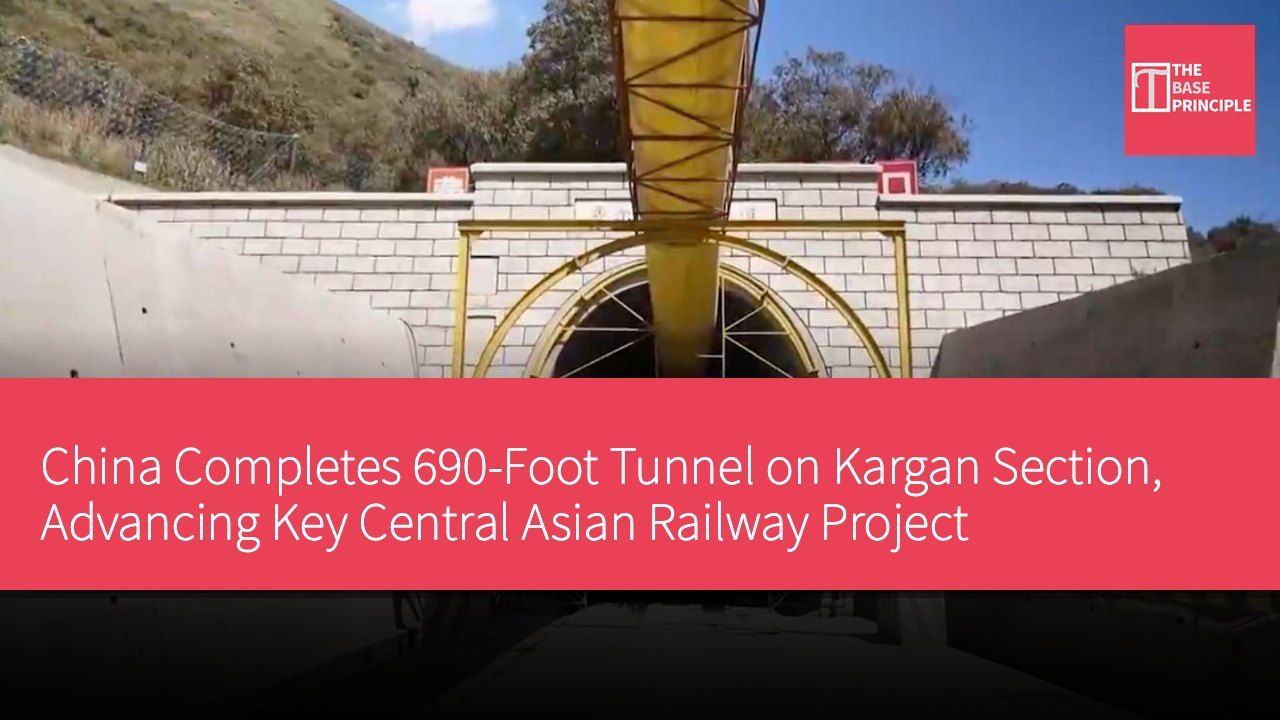
- China has completed the first tunnel on the Kyrgyzstan section, marking progress in the railway construction.
- The CKU railway will connect China's Xinjiang with Uzbekistan, providing a faster trade route.
- The project has faced decades of delays but is gaining geopolitical importance.
- The project adopts a dual-track design, resolving technical disputes and introducing China's standard gauge to Central Asia.
China has achieved a key milestone in the long-delayed China-Kyrgyzstan-Uzbekistan (CKU) railway project, with workers successfully boring the first tunnel on the Kyrgyzstan section. This marks an acceleration in Beijing's efforts to advance a major trade route in Central Asia. According to China National Radio and Television, the 210-meter (690-foot) tunnel was completed after construction began in June 2025, with the section now at 17% completion. This progress comes after Chinese President Xi Jinping's visit to Kyrgyzstan last week, where both sides pledged to support the smooth construction of the railway.
The project is a key component of China's Belt and Road Initiative, aiming to create a route to more western markets.
The Strategic Importance of the CKU Railway
The CKU railway will extend over 500 kilometers (310 miles), with about 305 kilometers (190 miles) located in Kyrgyzstan. The railway will connect Kashgar in China's western Xinjiang region with Andijan in Uzbekistan, traversing Kyrgyzstan's mountainous terrain. Once operational, the railway is expected to become the shortest land connection between China and markets in the Middle East and Europe. Reports suggest the railway could reduce transport time by up to eight days compared to the China-Europe railway. Additionally, the railway will open a new trade route for Southern Xinjiang. For the landlocked countries of Kyrgyzstan and Uzbekistan, the railway will provide direct access to the Chinese and Asia-Pacific markets.
Currently, construction has begun on 27 tunnels, 43 bridges, and 88 subgrade sections, with work also underway on 20 planned railway stations, according to China's official news agency Xinhua.
Challenges and Pressures Facing the Project
The railway was first planned in 1997 but has faced decades of delays. Engineers face challenges in the difficult mountainous terrain, and disagreements over railway gauge have added to the complexity. The project also holds significant geopolitical importance, as it provides China with an alternative route that bypasses the traditional corridor through Russia and Kazakhstan. As China's economic influence in Central Asia grows, Moscow is increasingly attentive to the railway's development. According to The Central Asia Times, Kyrgyzstan is increasingly seeking alternative foreign investment sources as Russia's regional influence is under pressure due to the ongoing war in Ukraine.
Meanwhile, economic ties between Russia and China continue to expand. Russian media outlet Izvestia reported on Sunday that Moscow is upgrading existing railway crossings and considering new road construction to cope with the growing bilateral trade.
The CKU project has adopted a dual-track design to resolve long-standing technical disputes. Approximately 167.5 kilometers (104 miles) from the Chinese border to Makmal will use China's standard railway gauge, while the remaining approximately 140 kilometers (87 miles) to Uzbekistan will use the Soviet-era broad gauge. Cargo will be transferred between systems at the planned Makmal hub. Li Lifan, director of the Shanghai Cooperation Organization Research Center at the Shanghai Academy of Social Sciences, told CCTV that 'the significance of this arrangement is that China's standard gauge is being introduced into the heart of Central Asia for the first time.'
China, Kyrgyzstan, Uzbekistan, and Russia are all members of the Shanghai Cooperation Organization, which celebrated its 25th anniversary at last week's leaders' summit.
The project's chief engineer, Xi Jihong, stated that the railway could be ready for operation by June 2031. However, Uzbekistan is hoping for faster construction progress. According to The Tashkent Times, Uzbekistan's Deputy Minister of Transport, Jasurbek Choriev, said in June that the country hopes to accelerate work and complete the railway by 2028. The differing timelines highlight the pressures facing the project, which has been in the design phase for decades. The successful boring of the first tunnel in Kyrgyzstan now provides a clear signal for advancing construction.
Project Specifications Tunnel Length 210 meters Total Length Over 500 kilometers Kyrgyzstan Section Length About 305 kilometers China Standard Gauge 167.5 kilometers Broad Gauge Section Length About 140 kilometers
The Geopolitical Impact of Central Asian Railway Construction
The construction of the CKU railway is not only an important step in economic development but also has profound geopolitical implications. As China's influence in Central Asia grows, the railway provides an alternative route that bypasses the traditional Russian corridor. For Kyrgyzstan and Uzbekistan, this means more direct access to the Chinese and Asia-Pacific markets, promoting trade and investment. As the project progresses, it could alter the economic landscape of Central Asia and draw the attention of other nations to the region.