
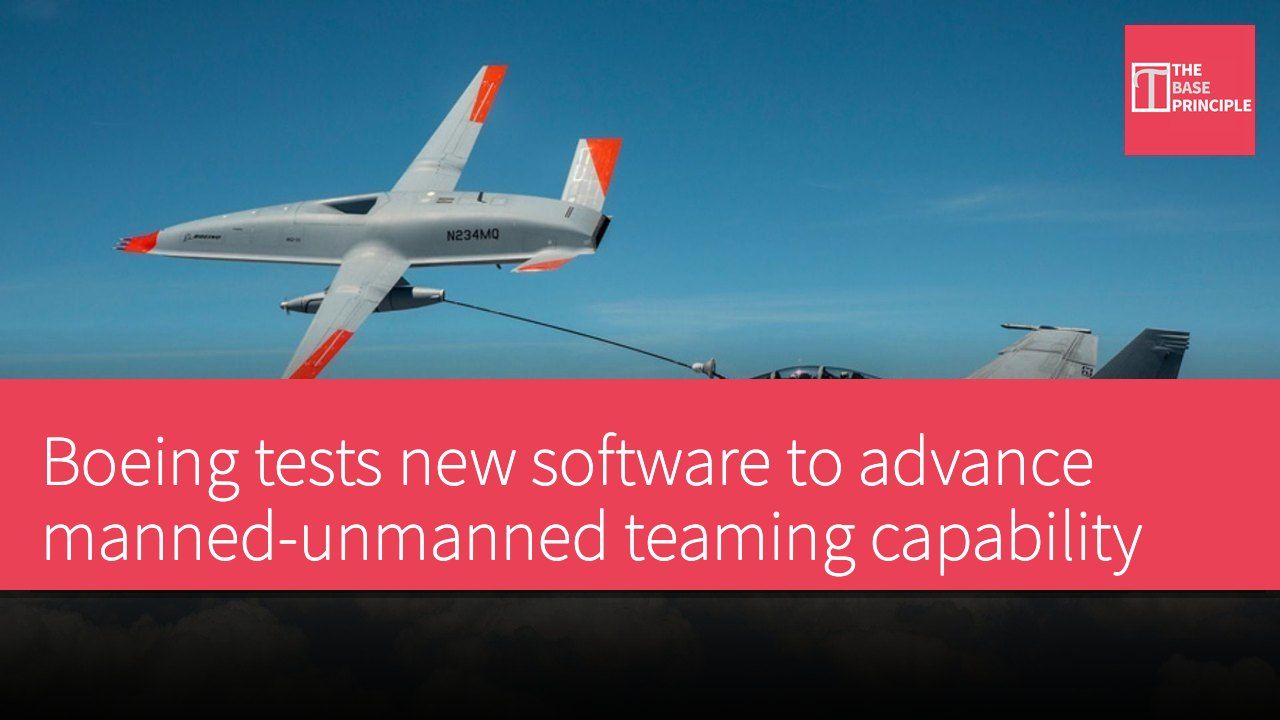
- Boeing tests new software to promote manned-unmanned teaming capability.
- The software aims to integrate into the MQ-25A Stingray unmanned tanker's communications capability.
- MUM-T software can improve tanker responsiveness, support coordinated strike operations.
- Successful integration will make aerial refueling more flexible, expand naval operational range.
Boeing demonstrated software designed to let manned and unmanned aircraft coordinate over military communications networks, advancing plans to integrate the capability into the U.S. Navy's MQ-25A Stingray carrier-based aerial refueling drone. The software, called Manned Unmanned Teaming (MUM-T), was tested during the Emerald Flag military exercise at Eglin Air Force Base in Florida. Boeing installed the software on a Beechcraft 1900D and an E90 King Air aircraft, allowing test pilots to demonstrate air-to-air command and control communications using Link 16 between the two aircraft.
The test did not involve the MQ-25A itself, but rather demonstrated the communications capability Boeing plans to integrate into the unmanned tanker after further testing and evaluation.
MUM-T software functions and applications
According to Boeing, the software uses open-architecture command-and-control messages communicated via Link 16, a tactical data network widely used by the U.S. and allied militaries to exchange information among compatible platforms. The system is designed to support manned-unmanned teaming among multiple aircraft types, rather than being limited to a single airframe. Boeing developed the software with the U.S. Navy, drawing on teams from its Phantom Works, MQ-25, F/A-18, and F-22 programs.
The company plans to debut the capability first on the MQ-25A Stingray and the F/A-18 Super Hornet, pending the completion of testing and evaluation.
The aim is to let crews aboard manned aircraft command or coordinate the unmanned tanker, helping it respond to changing refueling needs during a mission. "Integrating this software into the MQ-25A will allow a manned platform to control the aircraft, turning the tanker into a force multiplier that simplifies refueling operations and expands mission range," said Kayla Stice, Boeing's MQ-25 senior design program manager. The demonstration marks progress toward that capability, but Boeing said more test flights are needed before the software can be integrated into operational aircraft.
The MQ-25A Stingray is in development to provide carrier-based aerial refueling for the Navy's carrier air wings. By taking over the bulk of refueling duties currently performed by F/A-18E/F Super Hornets, the drone is intended to free more fighters for their primary strike missions while extending the carrier's operational reach. The Navy describes the Stingray as a critical step in integrating unmanned aircraft into carrier operations. Its role includes delivering fuel and helping establish the infrastructure and procedures needed for unmanned aircraft to operate alongside manned fighters at sea.
MQ-25A Stingray development and challenges
The MUM-T software can add another layer to that integration by letting pilots of compatible aircraft coordinate with the tanker over existing military data networks. Boeing says the capability aims to improve tanker responsiveness, reduce logistical friction, and support coordinated strike operations. "Embedding this software in the Stingray will enable autonomous coordination with manned platforms and increase the operational tempo of the carrier strike group," said Mark Dunn, head of Boeing's MQ-25 avionics integrated product team.
The software demonstration comes as the MQ-25A program moves toward production. In September, the U.S. Navy awarded Boeing a $562 million contract for the first low-rate initial production lot, covering three aircraft and advance procurement of parts to support three more. According to the Navy, first deliveries are expected to begin in 2029. The Stingray completed its first flight as an operational MQ-25A in April 2026, demonstrating autonomous taxi, takeoff, flight, and landing under the supervision of Navy and Boeing test teams.
The newly developed MUM-T software remains a standalone capability that must be validated through further flight testing before it can be integrated into the MQ-25A's operational software. If successful, the integration would help the Navy move from operating the unmanned tanker as a remotely monitored asset toward tighter coordination between manned fighters and autonomous support aircraft. That would make aerial refueling more flexible in carrier operations, though the scope of control and supported missions will depend on the capabilities ultimately tested and fielded.
MUM-T software's impact on unmanned tankers
The development of the MUM-T software marks a significant advance for the U.S. Navy in unmanned aircraft technology. The technology not only promises to boost the unmanned tanker's combat effectiveness but also strengthen coordination between manned and unmanned aircraft, thereby increasing overall operational flexibility. As the MQ-25A Stingray's development enters the production phase, this integration will enable the Navy to employ unmanned assets more effectively to meet the complex demands of modern warfare. Future test results will determine the technology's practical application and its impact on naval combat capability.