
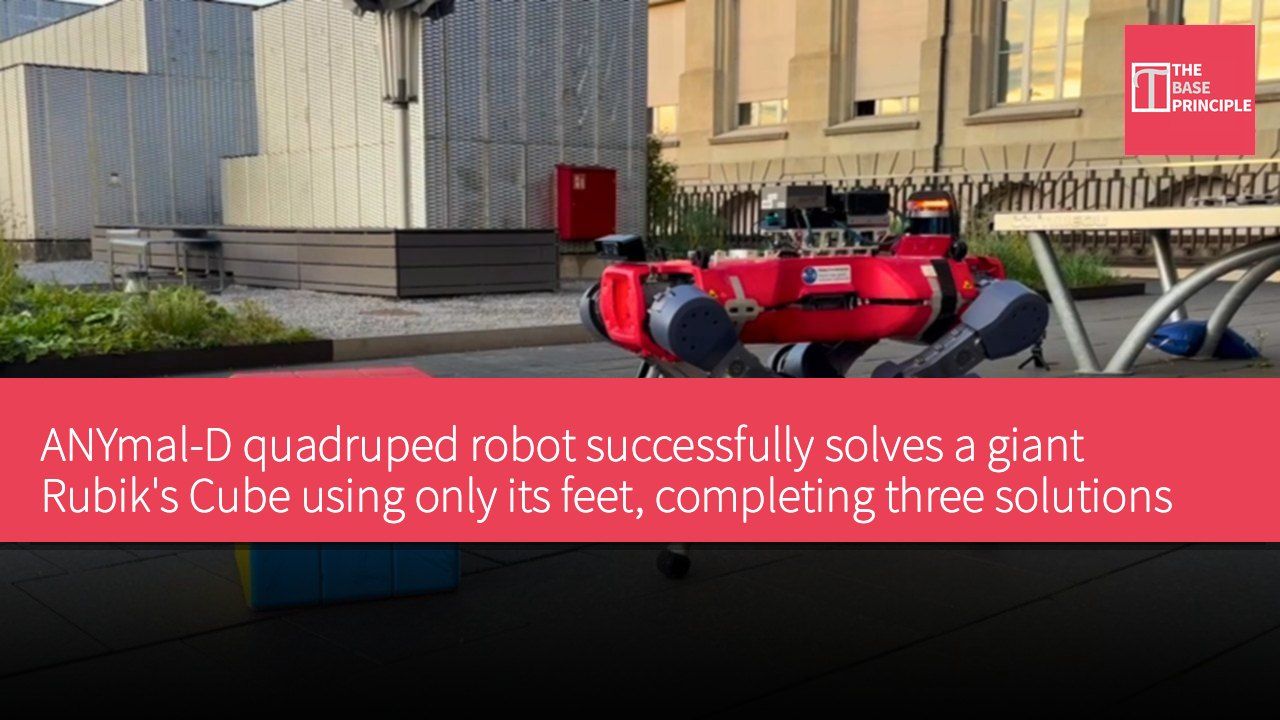
- The quadruped robot ANYmal-D can independently solve a giant Rubik's Cube in about 30 steps.
- The robot scans the cube using a depth camera, generates a solution, and executes the movements.
- The research team tested the robot's operational skills in various environments, demonstrating its adaptability.
- The robot successfully completed the multi-step task without the need for additional arms or grippers.
Researchers from ETH Zürich and NVIDIA report that a quadruped robot has successfully solved a giant Rubik's Cube independently using its paws. The robot, named ANYmal-D, completed three full solutions on actual hardware, with each solution taking about 30 steps and lasting 8 to 9 minutes.
The robot first scans the cube, then plans the solution, and finally executes it. It moves around the independently placed cube, using its mounted depth camera, the ZED X Mini, to flip the cube and view each face, piecing together the colors of each square. A standard Rubik's Cube solver generates the solution, which the planner converts into the robot's movements, including repositioning, flipping, and layer rotations. Between each action, the camera continuously updates the cube's position so the robot can accurately move to the correct location for the next action.
Robot's Process of Manipulating the Cube
According to the researchers, the system can position the cube within about 0.8 inches (2 centimeters) at a median distance of approximately 6.6 feet (2 meters), achieving a 100% accuracy rate for reading colors indoors and 98.7% outdoors.
The robot's manipulation of the cube relies entirely on its paw skills. Two flips can rotate the cube towards or away from the robot by 90 degrees. To rotate a layer, the right foot stabilizes the cube, while the left foot rotates the top two layers counterclockwise by a quarter turn. Clockwise rotation is achieved through a mirrored counterclockwise skill. The robot must keep other layers locked while reorienting the cube, as any unintended twists could disrupt the entire solution, TechEBlog notes.
Multi-Environment Testing Demonstrates Adaptability
The research team trained these skills in simulated environments, using reinforcement learning methods to reward the robot for landing in the correct position, cleanly rotating layers, and maintaining balance. A "teacher" that could see all scenarios in the simulation was distilled into a "student" that only utilized the robot's front camera's depth image and its own joint sensors. Initially, a temporary support stabilized the cube, which was gradually removed.
The researchers tested these skills on low-friction surfaces, cobblestones, and mossy ground, and attempted training under misaligned layers, even using ropes to pull the robot's legs. They also pushed the cube with sticks and blocked flipping actions with weights. These strategies allowed the robot to recover from disturbances and adapt to changes in the cube's position relative to itself. The flipping skills also apply to other objects, such as small light boxes and cylindrical containers.
The research team stated that these results demonstrate the robot's ability to complete long-duration, multi-step physical tasks using its onboard perception system and coordinated paw usage, without the need for additional arms or grippers. In simulations, they found that the onboard depth sensing improved performance, the controller's memory enhanced reliability, and overall body coordination helped the robot perform fixed and pushing actions simultaneously. Currently, the report only documents three autonomous hardware solutions, and the data source did not provide the size or weight of the cube. This research comes from the Robot Systems Laboratory at ETH Zürich and has been published on the project page and in a research paper on arXiv.
Item Specification Processor NVIDIA Camera ZED X Mini
Technical Breakthroughs and Application Potential of ANYmal-D
The successful solution of the giant Rubik's Cube by ANYmal-D showcases the potential of quadruped robots in complex tasks. Through depth perception systems and paw skills, the robot can perform multi-step operations, demonstrating not only its autonomy but also its ability to complete tasks without additional tools. The findings of this research may have significant implications for the future development of robotic technologies, particularly in applications requiring high flexibility and precision, such as warehousing, automated assembly, and disaster response.