
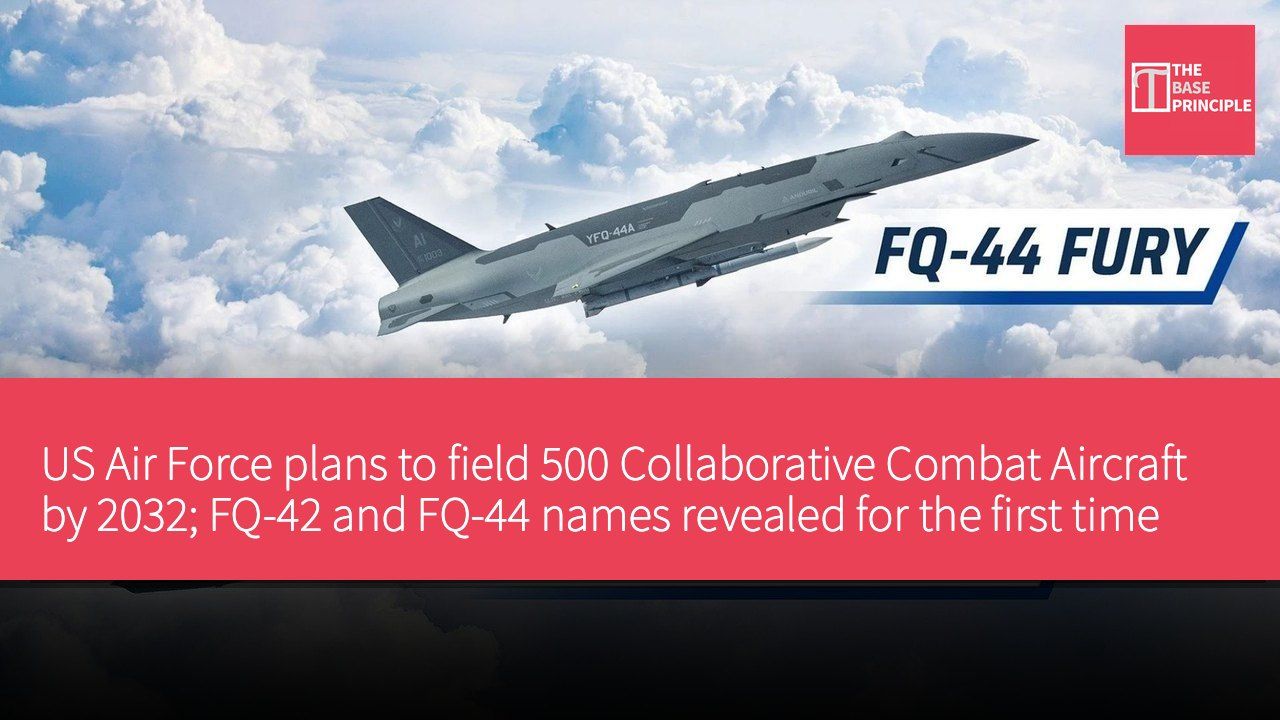
- The US Air Force plans to field at least 500 Collaborative Combat Aircraft (CCA) by 2032.
- FQ-42 Vengeance and FQ-44 Fury are the official names of the first two CCAs.
- CCAs are not remotely piloted but are semi-autonomous systems, with missions directed by humans.
- The scale of the new target poses significant challenges for production and operations.
The US Air Force plans to field at least 500 Collaborative Combat Aircraft (CCA) by 2032, significantly expanding its ambitions for semi-autonomous aircraft capable of fighting alongside human pilots. Air Force Secretary Troy Meink announced the target on September 14, while also unveiling the official names of the service's first two CCAs: General Atomics' FQ-42 Vengeance and Anduril's FQ-44 Fury. These aircraft are designed to fight alongside crewed fighters such as the F-35 and the future F-47, providing additional sensors, weapons and other capabilities without requiring a pilot in every aircraft.
Major growth in Air Force plans
The new target represents a major expansion in Air Force plans. As recently as June, the service said it intended to procure more than 150 operationally capable CCAs by the end of the decade, and had awarded production contracts to General Atomics and Anduril. Now the Air Force wants to operate at least 500 by 2032. The service also described an overall goal of roughly 1,000 operationally capable CCAs, with the program structured around continuous competition and progressive increments. The FQ-42 and FQ-44 are first-generation increment aircraft whose mission is not to replace traditional fighters but to augment crewed aircraft by distributing sensing, weapons and other functions across larger formations.
The CCA concept does not rely on remote piloting of each aircraft for missions, but on semi-autonomous systems capable of handling navigation and other tasks within parameters set by human operators. According to reporting by War Zone, the Air Force has already pushed testing of these aircraft beyond basic flight tests. In July, a YFQ-44A fired an AIM-120 air-to-air missile at a digital target during a live-fire test. The service stressed that employment of weapons remains under human control and that CCAs will not make autonomous decisions to fire. The aircraft have also been tested under more realistic operating conditions.
During the Agile Combat Employment exercise held at Creech Air Force Base in Nevada, the Air Force generated multiple CCA sorties, integrating the unmanned aircraft with crewed platforms and evaluating operations from dispersed locations.
Production challenges ahead
The Air Force has also separated CCA mission-autonomy software from the aircraft themselves. Its government-owned autonomy Government Reference Architecture is designed to allow software from different vendors to be integrated across compatible platforms. Six companies, including Anduril, General Atomics, Lockheed Martin, Northrop Grumman, RTX Collins Aerospace and Shield AI, are competing to develop mission-autonomy software for the program. The approach is intended to sustain competitive vigor and allow the Air Force to introduce improved autonomy without redesigning the aircraft.
However, the scale of the new target poses significant challenges for production and operations. The Air Force will need to manufacture hundreds of aircraft while also developing the maintenance, weapons, communications and command-and-control infrastructure required to support them.
For General Atomics and Anduril, the transition is already underway. The FQ-42 Vengeance and FQ-44 Fury have moved from prototyping into production while the Air Force continues to test how humans and autonomous aircraft will work together. If the service can reach 500 aircraft by 2032, CCAs will no longer be an experimental addition to US airpower but will become a substantive new layer of the American fighter force, intended to put more aircraft, sensors and weapons into contested airspace without a corresponding increase in pilot numbers.
The strategic significance of Collaborative Combat Aircraft
The US Air Force's Collaborative Combat Aircraft (CCA) program marks a significant shift for the future fighter force. The introduction of these semi-autonomous aircraft will not only enhance combat capability but also improve the flexibility and efficiency of airpower without increasing pilot numbers. However, as the scale of the target grows, the Air Force must overcome challenges across production, maintenance and infrastructure to ensure the program's successful implementation and maintain a competitive edge in modern warfare.