
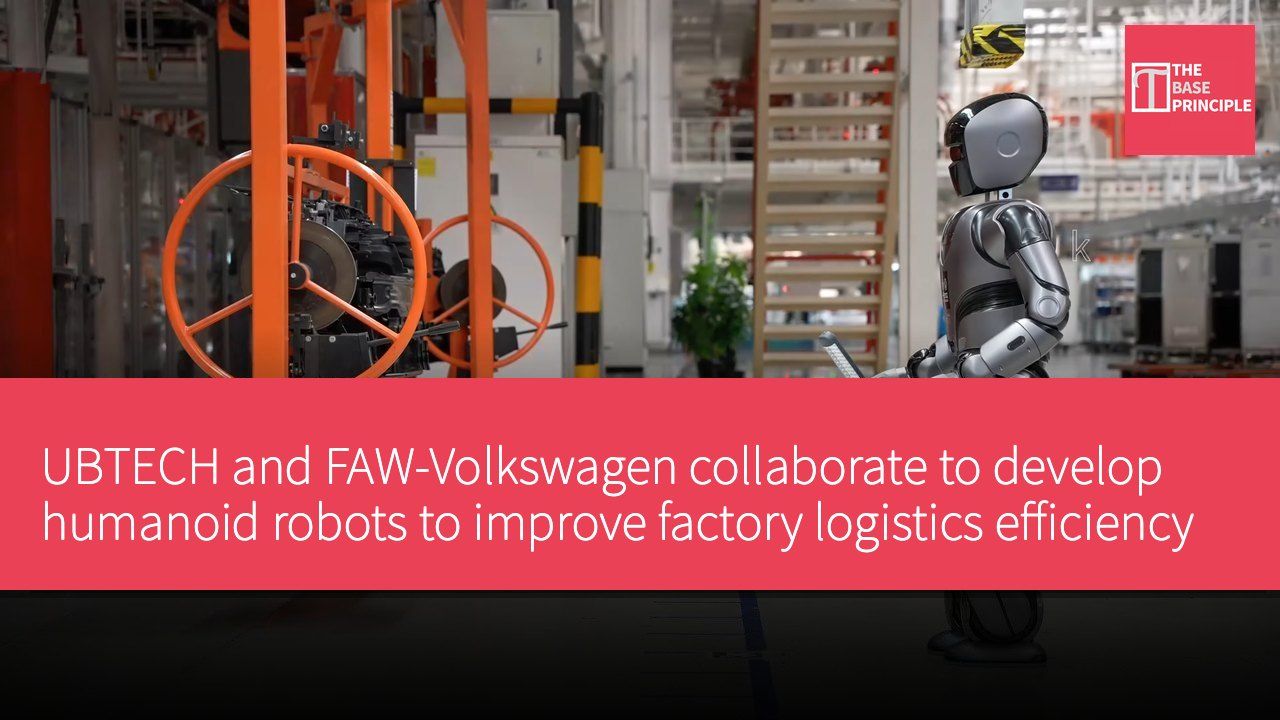
- UBTECH and FAW-Volkswagen collaborate on humanoid robots for logistics applications.
- Collaboration will extend to factory logistics and smart manufacturing applications.
- Humanoid robots can perform multiple tasks, adapting to personalized vehicle demands.
- Current agreement does not specify concrete logistics tasks or robot quantities.
Chinese robotics company UBTECH and FAW-Volkswagen have reached a cooperation agreement to jointly develop and test humanoid robots for logistics applications in automotive manufacturing facilities. The collaboration will focus on developing demonstration scenarios and testing robot solutions to enhance factory logistics and smart manufacturing performance. UBTECH previously conducted vehicle quality inspection trials with FAW-Volkswagen at the Qingdao factory using its Walker S Lite humanoid robot. Both parties stated that the purpose of expanding cooperation is to support more flexible manufacturing, responding to automakers' growing demand for personalized vehicles.
UBTECH and FAW-Volkswagen have expanded their humanoid robot collaboration, advancing from vehicle inspection trials to logistics and broader smart manufacturing applications. Under the strategic cooperation agreement announced on October 8, the two sides will jointly develop and test embodied AI robot applications for factory logistics and establish demonstration sites to evaluate their use in actual production environments. This collaboration builds on FAW-Volkswagen's earlier deployment of UBTECH's Walker S Lite humanoid robot at its Qingdao factory. The robot was used for vehicle quality inspection training and connected to the factory's automated control system.
Collaboration scope expands to logistics
The latest agreement expands the scope of collaboration to logistics, formally establishing it as an area of development.
The two companies began collaborating in July 2024, when FAW-Volkswagen set up a production line scenario at its Qingdao facility to test UBTECH's industrial Walker S humanoid robot. The robot was tested on tasks including bolt tightening, component installation, and parts handling. The two sides also identified industrial logistics and supply chain applications as potential areas for future cooperation. The new logistics focus targets the more repetitive aspects of automotive manufacturing: moving components and materials within production facilities. Unlike fixed industrial automation systems designed for specific operations, humanoid robots can perform multiple tasks using the same physical platform, giving them greater utility when production configurations need to change more frequently to accommodate increasingly personalized vehicles.
UBTECH's industrial humanoid technology
UBTECH is building its industrial humanoid technology around four main systems: an embodied intelligence system, a humanoid cerebellum for motion control, high-performance robot hardware, and swarm intelligence for coordinating multiple robots. The company says its embodied intelligence system uses a self-developed stack combining foundation models, world models, and action models. This architecture aims to enable robots to interpret their surroundings, predict environmental changes, and select appropriate actions. Combined with humanoid hardware, this approach is intended to give robots greater flexibility than traditional automation equipment, which typically performs predefined actions.
UBTECH is also expanding its manufacturing infrastructure. Its industrial humanoid super-intelligent factory in Liuzhou, Guangxi, began operation on September 12. The facility covers 14,000 square meters and produces the company's Walker S and Cruzr series, and is designed to use robotic systems to manufacture robots. According to data from the Guangxi local government, the factory can produce one robot every 10 minutes. For FAW-Volkswagen, the expanded partnership provides a real-world automotive manufacturing environment to test these capabilities.
The automaker has production facilities in Changchun, Chengdu, Foshan, Qingdao, and Tianjin, producing vehicles under the Volkswagen, Audi, and Jetta brands.
However, the current agreement does not specify which humanoid model will be used for the new logistics applications, the specific logistics tasks, the number of robots involved, or a timeline for regular deployment. The current focus is on joint development, testing, and demonstration. If trials succeed, the partnership could provide a pathway for humanoid robots to move from isolated inspection tasks to broader factory operations, enabling them to handle materials, components, and other logistics work within existing automated production systems.
Impact of humanoid robots on automotive manufacturing
The collaboration between UBTECH and FAW-Volkswagen marks the growing importance of humanoid robots in the automotive manufacturing sector. As automakers' demand for personalized vehicles grows, traditional fixed automation systems are struggling to meet flexibility needs. Humanoid robots capable of performing multiple tasks in the production process offer factories greater operational flexibility, which is critical for improving overall production efficiency. As the collaboration deepens, successful trials could drive further integration of humanoid robots into automated production systems, transforming existing logistics and production models.