
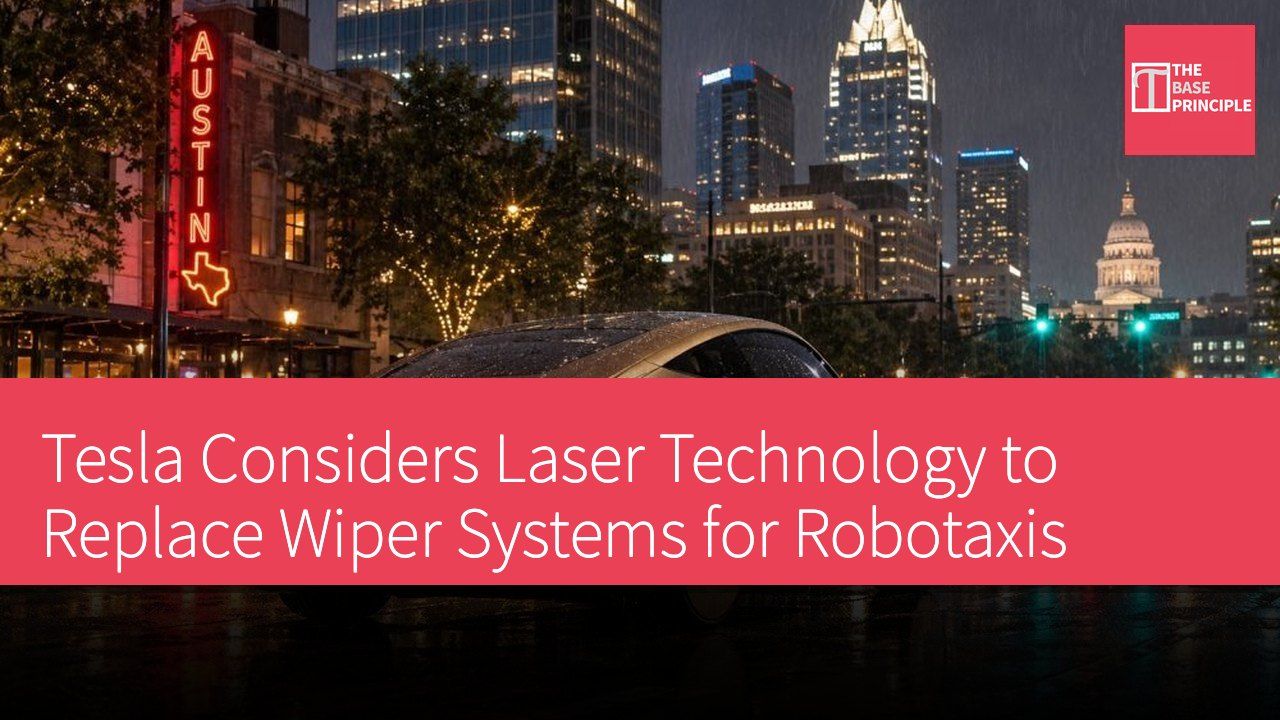
- Tesla is considering using laser technology to clean the lenses of its robotaxis.
- Lasers can focus on specific areas to remove water films and create a barrier.
- Tesla's patent filed in 2019 involves a pulsed laser cleaning system.
- Unmonitored robotaxi services have launched in several cities.
Tesla may use lasers in the future to replace wipers, keeping the lenses of its robotaxis clear. Lars Moravy, Tesla's Vice President of Vehicle Engineering, proposed this idea in the latest episode of "Jay Leno's Garage." In the episode, he and Design Chief Franz von Holzhausen introduced the Model Y L to Leno. He stated, "If you focus the laser on a specific area, you can remove the water film and create a barrier."
Considering autonomous driving, it may be sufficient to clean just the area where the lens is located." He added that cleaning the entire windshield would require excessive laser use, which is not practical.
Tesla's Laser Cleaning Patent
This comment recalls a rather unusual patent from Tesla. The company filed a patent for "Pulsed Laser Cleaning of Glass Objects Accumulated on Automotive and Photovoltaic Components" in May 2019, which was approved by the U.S. Patent Office in September 2021, with an updated divisional version approved on March 31, 2026. The system can detect debris on glass, identify its type, and emit lasers at calibrated rates to ensure the laser beam does not penetrate the glass itself. Potential targets mentioned in the application include windshields, side windows, lens covers, and solar panels.
Lasers were rumored to be used in the Cybertruck, which debuted in November 2019 without wipers. Tesla ultimately opted for an oversized single wiper, and Elon Musk admitted that the wiper was the most troubling aspect for him. The production line is expected to close in mid-2027 to make room for increased Cybercab production.
Changing Roles of Passengers
Over time, the role of passengers in vehicles has changed. Drivers of private cars can notice dirt on the windshield and clean it, while a Cybercab heading to the next pickup point has no personnel onboard to check. Tesla has been addressing this issue through traditional hardware. Reports indicate that in January, a cleaning device was installed on the side repeaters of Model Y robotaxis in Austin, while the lens cleaning patent approved in May describes a liquid and wiper assembly for vehicle lenses and Optimus's eyes.
Using lasers would eliminate the need for liquids and wipers, both of which require regular replacement across the fleet.
In the same episode, Leno experienced fully autonomous driving (supervised mode) for the first time. When an ambulance approached with its siren on, the Model Y L automatically stopped. Leno remarked, "We activated self-driving mode! I didn't touch anything." Moravy and Holzhausen also explained that while using FSD (supervised mode), the owner remains responsible, while Tesla is accountable for the operation of the robotaxi as the operator. Tesla launched the Model Y L in the U.S. in July, priced at US$61,990 (approximately HK$484,962).
Moravy did not provide a specific timeline and described the laser device as an option Tesla is considering, rather than a confirmed feature.
However, the fleet of services continues to expand. Tesla launched its unmonitored robotaxi service in San Antonio on Monday, marking its eighth city, and on the same day, expanded its service area in Austin to approximately 443 square miles. Regions within these markets, including Houston, Miami, and Tampa, frequently experience seasonal rainfall.
Impact of Laser Technology on Autonomous Driving
As autonomous driving technology advances, the need to clean lenses becomes increasingly important. Tesla's consideration of laser technology to replace traditional wipers could effectively reduce maintenance costs and enhance cleaning efficiency, especially in a driverless environment, ensuring vehicle safety and functionality. Furthermore, as Tesla rolls out unmonitored robotaxi services in multiple cities, this innovation could have a profound impact on future mobility patterns.