
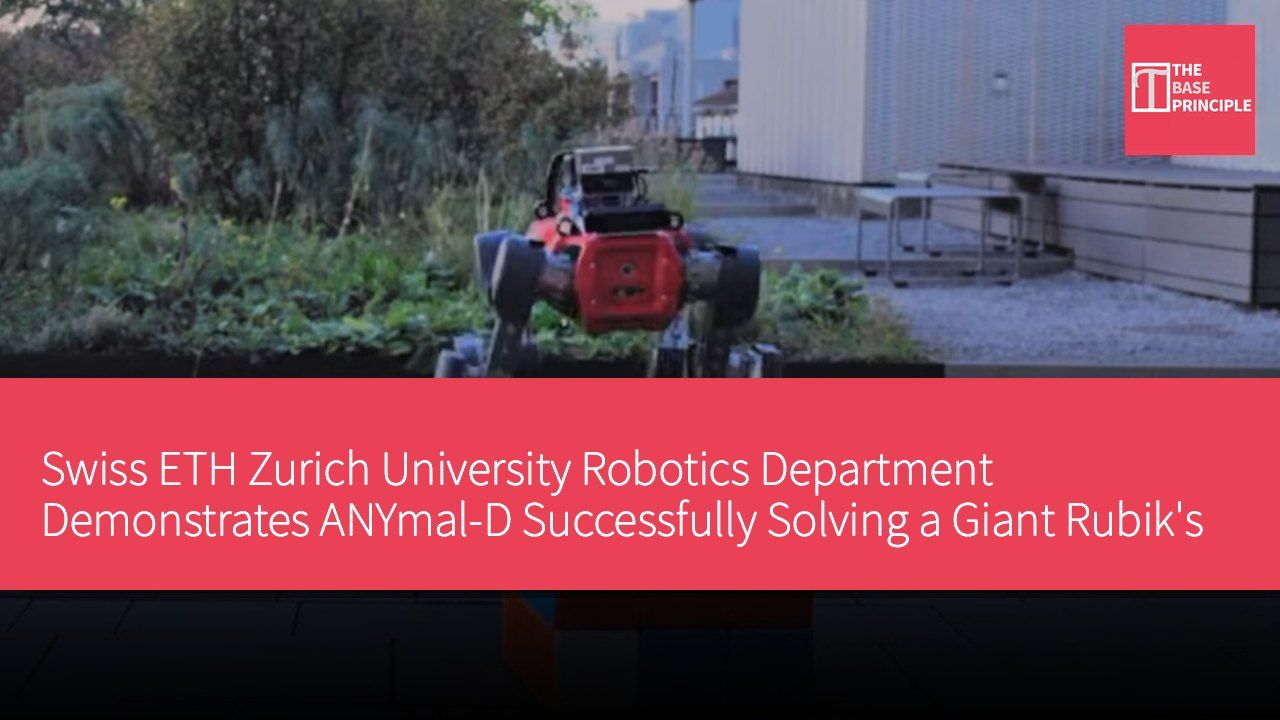
- ANYmal-D can independently solve a giant Rubik's Cube using its four legs.
- The process of solving the cube involves inspection, calculation, and physical manipulation while maintaining balance.
- The robot learns the process of solving the cube through reinforcement learning and simulation.
- This research demonstrates that robots can use tools in unconventional ways to solve problems.
The Robotics Systems Laboratory at ETH Zurich has showcased its ANYmal-D's ability to independently solve a giant Rubik's Cube. While robots solving Rubik's Cubes is not unprecedented, what sets this achievement apart is that the robot maintains balance while operating with its four legs. This technique is referred to as "pedipulation," and the team utilized a combination of traditional algorithms, computer vision, and reinforcement learning to achieve this. The process of solving the cube involves multiple independent tasks. First, the robot needs to understand the initial state of the cube by inspecting its six faces and identifying the positions of the colors.
Next, it must calculate mathematically how to solve the cube, in other words, determine the required sequence of rotations. Depending on the level of knowledge, this may include executing basic "algorithms," such as the classic "white cross," "white corners," "middle layer," "yellow cross," and so on, or faster methods. However, all steps require physical manipulation of the cube to complete each action, particularly to avoid incorrectly moving the wrong pieces.
Challenges of Robot Solving the Cube
For humans, this is typically the simplest part of the process, but for a four-legged robot, it poses significant challenges. Lacking hands, it must use its legs to move layers and flip the entire cube while maintaining balance. To achieve this, ANYmal must balance on its remaining legs, accurately position its feet, apply the appropriate force, and continuously adjust its movements when touching the cube. The cube weighs approximately 10 pounds (4.6 kilograms). To successfully complete a move, the robot needs to ensure that the base layer does not move while applying enough torque to shift the required layer.
Moreover, it is crucial to repeat this process continuously without falling. An accidental move could jeopardize the entire attempt; at best, it would require correction, and at worst, it might necessitate starting over. According to the team, this process is achieved through a combination of reinforcement learning, simulation, and "apprenticeship training." Thus, the robot is no longer guided by hardcoded instructions but can learn "muscle memory" through trial and error. However, this is only part of the challenge; simply moving the cube does not guarantee it will be solved.
Potential Applications for Future Robots
For this part, the team provided the robot with a solver named Kociemba to determine the necessary moves. It then combined computer vision, color classification, and algorithms to calculate the sequence of moves. Subsequently, this information was used to instruct the robot's limbs on the actions needed while monitoring the cube's state to check and correct errors. What were the results? According to the team, the robot successfully solved all three attempts, with each solution taking between 8 to 9 minutes and requiring about 30 independent robotic actions.
This performance is quite impressive given the lack of hands. But what is the broader significance of this research? It demonstrates that robots can be taught to use existing tools in more unconventional ways to solve problems. For example, it could enable robots to use their legs to open doors, manipulate valves, move obstacles, and more, without the need for specialized tools. This could lead to future robots that are simpler, lighter, and potentially cheaper. Ultimately, this will be highly valuable in industrial inspection, maintenance, search and rescue, and other environments where robots need to do more than just move.
Implications of ANYmal-D for Robotic Technology
ANYmal-D's success illustrates how robots can perform complex physical operations using their legs in the absence of hands. This not only showcases its capabilities in solving specific problems but also provides new insights for the future development of robotic technology. Through reinforcement learning and simulation, robots can learn and adapt autonomously, potentially making them more versatile and applicable in various environments. In the future, further development of this technology may enable robots to perform more complex tasks in industrial and everyday settings, thereby improving efficiency and safety.