
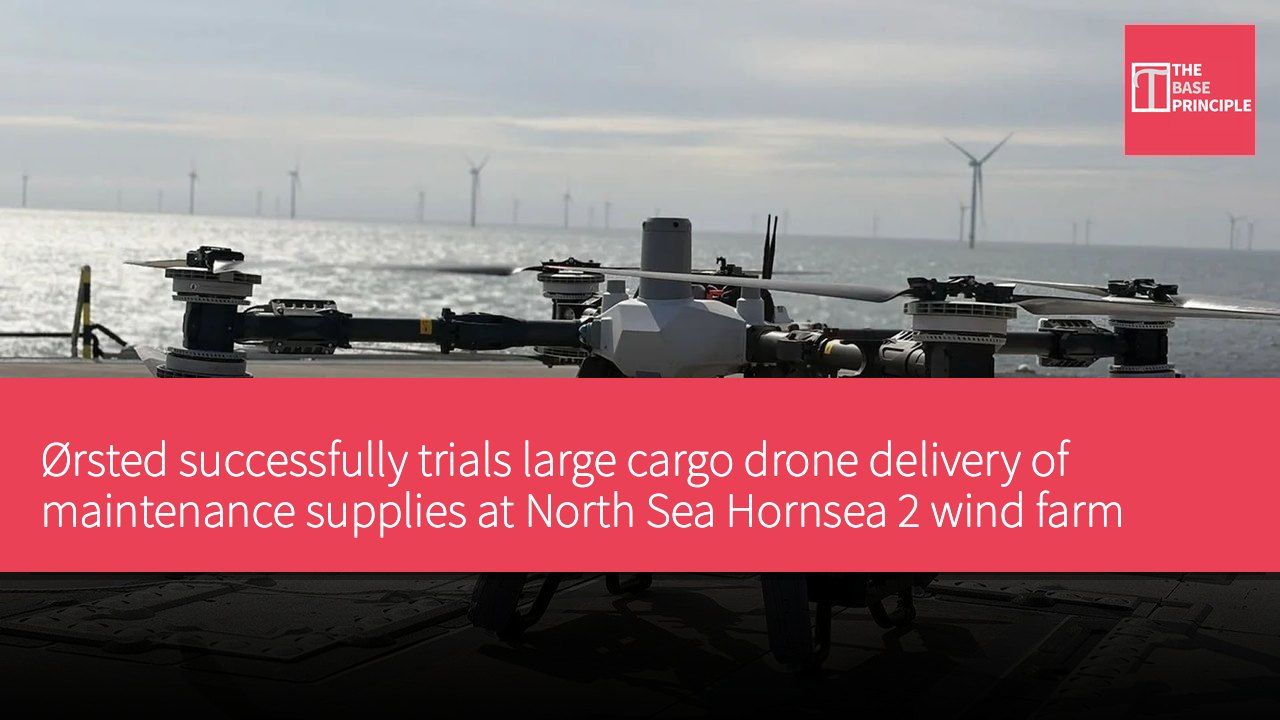
- Ørsted successfully tests large cargo drone delivery of maintenance supplies at Hornsea 2 wind farm.
- Drone can operate beyond visual line of sight, reducing personnel involvement.
- Trial confirms drones can improve work efficiency, reduce operating costs and emissions.
- This is Ørsted's first time achieving automated cargo pickup under actual conditions.
Ørsted announced it has completed a new trial of a large cargo delivery drone at its North Sea Hornsea 2 Offshore Wind Farm. According to the company, the trial aims to test whether drones can become a viable alternative to conventional offshore vessel maintenance operations, to reduce associated costs. The trial was conducted jointly with Skyports Drone Services, using its large cargo drone. According to the press release, the Skyports team developed a new payload collection method for the trial and achieved automated hook operations.
Notably, the drone operated beyond visual line of sight (BVLOS), meaning the drone operator does not need to maintain visual contact with the drone. In this scenario, the team demonstrated deliveries within the wind farm at a range of approximately 2.5 miles (4 kilometers) without visual contact. The team explained this minimizes personnel involvement, allowing the drone to retrieve and drop off cargo autonomously.
Innovation in drone operations
The trial lasted approximately four weeks and required collaboration from a diverse team spanning safety, aviation, drone operators, and other technicians. Ørsted used drones to handle the heavy lifting and coordinated closely with the UK Civil Aviation Authority. Each package weighed between 121 pounds (55 kilograms) and 143 pounds (65 kilograms), containing tools, spare parts, and other materials required for specific tasks. These packages were then delivered to different turbines, where technicians would perform work upon arrival. Once completed, the drones were used again to collect the used packages and return them to the service operation vessel (SOV).
The technology is impressive, but what is the practical need? Traditionally, such maintenance packages typically need to be shipped to the site. Once there, the packages must be lifted up to the wind turbine, which is both time-consuming and potentially hazardous. Drones, by contrast, can relatively easily deliver packages from the SOV (the starting point) to the work site (for example, the top of the turbine). This also enables rapid delivery of emergency parts to the site with almost no delay. "The offshore environment is a challenging domain — traditional turbine logistics, whether by vessel or helicopter, involve time, coordination, varying degrees of risk, and cost.
At Hornsea 2, we demonstrated the potential of cargo drones as a viable alternative, minimizing these factors," said Alex Brown, CEO of Skyports Drone Services, in the press release.
Practical application of drone technology
He added: "These drones provide a practical method for wind farm operators like Ørsted to reduce lifting and vessel movements, accelerate technician work efficiency, and maximize turbine generation time." It should be noted that this is not the first time Ørsted has experimented with heavy-lift drones at its offshore wind farms, but this trial marks the first time more automated cargo pickup and recovery has been achieved and proven effective under actual conditions. "This trial validates our approach to integrating drone technology into routine operations. By delivering parts and tools more efficiently and safely, we can improve turbine uptime and reduce emissions and operating costs," said Richard McCrilley, Ørsted's project lead
explained. "Because we have a daily on-site presence, we can respond to various ad-hoc flight requests and dispatch equipment to support teams. We can cover both planned and emergency work."
Potential of drones at offshore wind farms
The application of drones at offshore wind farms shows their potential in improving maintenance efficiency and reducing costs. Traditional logistics methods are not only time-consuming but also carry safety risks, while drones can deliver maintenance supplies quickly and safely. The successful trial of this technology not only provides wind farm operators with a new option but could also change the operating model of offshore maintenance operations, further advancing the development of renewable energy.