
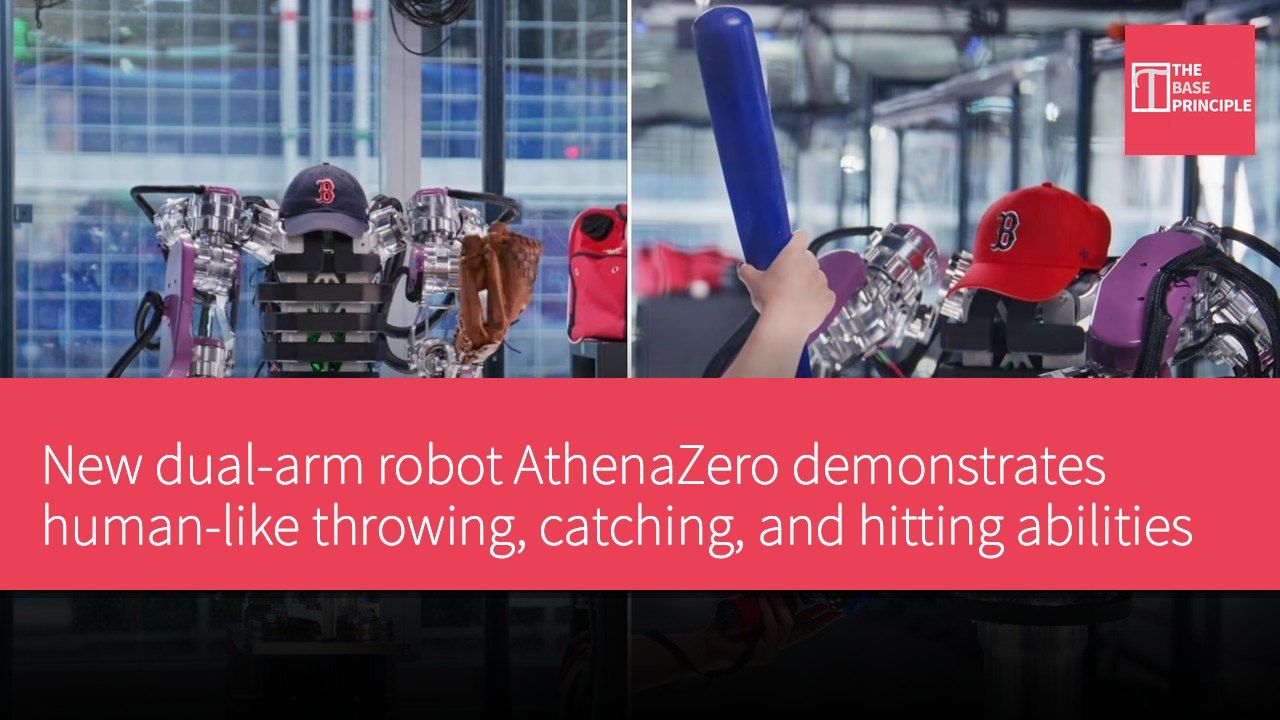
- AthenaZero demonstrates human-like throwing, catching, and hitting abilities.
- The robot's design enables it to respond to external forces, enhancing interaction capabilities.
- Researchers focused on reducing the robot's effective inertia to improve responsiveness.
- AthenaZero successfully completed three baseball-related tasks, demonstrating its potential.
A new dual-arm robot developed by the Robotics and AI Institute (RAI) has demonstrated the ability to throw, catch, and hit with coordinated human-like motions, offering a different solution for robots interacting with objects in dynamic environments rather than simply moving them from one place to another. The robot system, named AthenaZero, aims to replicate some of the mechanical properties humans require to perform fast, powerful, and delicate movements. In experiments reported in Science Robotics, the robot completed three baseball-inspired tasks, including throwing a ball, catching a ball, and hitting a ball with a bat.
The research was led by robotics expert Andrew S. Morgan, who told TechXplore that the team wanted to explore how a robot's mass and force-generation capacity could be designed to more closely resemble those of humans.
Innovative features of the robot design
The AthenaZero robot consists of a central torso, two robotic arms equipped with hands, and a system of motors and gears. Although the structural parts of the arms are rigid, their joints can respond to external forces, allowing the robot to react in a controlled manner when interacting with objects or its surroundings. This design reflects an alternative approach to robotic manipulation. Many conventional industrial robots are designed for rigidity and precision, making them highly effective for repetitive tasks such as heavy lifting or placing parts on assembly lines. However, that rigidity makes physical interaction more difficult to manage when objects move unpredictably or require a gentle touch.
AthenaZero's design enables it to operate across a wider range of forces, allowing it to perform delicate or powerful movements as needed during tasks.
The researchers also focused on reducing the robot's effective inertia, a property that describes how much an object resists changes to its motion. Lower inertia helps the arms accelerate and decelerate more easily, potentially improving the robot's ability to react quickly when dealing with moving objects. According to Morgan, this system represents the team's first attempt at a low-inertia design approach.
Baseball as a test platform
Why test a baseball robot? Baseball provides researchers with a practical way to examine several difficult manipulation problems. Throwing requires the robot to coordinate its motions to apply force to an object, while catching demands that it react to an incoming object and manage the forces generated on contact. Hitting with a bat adds another challenge: coordinating both arms to position and swing an object at the right moment. These tasks go beyond the predictable motions typical of traditional factory automation. The robot must coordinate its joints while accounting for physical contact, timing, and the motion of objects through space.
The researchers reported that AthenaZero successfully completed all three tasks in initial evaluations. The experiments were intended to demonstrate the potential of its mechanical design, not to prove the robot can already perform a wide range of real-world tasks.
Advancing toward more capable robotic manipulation, robotic manipulation remains a major challenge, with researchers working to develop machines that can reliably interact with objects of different shapes, weights, and textures. AthenaZero is part of a broader research effort aimed at understanding how a robot's physical structure affects its ability to manipulate objects. The team is investigating whether designing a robot's mass, inertia, and force characteristics — not just relying on better control software — can make complex motions easier to achieve. The researchers plan to continue refining the system and evaluating it on more challenging manipulation tasks.
Baseball serves as a test platform for these fundamental capabilities, while dexterous manipulation — the ability to handle objects skillfully and reliably — remains the larger goal.
For now, AthenaZero demonstrates a promising direction in robot design. If its approach can scale to other tasks, robots will be better equipped to handle dynamic physical interactions that remain difficult for conventional rigid manipulators.
AthenaZero's impact on robotic manipulation
The development of AthenaZero marks an important advance in robotic manipulation technology. Its design not only emphasizes responsiveness to external forces but also enhances the robot's agility by reducing effective inertia. These characteristics enable the robot to interact more effectively with objects in dynamic environments, surpassing the limitations of traditional industrial robots. Baseball as a test platform allows researchers to examine complex manipulation problems, which has significant implications for future robot applications. If these technologies can scale to other domains, they will help address many real-world challenges.