
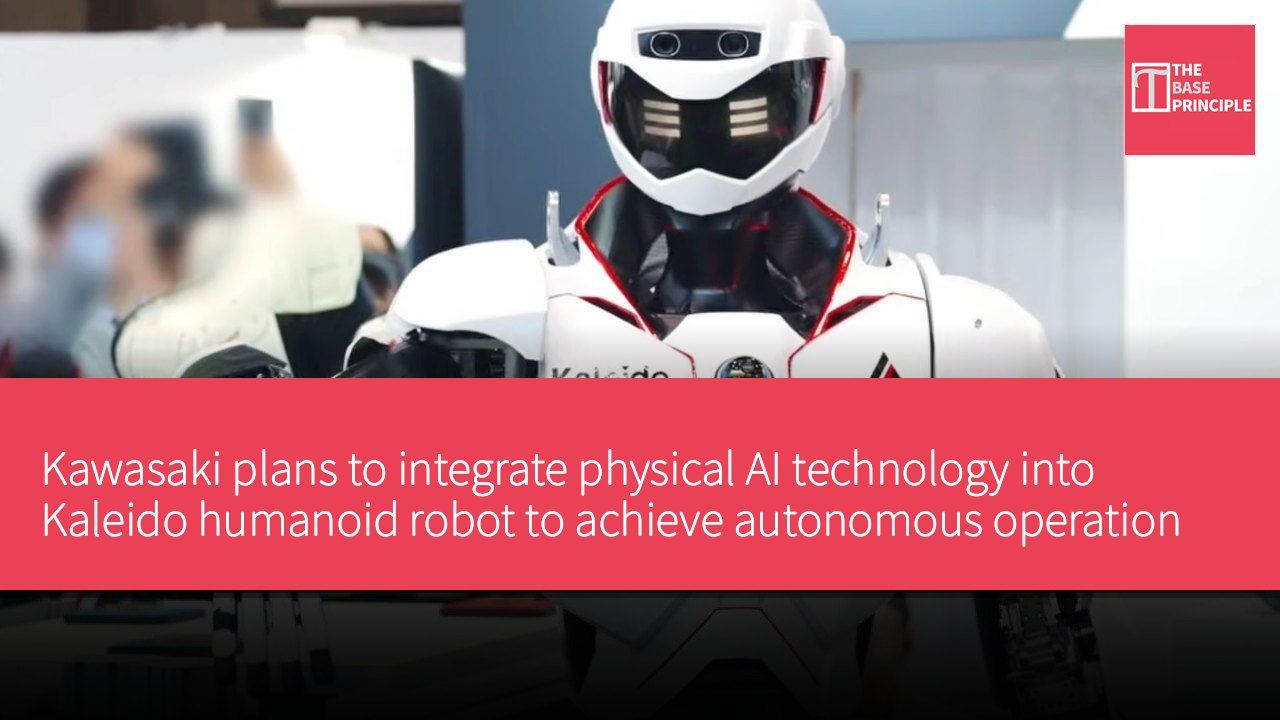
- Kawasaki plans to integrate Noetra's AI platform into the Kaleido humanoid robot.
- Initial focus will be on simple tasks, gradually shifting to more complex work.
- Kawasaki's goal is to eventually achieve fully autonomous operation, reducing human intervention.
- Plan to operate tens of thousands of various types of robots by 2040, advancing robot strategy.
Kawasaki plans to integrate the physical AI platform of Japanese physical AI developer Noetra into its Kaleido humanoid robot. According to Nikkei Asia, this move will make Kaleido the first planned adopter of Noetra's physical AI technology. Kawasaki expects to initially use a combination of remote human control and AI, as the system evolves toward greater autonomy. The company's plan reflects the trend of humanoid robots gradually entering industrial operations, initially focusing on relatively simple tasks before potentially moving to more complex work such as assembly and other manufacturing activities.
Kawasaki Heavy Industries plans to incorporate Noetra's platform into the Kaleido humanoid robot, with deployment expected as early as 2030. Kaleido has been in development since 2015 and is positioned for industrial applications. Kawasaki's initial plans focus on relatively simple tasks, such as plant patrols and transporting parts within factories and warehouses. The company is also discussing the robot with potential customers in the automotive and semiconductor industries. The transition to autonomous operation is expected to proceed in phases. Early deployments will combine remote human control with AI, allowing operators to supervise or control the robot as Noetra's physical AI capabilities handle a growing share of tasks.
Kaleido's Autonomous Operation Plan
As foundational AI advances, Kawasaki aims to reduce the need for human intervention and ultimately achieve fully autonomous operation. Humanoids Daily reports that this approach reflects the technical challenges humanoid robots face in industrial environments. Performing pre-programmed actions in a controlled environment differs significantly from operating autonomously around people, equipment, and changing conditions. Robots must perceive their surroundings, understand the physical properties of objects, plan movements, and adjust their actions as conditions change. Kawasaki's Kaleido 9 has already demonstrated some of these capabilities.
The company has demonstrated autonomous walking and obstacle avoidance using LiDAR-based localization, as well as a remotely operated disaster relief demonstration.
Kawasaki's March 2026 roadmap targets remote-assisted work in controlled environments around 2030, while the goal for autonomous operation in unstructured environments is 2040. Noetra's physical AI platform aims to provide an additional layer of capability. The company is developing a multimodal foundation model for fiscal 2028, and a physical-world AI capable of understanding physical properties by fiscal 2030. Its technology development involves Sony, SoftBank, NEC, and Honda, with Kawasaki also among its investors.
Challenges and Opportunities for Future Applications
For Kaleido, this technology could eventually extend beyond basic transport and patrol tasks. Kawasaki expects future software and AI improvements to support more challenging applications, including product assembly. Such tasks demand high precision, as the robot must coordinate its arm and hand movements while responding in real time to objects, tools, and workpieces. Kawasaki also plans to combine Noetra's technology with its physical AI collaboration with NVIDIA. Announced in May, that partnership focuses on developing more complex and precise autonomous movements.
Combining these two efforts could give Kawasaki access to AI models and computing technology, allowing their application to its existing humanoid platform.
The company's plans also indicate that humanoid robots are only part of a broader robot strategy. Kawasaki aims to operate tens of thousands of robots by 2040, including wheeled robots, quadrupeds, and hospital transport robots, alongside humanoids. Accordingly, Kaleido's key technical objective is not merely to enable the robot to perform more tasks, but to gradually shift responsibility for those tasks from human operators to AI. The planned 2030 deployment represents an early stage of this transition, not an immediate shift to fully autonomous humanoid operation.
Item Specification Development Year 2015 年 Target Deployment Year 2030 年 Expected Year for Autonomous Operation Realization 2040 年
Long-Term Vision for Kawasaki's Robot Plan
Kawasaki's plan shows the potential of humanoid robots in industrial applications, particularly in the automation of simple tasks. As technology advances, robots will be able to operate in more complex environments, which will not only improve production efficiency but also reduce labor demand. Combined with Noetra's physical AI technology, Kawasaki's vision is to gradually achieve autonomous operation, which holds significant importance for the development of robot technology. Future challenges include how to perform precise operations in dynamic environments, which will be key to further advancing robot technology.