
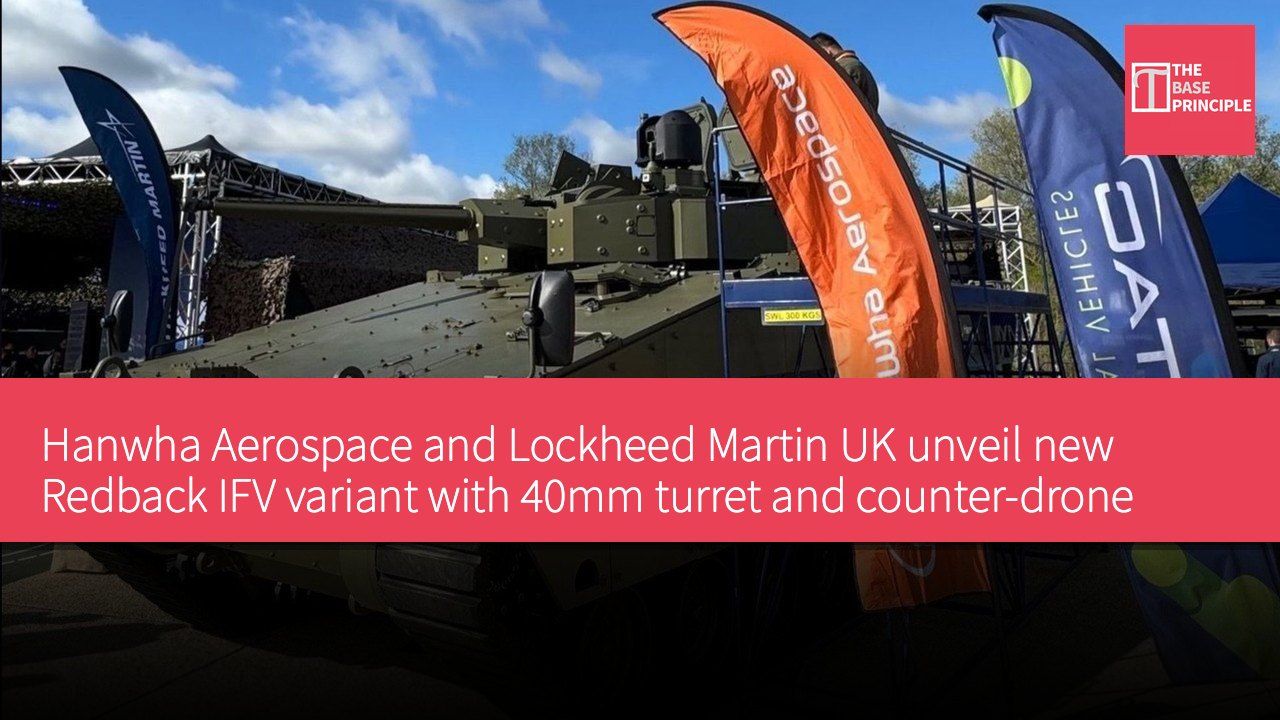
- Hanwha Aerospace and Lockheed Martin have unveiled a new Redback IFV equipped with a 40mm turret.
- The new vehicle can fire NATO-standard munitions, offering flexibility.
- The addition of the SkyKeeper system gives the Redback counter-drone capabilities.
- This new configuration is intended to meet the modernization needs of NATO nations.
Hanwha Aerospace and Lockheed Martin UK have unveiled a new variant of the Redback infantry fighting vehicle (IFV), combining a British-built 40mm turret with counter-drone technology. The two companies showcased the configuration at the Defence Vehicles Dynamics 2026 exhibition in Millbrook, UK, pitching the Redback to NATO nations seeking to modernize their armored and reconnaissance forces.
The new vehicle retains the tracked Redback hull but swaps out the configuration chosen by Australia in favor of a manned turret from Lockheed Martin UK. The turret is armed with a CTA International 40mm cannon, giving the vehicle a weapons fit distinct from the Australian Redback's 30mm gun. The turret was developed and integrated at Lockheed Martin UK's Bedfordshire facility. The choice of a 40mm weapon also allows the vehicle to fire a range of NATO-standard munitions. Hanwha's Lee Byeong-gil said the company selected the gun because its ammunition types provide flexibility.
By comparison, the Australian Army's Redback IFV is fitted with Northrop Grumman's Mk44S Bushmaster II 30mm cannon, together with Spike LR2 anti-tank missiles and other systems. Australia has signed a contract with Hanwha Defence Australia for 129 Redbacks under the LAND 400 Phase 3 program.
Integration of counter-drone technology
Perhaps the bigger shift in turning the IFV into a counter-drone platform is the addition of Lockheed Martin UK's SkyKeeper command-and-control system. SkyKeeper is designed as a battlefield command-and-control system for ground-based air defense and counter-UAS (C-UAS) operations. Lockheed Martin says it can fuse information from multiple sensors and coordinate kinetic and non-kinetic effectors. The system is also designed to fit the UK's Generic Vehicle Architecture. For the Redback, SkyKeeper has been directly integrated into the turret architecture for the first time.
The two companies said this gives the vehicle a dual role: traditional infantry combat and counter-drone operations, reflecting the mounting challenges facing armored formations.
Small drones can provide persistent reconnaissance and carry explosives, forcing armored units to deal with aerial threats alongside conventional ground targets. Embedding counter-drone command and control into an IFV could allow the vehicle to participate in wider aerial surveillance rather than relying solely on its own sensors. However, the two companies have not publicly disclosed the full sensor, effector or operational architecture of the new Redback configuration.
Market positioning of the new configuration
The new variant is not intended to replace the Australian Redback configuration, but rather gives Hanwha an alternative setup that can be tailored to individual customer requirements. The company plans to conduct live demonstrations in 2027, including in Canada and South Korea, as it courts potential NATO and allied customers. The approach also leverages the Redback's existing development work. Australia selected the vehicle in 2023, and its 129-vehicle program is to be produced locally. For Hanwha and Lockheed Martin UK, then, the new configuration is more a demonstration of how an existing armored platform can be reconfigured around evolving battlefield demands.
The combination of a 40mm cannon with an integrated counter-drone command system offers NATO customers an additional Redback configuration as armored forces increasingly need to defend against threats from both the ground and the air.
Strategic significance of the new Redback IFV
As drone technology advances rapidly, traditional armored formations face new challenges. Hanwha Aerospace's partnership with Lockheed Martin in launching a counter-drone-capable Redback IFV reflects keen insight into the future requirements of the battlefield. The dual-role design not only enhances the vehicle's operational flexibility but also provides NATO nations with a new option for confronting threats from both the air and the ground. As the global security environment shifts, this new configuration will help strengthen cooperation and defense capability among allies.