
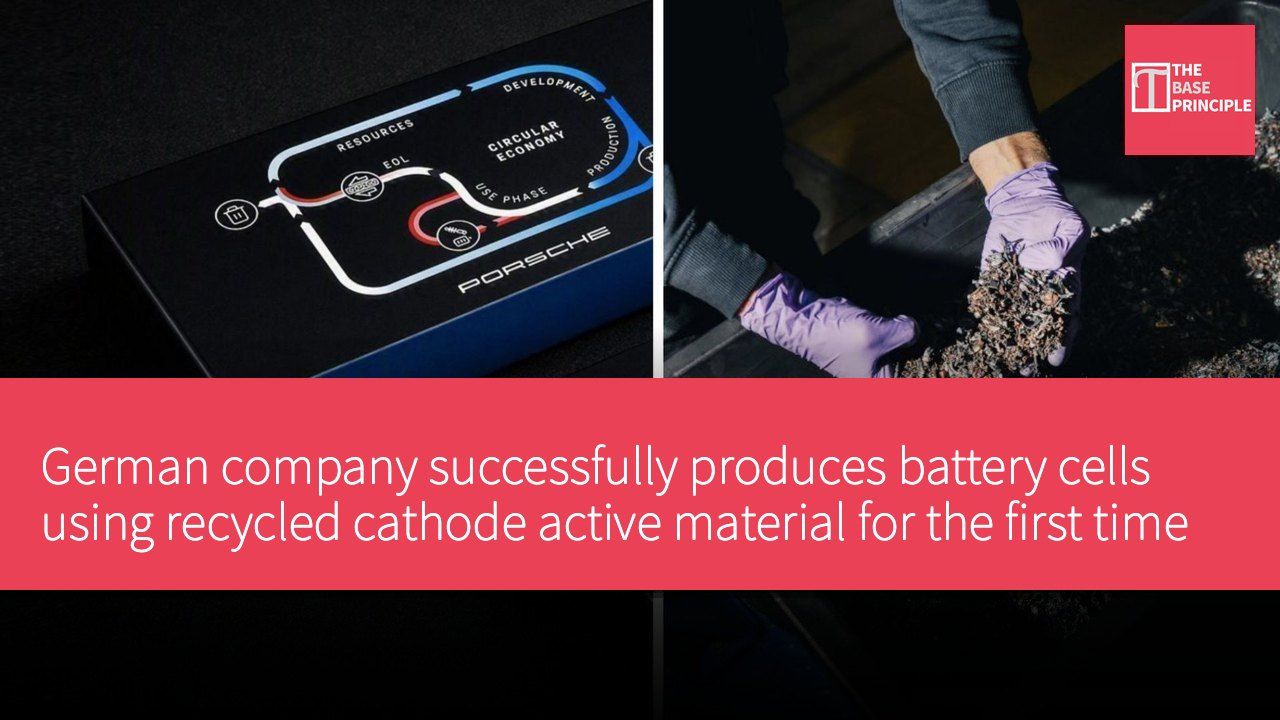
- A German company has produced battery cells using recycled material for the first time, advancing the circular economy.
- Porsche is partnering with cylib to recover materials such as lithium and cobalt from end-of-life batteries.
- The recycled active material fully replaces conventional raw materials, demonstrating technical feasibility.
- The quality of the recycled material meets Porsche's high standards and could be applied to series-production batteries in the future.
A German company has, for the first time, successfully produced battery cells using recycled cathode active material. To achieve this, Porsche collaborated with the German recycling company cylib, which specialises in recovering battery raw materials from its own high-voltage batteries. The cells manufactured in this pilot project are currently undergoing extensive operational testing.
"By manufacturing battery cells using entirely recycled raw materials such as lithium and cobalt, we have reached an important technical milestone," said Joachim Scharnagl, Member of the Executive Board for Procurement at Porsche. "This innovation is a key step in advancing the principles of the circular economy and raw material resilience, always with the ambition of optimising progress, quality and resource efficiency." This achievement follows the launch of the high-voltage battery recycling pilot project last year. Within that project, Porsche and its partners recover valuable raw materials from end-of-life high-voltage batteries, process them into new materials and subsequently use them in new battery cells for Porsche test vehicles.
Technical feasibility of recycled materials
Following the recovery and processing stages, the project has now moved to its next phase: for the first time, the recycled active material fully replaces the conventionally used raw materials. The recycled cathode active material includes lithium, nickel, cobalt and manganese. "cylib has closed the battery recycling loop, from end-of-life batteries to recovered raw materials," said Dr. Lilian Schwich, Co-CEO and Co-Founder of cylib. "The pilot project with Porsche demonstrates that our approach works in practice: the valuable raw materials from Porsche batteries, after their first service life, have the potential to flow back into new high-performance batteries in the future."
Porsche's recycling process
The company revealed that, in addition to recovering raw materials, Porsche places strong emphasis on the quality of the recycled materials. The next step is to ensure that the recovered raw materials meet Porsche's high standards for value, quality and performance when used in batteries. Initial tests have already demonstrated the technical feasibility of the approach. Further results are expected to be published in the second half of 2026. The insights gained from the pilot project will form the basis for the potential future use of these materials in series-production batteries. Findings from the pilot project have already been incorporated into Porsche's standard battery disposal process.
The collaboration between Porsche and cylib has made it possible to recycle end-of-life high-voltage batteries collected from Porsche Centres across Germany. Since May 2026, these batteries have been recycled using an innovative water-based process. The recovered battery raw materials are tracked through dedicated material accounts and will be available to Porsche and selected partner companies for use in battery cell production starting in 2028. This approach aims to reduce dependence on global raw material sources. In the future, battery raw materials recycled in Europe could be used in high-voltage batteries for Porsche vehicles.
Impact of recycling technology on battery production
The collaboration between Porsche and cylib marks a significant shift in battery production by applying recycled materials in new battery cells. This not only helps reduce resource waste but also improves material utilisation efficiency. As environmental awareness grows, this innovative approach aligns with the global trend of promoting a circular economy. Ensuring that recycled materials meet high quality standards is crucial for future battery performance. This development could influence the entire electric vehicle industry, encouraging more companies to adopt similar recycling strategies.