
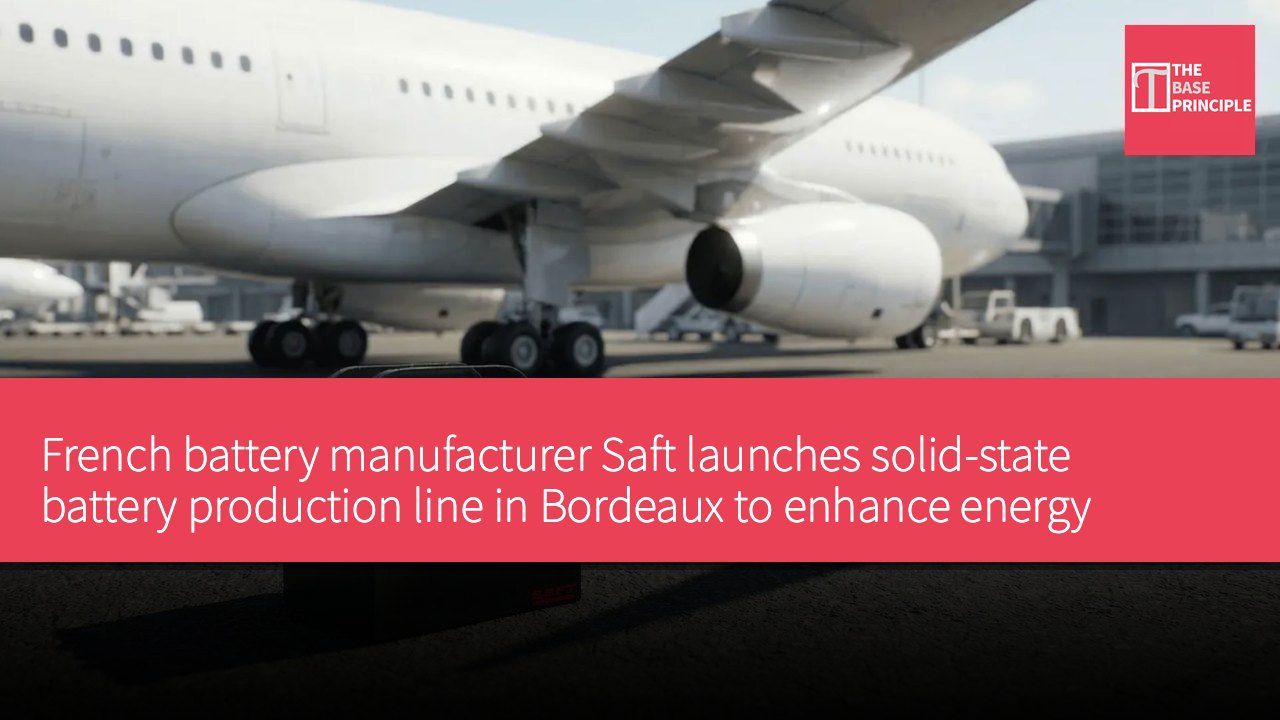
- Saft has launched a solid-state battery production line in Bordeaux, advancing electric aircraft technology.
- Solid-state batteries have an energy density that is 50% higher than traditional lithium-ion batteries.
- The new production line establishes France and Europe as leading participants in solid-state technology.
- Solid-state technology is receiving significant attention in space and aviation electrification.
French battery manufacturer Saft has inaugurated a new battery production line in Bordeaux to advance solid-state technology for electric aircraft and space applications. The company's wholly-owned subsidiary TotalEnergies held the launch ceremony for the production line on October 19, transforming years of research into manufacturing capabilities. The company stated that solid-state batteries can achieve an energy density that is 50% higher than traditional lithium-ion batteries, with improved safety. These potential advantages are particularly important in the aviation industry, where battery weight and performance are core considerations for achieving electrification.
The facility enables Saft to develop and produce batteries using sulfide and polymer electrolytes at room temperature. According to the company, Saft is the first French manufacturer with this combination of capabilities.
Technical Advantages of Solid-State Batteries
Solid-state electrolytes provide enhanced safety and density. Solid-state batteries replace the liquid electrolytes used in traditional lithium-ion batteries with solid materials. The electrolyte allows ions to move between the battery's electrodes during charging and discharging. Replacing the liquid components offers a safer and more compact battery solution. Saft emphasizes that the increase in energy density is another major advantage, noting that solid-state batteries can potentially achieve a 50% improvement compared to classic lithium-ion technology. The Bordeaux production line covers polymer semi-solid and sulfide solid-state technologies. According to the company, its launch is the result of over a decade of research, innovation, and industrial development.
"Solid-state batteries are one of the most promising innovations to meet future electrification demands," said Saft CEO Cedric Duclos. "These new production lines mark an important milestone for Saft, as we translate years of research into actual industrial capabilities, demonstrating our desire to establish France and Europe as leading participants in this strategic technology."
Solutions to Emission Issues
The dry electrode manufacturing process also addresses emission issues associated with battery electrode production. Saft stated that its batteries utilize a dry electrode process that can reduce carbon dioxide emissions during this production phase by up to 40%. This figure specifically refers to the electrode production stage, rather than the overall manufacturing process or emissions over the entire lifecycle of the battery. The new production line represents a step toward the industrialization of this technology. Saft's announcement focuses on establishing the capabilities to develop and produce these batteries, targeting the aviation and space industries, both of which seek improvements in safety, performance, and energy density.
Saft noted that solid-state technology has garnered significant attention from the space industry and is also viewed as important for aviation electrification. Electric aircraft battery cells are currently under evaluation. Saft has provided semi-solid battery cells to Safran for assessing future electric and hybrid aircraft architectures. This delivery is based on a partnership announced at the Paris Air Show in June 2025, aimed at developing high-voltage battery systems for the aviation sector. Most of the battery cells will be sent to Safran's system testing center in Niort, France, which is responsible for much of the validation and integration work required for developing electric and hybrid propulsion systems.
The evaluation of solid-state battery cells and batteries is expected to begin next year. Currently, the delivered semi-solid battery cells provide partners with an early milestone in assessing battery technology for future aircraft.
Potential of Solid-State Battery Technology in Aviation
The development of solid-state battery technology is significant for the aviation industry, as the energy density and safety of batteries directly impact the performance of electric aircraft. With Saft's production line in Bordeaux now operational, France and Europe are poised to take a leading position in this critical technology area. Solid-state batteries not only enhance energy density but also reduce carbon emissions during the production process, which is particularly important for the aviation industry’s pursuit of sustainability. As evaluations and collaborations on electric aircraft technology progress, the application prospects for solid-state batteries will broaden, potentially transforming the future landscape of air transportation.