
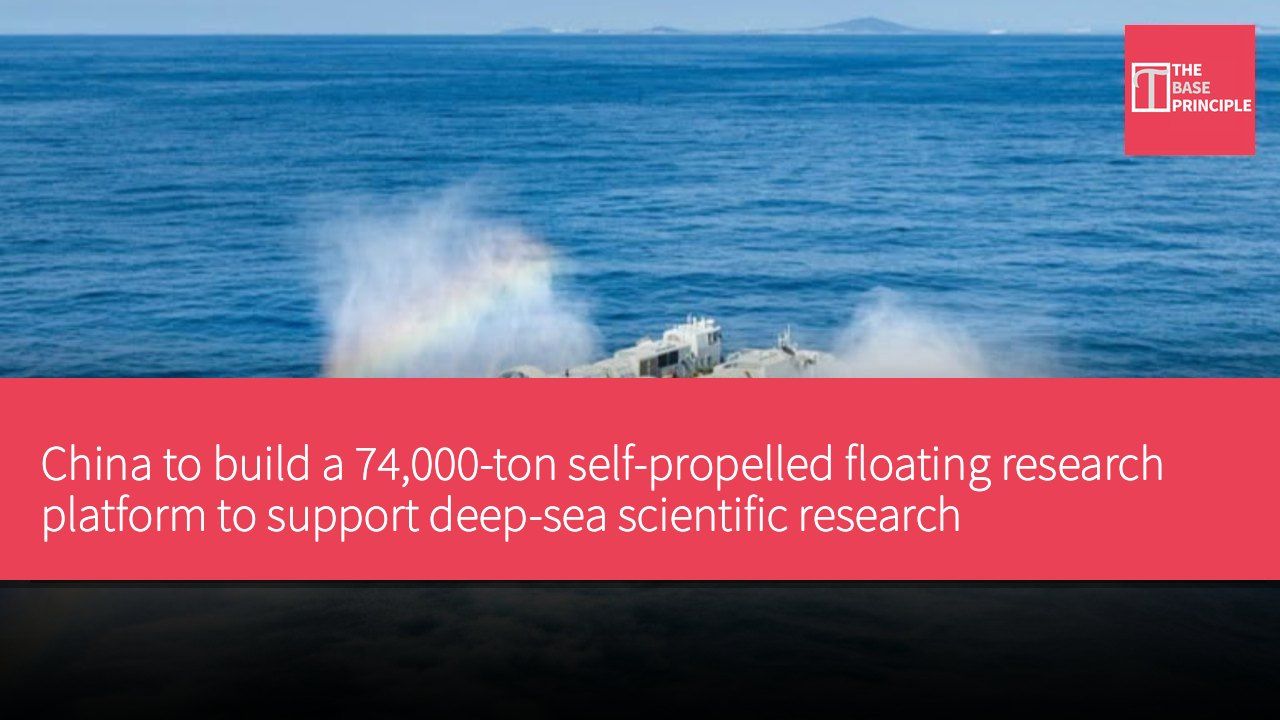
- China will build the world's first self-propelled floating research platform to support deep-sea research.
- The platform is designed as a catamaran with a semi-submersible main structure, capable of operating in harsh sea conditions.
- The platform will feature six laboratories focused on marine disaster and ecosystem research.
- It is expected to be delivered in June 2030, supporting long-term research missions without frequent returns to port.
China has awarded a contract worth $413 million (approximately HK$3.22 billion) to construct a self-propelled floating research platform aimed at supporting long-term deep-sea scientific research under harsh marine conditions. This vessel is described as the world's first floating artificial island specifically designed for such research, combining onboard laboratories with a mobile structure intended to remain at sea for extended periods. Shanghai Jiao Tong University will operate the platform, while the Shanghai Waigaoqiao Shipbuilding Company, a subsidiary of China State Shipbuilding Corporation (CSSC), will be responsible for its design and construction.
Construction is set to begin in 2028, with delivery expected in June 2030.
Platform Design and Features
Unlike traditional research vessels, the platform will utilize a catamaran design and feature a semi-submersible main structure, intended to move between research areas while providing accommodation and laboratory space for scientists studying marine ecosystems, marine engineering, and severe weather conditions.
The planned research vessel will be approximately 453 feet long and 279 feet wide, with a main deck height of 148 feet. According to Chinese media reports, its displacement is expected to reach 74,000 tons, with a maximum speed of 11 knots. The catamaran design aims to provide stability and offshore operational capability. According to project specifications, the platform is designed to operate in sea state 7, which corresponds to wave heights of approximately 20 to 30 feet, and can withstand typhoons of category 17 with wind speeds exceeding 165 miles per hour.
The vessel's self-propulsion capability is a key component of its concept. It is not intended to be permanently fixed in one location but will be repositioned according to changing research needs, combining the mobility of a vessel with the workspace and long-term accommodation capabilities of a floating facility.
Shanghai Waigaoqiao Shipbuilding Company stated that the project will leverage its experience in constructing large, technically complex offshore structures, including a sixth-generation semi-submersible drilling platform designed for water depths of up to 9,843 feet.
Research Capabilities and Staffing
The floating platform will feature six onboard laboratories focused on marine heavy equipment and systems technology, as well as facilities for researching marine disasters, meteorology, and long-term changes in marine ecosystems. Its research missions are expected to cover engineering challenges in deep-water operations and environmental processes affecting the ocean. Long-term observations will help researchers study changes that are difficult to capture during short-term research voyages, while the onboard engineering facilities will support testing of marine equipment and systems.
The vessel is designed to accommodate 238 people, including crew and researchers. This capacity aims to support long-term missions without the need for frequent returns to port for personnel changes or logistical support. The combination of laboratories, accommodation, and large working platforms will also enable researchers to conduct multiple studies from a single location. The project, expected to be delivered in June 2030, allows several years for detailed design and construction, after which the platform can begin operations.
Item Specifications Length Approximately 453 feet Width Approximately 279 feet Main Deck Height 148 feet Displacement 74,000 tons Maximum Speed 11 knots Capacity 238 people
Research Potential of the Self-Propelled Floating Platform
The construction of this self-propelled floating research platform marks a significant advancement for China in deep-sea scientific research. Through its unique design, the platform can operate in harsh sea conditions while being able to move flexibly according to research needs, which is crucial for conducting long-term observations and data collection. With six specialized laboratories and a design that accommodates 238 people, this platform will provide robust support for research on marine ecosystems, disasters, and meteorology, and may drive further advancements in related technologies.