
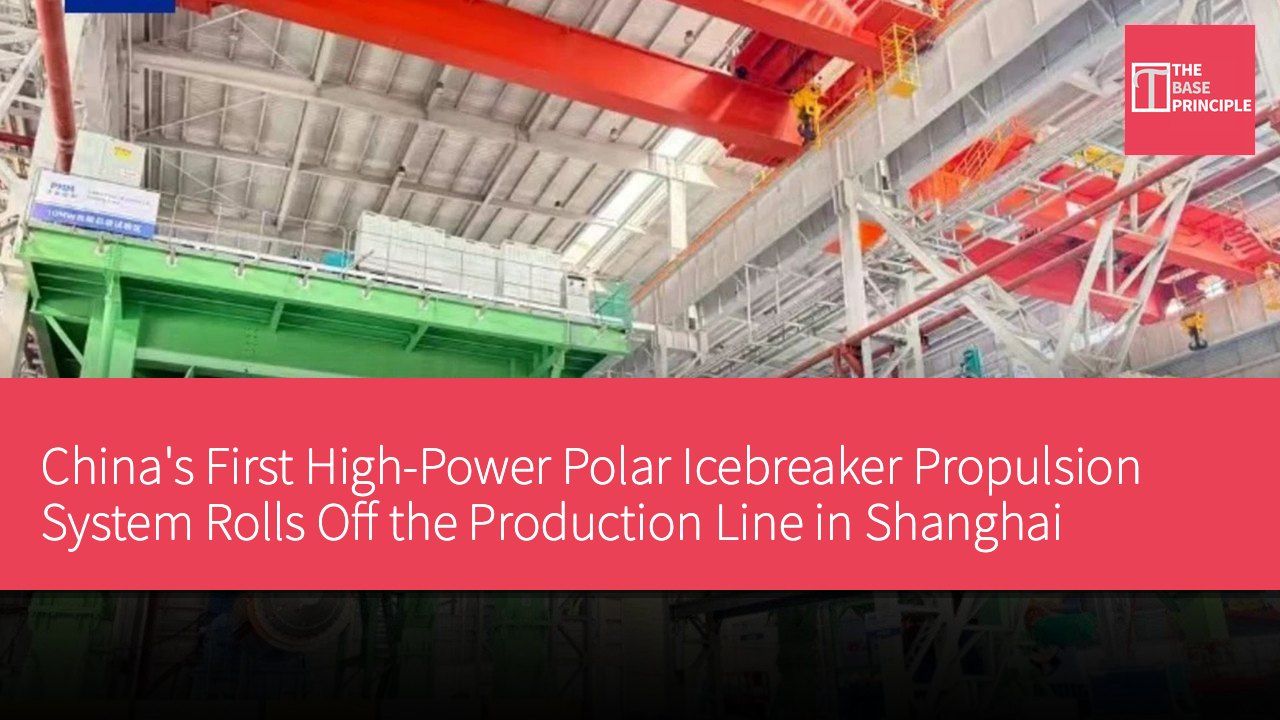
- China's first high-power suspended propulsion system has been launched in Shanghai, with a power output of 10 megawatts.
- The propulsion system can break through ice thicknesses of up to 2.1 meters and features an all-electric design.
- Powermaster Marine becomes the second global supplier of such equipment.
- This project marks a significant technological advancement for China's high-end shipbuilding industry.
China's first domestically developed high-power suspended propulsion system was launched in Shanghai on Tuesday, marking a significant step in the country's efforts to replace imported propulsion equipment in specialized fields. Developed by Powermaster Marine, the system has a power output of 10 megawatts and has completed full-scale testing in China before being scheduled for transport to a European shipyard. According to reports from China Central Television (CCTV) and Shanghai Observer, its all-electric design and 360-degree rotation capability allow it to perform icebreaking operations in both forward and reverse directions.
Propulsion System Design and Performance
The suspended propulsion system for polar vessels must withstand repeated ice impacts and extremely low temperatures, necessitating high structural strength, stable power output, and long-term reliability. The new system underwent full-scale testing on a domestic 40 megawatt full-load test platform to evaluate its performance under extreme conditions. According to Shanghai Observer, the testing plan included 18 checks, with trials conducted at 150% overload and 120% overspeed.
According to Zhou Hao, Chairman and General Manager of Powermaster Marine, the propulsion system can operate at 160% of its rated torque under icebreaking conditions. He also noted that the system can break through ice thicknesses of up to 2.1 meters (nearly 7 feet), including a 20-centimeter snow cover. The system's rotating design enables it to perform icebreaking operations in any direction, supported by the equipment's all-electric propulsion system.
According to Shanghai Observer, the propulsion system is expected to arrive at a European shipyard by the end of November, with plans for installation on the vessel in February 2027, followed by onboard testing in June. Delivery preparations are anticipated to be completed between August and October, which are still scheduled milestones, as the system's onboard testing is yet to be conducted. This project follows a February 2025 order for a high-power, high-ice-class suspended propulsion system, which, according to Shanghai Observer, is China's first such order.
Breakthrough for China's High-End Shipbuilding Industry
Reports indicate that this order makes Powermaster Marine the second global supplier capable of providing such equipment, following Swiss technology group ABB. This production milestone also positions China among the few countries capable of developing high-power suspended propulsion systems for polar icebreakers. This development addresses China's long-standing reliance on overseas suppliers for such polar vessel propulsion equipment.
Wang Peng, an associate researcher at the Beijing Academy of Social Sciences, told Global Times that this achievement marks a significant step for China's high-end shipbuilding industry in overcoming technical bottlenecks. He noted that it also strengthens the domestic marine equipment supply chain, moving related industries from technical testing to practical onboard applications. He added that this could enhance China's capability to independently develop and manufacture advanced marine equipment and elevate the standards of the entire supply chain.
As China expands its polar research capabilities, the launch of this propulsion system coincides with the return of the icebreakers "Xuelong" and "Xuelong 2" to Shanghai after completing their 16th Arctic ocean expedition on September 30.
Item Specifications Power 10 megawatts Icebreaking Thickness 2.1 meters Test Platform 40 megawatt full-load test platform
Impact of the Propulsion System on China's Polar Research
The development of this high-power suspended propulsion system not only enhances China's autonomous capabilities in polar icebreaker technology but also reduces dependence on foreign suppliers. As China strengthens its polar research, the success of this technology will contribute to raising domestic marine equipment standards and driving the development of related industries. This achievement also demonstrates China's technological progress in the high-end shipbuilding sector, providing strong support for future polar exploration and research.