
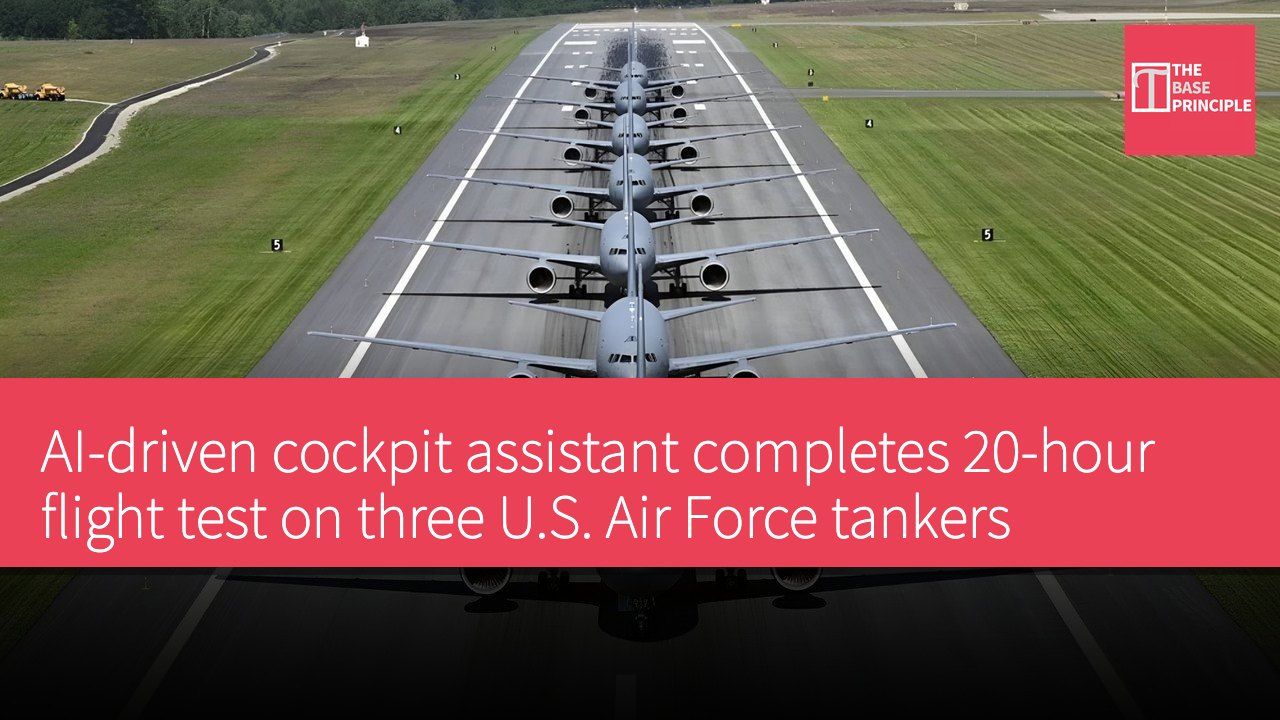
- Beacon AI's Murdock system completed approximately 20 hours of flight testing on U.S. Air Force tankers.
- Murdock is the first commercial AI flight assistant to operate on multiple aircraft.
- The system connects to a cloud data platform via satellite communication, enhancing safety and operational efficiency.
- Pilots retain control and responsibility for operational decisions, with Murdock providing suggestions rather than control.
An AI-driven cockpit assistant has completed five flights on three U.S. Air Force tankers, testing how the software supports pilots without controlling the aircraft. Beacon AI's Murdock system logged approximately 20 hours of flight time on KC-46A Pegasus tankers in August and September 2026. These demonstration activities were conducted under the Air Force's AFWERX Tactical Funding Increase (TACFI) agreement in collaboration with the Air Mobility Command (AMC).
The flight activities began at Eglin Air Force Base in Florida during the Emerald Flag phase, followed by operations in two other airspaces, including a civilian airport. Beacon stated that Murdock is the first commercial AI flight assistant to operate on multiple aircraft. Its approach focuses on processing flight data and providing suggestions through an onboard interface.
Technical Architecture of the Murdock System
Murdock's technology combines onboard computing hardware with an interface directed at crew members. It reads data from certified avionics buses, providing pilots with advisory information while recording flight data for analysis. The system also connects to Beacon's cloud data platform, Lighthouse, via satellite communication. Lighthouse processes information collected during multiple flights, helping Beacon develop software capabilities aimed at enhancing safety and operational efficiency. This architecture allows the company to develop the cockpit assistant without replacing existing avionics or modifying certified flight-critical systems.
Pilots retain control and responsibility for operational decisions. Beacon classifies the capabilities demonstrated as Level 2 assistance within its proprietary framework. The software provides suggestions to the crew, but the final decision on how to respond rests with humans.
Long-term Development and Fleet Learning
CEO Matt Cox stated that these flights demonstrated how the technology can provide tangible benefits to aircrew. He added that as operational experience and supporting evidence accumulate, Beacon plans to expand its capabilities. The flights on operational tankers have provided Beacon with real-world data from different aircraft and operational environments. These flights covered multiple airspaces and procedures, offering a broader range of conditions than a single aircraft demonstration. Beacon refers to its long-term approach as "fleet learning." This concept leverages accumulated flight data to refine software capabilities for participating aircraft, potentially helping operators benefit from improvements developed through shared operational experiences.
AFWERX supports the project through its TACFI program, which aids in advancing the operational application of technology. The agreement was signed following a Phase II Small Business Innovation Research contract with the U.S. Special Operations Command. This effort also reflects the Department of Defense's increasing emphasis on software that improves cockpit awareness without stripping pilots of control. The House Armed Services Committee mentioned consulting flight assistance systems in its report on the Fiscal Year 2027 National Defense Authorization Act. Legislators directed the Secretary of Defense to brief the committee on plans to evaluate and adopt these technologies by February 1, 2027.
The KC-46 may provide Beacon with a pathway to commercial aviation. The tanker is derived from Boeing's 767 platform and has recorded 1,361 deliveries since 1982. However, military demonstrations do not establish readiness or regulatory approval for commercial aircraft. Any expansion will require further development, testing, and validation. Beacon's near-term goal is to extend Murdock's support to more flight phases. Planned features include assistance with mission scheduling and post-flight debriefings. A broader engineering challenge is to make cockpit software more practical through repeated operational testing.
Its success will depend on whether data-driven improvements can alleviate crew workload and support safer decision-making without disrupting established flight procedures.
Future Challenges and Opportunities for AI Flight Assistants
The successful testing of the Murdock system demonstrates the potential of AI technology in aviation, particularly in enhancing flight safety and efficiency. As data accumulates, Beacon AI plans to further expand its capabilities, which is crucial for future commercial aviation applications. However, the promotion of the technology still needs to overcome regulatory and practicality challenges, especially in ensuring pilot control while effectively reducing their workload. These factors will influence the widespread adoption of AI flight assistants and their long-term development in the aviation industry.