
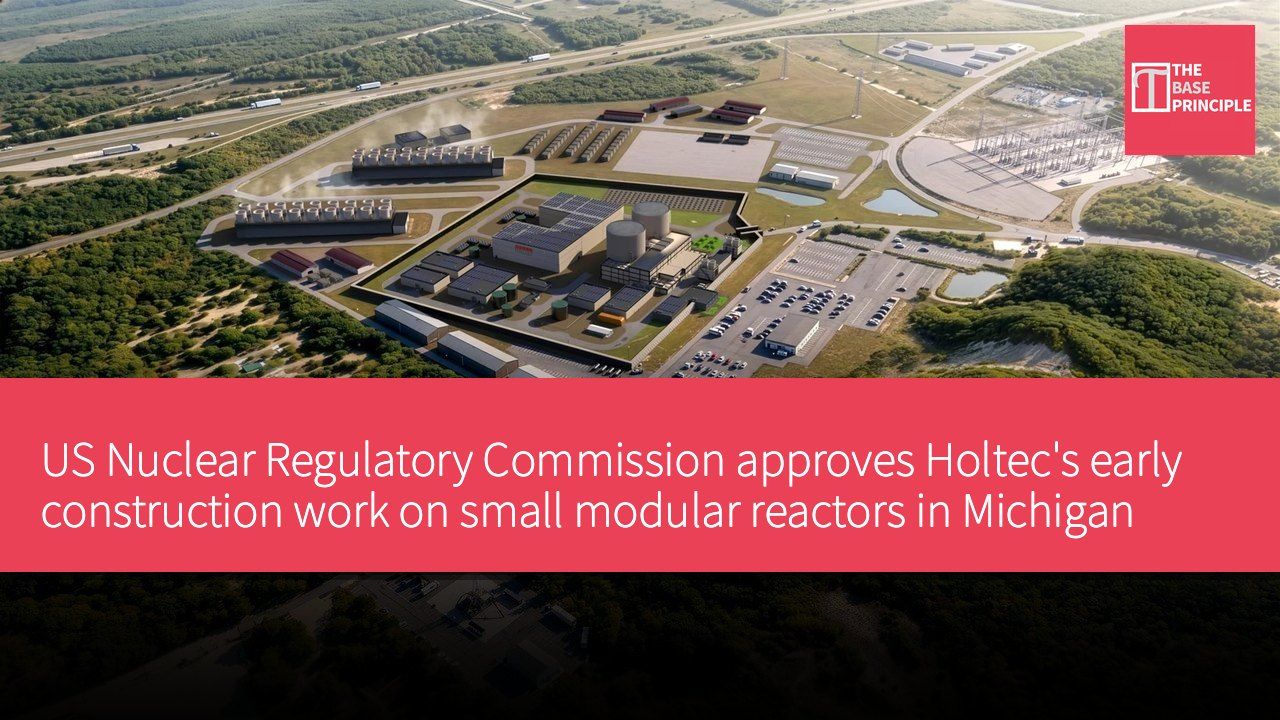
- The NRC has approved Holtec to carry out early construction work on small modular reactors in Michigan.
- The two reactors are planned to provide a combined 680 megawatts of power.
- The NRC has determined that the authorized activities will not cause significant environmental impact.
- Holtec still requires further regulatory approval before full construction can proceed.
The U.S. Nuclear Regulatory Commission (NRC) has approved clean energy company Holtec to proceed with early construction work on two small modular reactors planned for the Palisades Energy Center in Michigan, including excavation and site preparation, ahead of the issuance of a limited work authorization. The NRC granted the exemption on August 28, 2026, allowing Holtec to install permanent support excavation and cut-off wall systems for Pioneer Units 1 and 2. The approval covers work needed to stabilize the site and prepare it for the reactors and associated facilities.
Overview of Reactor Power Capacity
The two reactors are planned to provide a combined 680 megawatts of power and form part of Holtec's effort to deploy its SMR-300 advanced small modular reactor at the Palisades site, where the company is also working to restart the existing nuclear plant. The newly approved work will include excavation, drainage and ground improvement for the nuclear island, turbine island and plant structures.
These walls will help keep the surrounding soil stable, control the flow of groundwater, and protect nearby structures and utilities during construction. The support system will use diaphragm walls, soldier pile and tremie concrete (SPTC) walls, and a perimeter cut-off wall. Depending on site conditions, tiebacks or internal bracing may be used to provide additional support. Holtec plans to retain the support excavation walls after construction rather than remove them. The space between the walls and permanent structures will be backfilled to ground level. The NRC's decision was based on an environmental assessment issued on August 25, in which the agency concluded that the authorized activities would not cause significant impact to the human environment or historic properties, and that the exemption did not require a separate environmental impact statement.
Scope and Limits of the NRC Approval
The NRC also determined that the exemption complies with federal regulations, including provisions covering public health and safety, national security, and special circumstances. However, the approval does not constitute a construction permit, and Holtec still requires further regulatory approval before full construction of the nuclear units can proceed. The early excavation work is intended to establish the stable foundational conditions needed for subsequent plant construction. Holtec will also carry out geological mapping and collect data during the excavation. The company must notify the NRC when the excavation is open for inspection, and information gathered from the exposed geology will be incorporated into analyses used to evaluate how the structures interact with the surrounding land.
The NRC's exemption allows Holtec to advance these activities while its broader application moves through the regulatory process. The company submitted the exemption request on December 31, 2025 as the first phase of its staged construction permit application. Holtec is developing the Pioneer units around its SMR-300 reactor, which uses passive safety systems designed to respond to abnormal conditions without relying on active operator intervention. The company expects the first two SMR-300 units to be deployed at the Palisades site.
It is also pursuing the restart of the existing Palisades nuclear plant, which would make the site a combination of existing and new nuclear power generation. For now, the latest NRC decision paves the way for site preparation but does not involve reactor construction or operation. The exemption gives Holtec permission to establish the underground excavation and foundational conditions needed for the project's next phase.
Outlook for Small Modular Reactors
Small modular reactors (SMRs) are valued for their flexibility and safety, and Holtec's plans demonstrate the potential of nuclear power in the clean energy transition. The NRC's approval, while not equivalent to a full construction permit, clears the way for Holtec to move forward. As global demand to reduce carbon emissions increases, the role of nuclear power may be reassessed, particularly with regard to the restart of existing nuclear plants and the construction of new reactors. These developments can enhance not only energy security but also regional economic growth.