
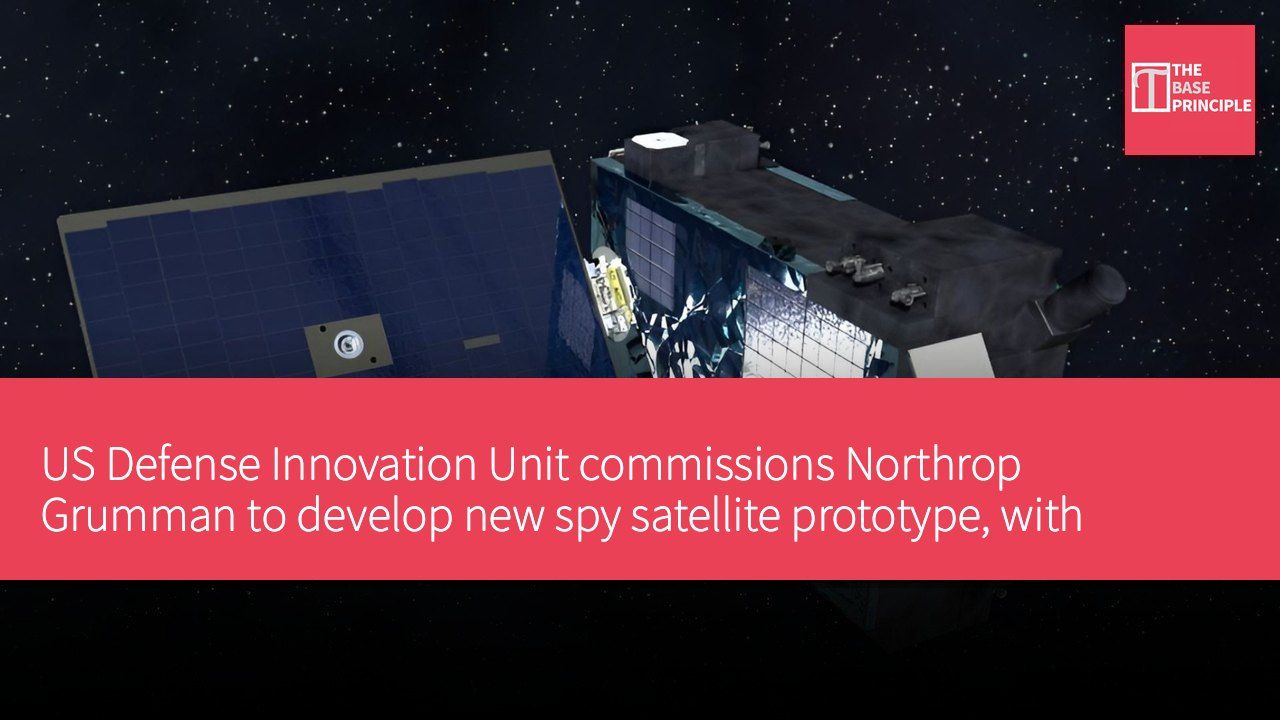
- Northrop Grumman has won a US Space Force contract to develop a new spy satellite prototype.
- The GHOST-R program is designed to deliver faster, more cost-effective surveillance capability.
- The satellite will support multiple space domain awareness missions, including object characterization and damage assessment.
- The prototype is to be completed within 24 months, reflecting an emphasis on commercially derived spacecraft.
Northrop Grumman has won a US Space Force contract to develop a new geostationary-orbit reconnaissance satellite. The spacecraft will serve as the prototype for the Defense Innovation Unit's GHOST-R program, which is intended to deliver faster and more cost-effective surveillance capability for the most important regions around Earth. Northrop will use its ESPASat-L spacecraft bus for the mission. TRL-11, based in Irvine, California, will provide the satellite's optical payload. The suitcase-sized ESPASat-L spy satellite gives Northrop a compact platform capable of carrying dedicated mission hardware into space.
The spacecraft is roughly the size of a small suitcase and is compatible with Northrop's ESPAStar shared vehicle architecture. Its modular design allows different payloads to support different missions.
For GHOST-R, optical equipment will give the satellite its primary observation capability. Northrop will then assemble, integrate and test the complete spacecraft. These activities will take place at facilities in Dulles, Virginia, and Gilbert, Arizona. The finished spacecraft will ultimately be handed over to the Space Force for operations. GHOST-R will target resident space objects in geostationary orbit, an area where satellites can support military communications and other critical national security functions.
Main capabilities of the GHOST-R program
Northrop faces an accelerated 24-month prototype timeline that covers spacecraft production, payload integration, testing and delivery. The schedule reflects growing interest in commercially derived spacecraft for national security missions. Existing platforms can provide a foundation, eliminating the need to start each mission with a fresh satellite design. Ryan Tintner, vice president and general manager of space superiority at Northrop Grumman, pointed to increasing activity in the geostationary belt. "Space is becoming more crowded and contested every day," Tintner said.
He noted that faster deployment could improve the military's ability to understand activity around critical spacecraft.
An accelerated prototype schedule
GHOST-R also falls under DIU's "Kill Web" program, which explores space architectures that combine sensing, artificial intelligence and targeting technologies. This link will allow future systems to process on-orbit observation data more quickly and aligns with the military's push for commercially sourced technology that can reach operational use faster.
GHOST-R will support multiple space domain awareness missions, with planned tasks including characterizing resident space objects and identifying spacecraft. The satellite will also support battle damage assessment, a capability that can help determine the condition of a spacecraft after an attack or other damaging event. Northrop's prototype will augment the existing US space surveillance system. The Space Force plans to operate commercial spacecraft alongside government-owned satellites in a hybrid architecture, an expanded approach that also distributes surveillance functions across more spacecraft, preventing the loss of overall capability if a single satellite is lost.
Northrop already has experience supporting US surveillance missions in geostationary orbit, with its GSSAP spacecraft monitoring satellite activity in that region. GHOST-R takes a different path to enhance surveillance capability, combining a compact spacecraft bus, commercially supplied optical hardware and an accelerated development schedule. The current goal is clear: deliver an operational prototype within two years. If successful, the program will give the Space Force another way to expand its ability to observe activity in geostationary orbit.
Impact of the GHOST-R program on space surveillance
The launch of the GHOST-R program highlights the US strategic need for space surveillance, particularly against the backdrop of growing activity in geostationary orbit. Through the integration of commercial technology, the program can not only improve surveillance capability but also accelerate deployment, enabling the military to better understand changes in the space environment. This trend reflects the Department of Defense's demand for new technology and underscores the importance of commercial spacecraft in national security missions, with more similar programs likely to follow in the future.