
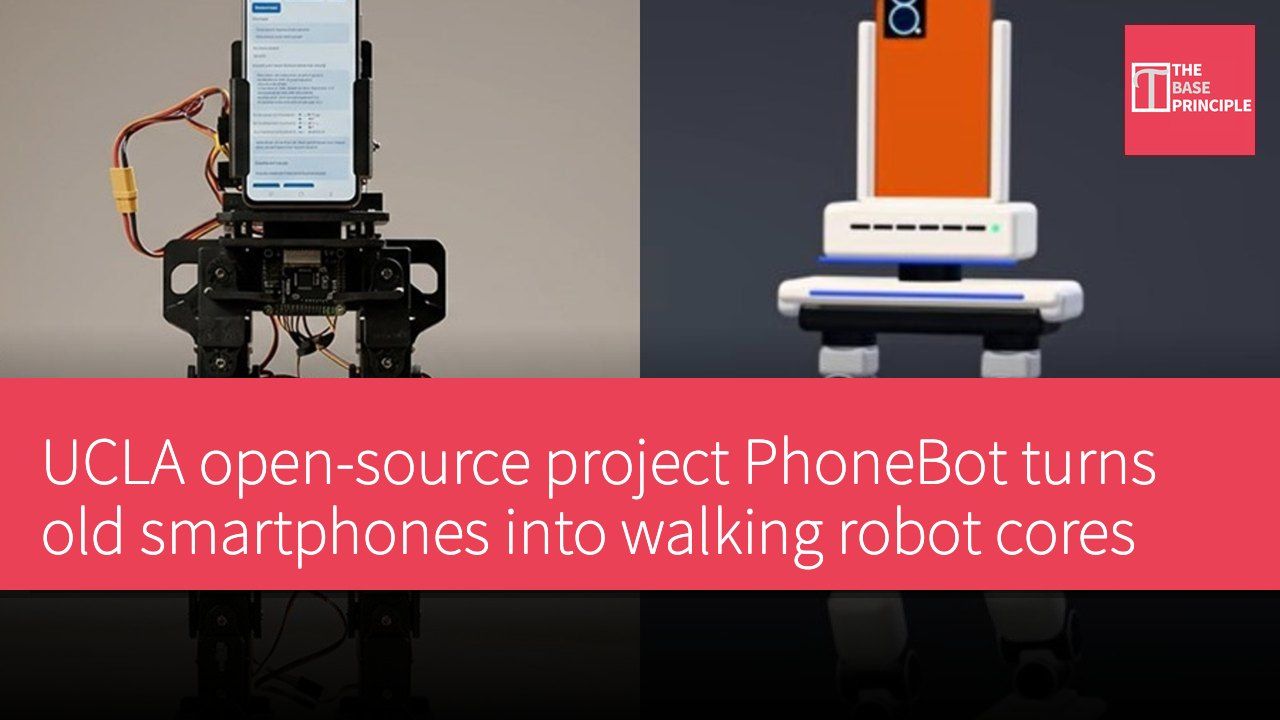
- PhoneBot turns old Android phones into walking robots.
- The robot uses low-cost DYNAMIXEL servo motors for motion control.
- The walking controller trains a neural network through reinforcement learning to improve walking efficiency.
- It currently lacks arms and is still improving its ability to walk on uneven terrain.
A robot project called PhoneBot is harnessing the potential of old Android phones to give them a second life. Developed by the Robotics and Mechanisms Laboratory at the University of California, Los Angeles (UCLA), this open-source project sees PhoneBot stand about 19 inches tall and weigh under 4 pounds. Researchers use an ordinary smartphone as its torso, leveraging the phone's camera, motion sensors, processor, and wireless connectivity for vision, balance sensing, and motion computation.
The entire robot's body, motors, and supporting electronics cost about US$400 (approx. HK$3,120), with the phone becoming the main variable. To simplify electronics design, no rewiring is needed when swapping phones. PhoneBot uses 13 low-cost DYNAMIXEL servo motors: six per leg, with joints including hip, knee, and ankle, plus one motor that can rotate the upper body. This torso joint lets the phone's camera scan left and right while the feet remain stable, facilitating personnel tracking.
Reinforcement learning training for the walking controller
A small computer in the lower body receives commands from the phone via Wi-Fi and converts them into motor positions, so the phone does not need a hardware connection. The team tested four Android devices, including a 2017 Honor 9 and two budget models priced between US$50 (approx. HK$390) and US$80 (approx. HK$624). All four devices could perform core tasks such as walking control, motion detection, and basic vision. The older Honor 9 lacked the Google services required for map navigation.
The walking controller is a neural network trained entirely in simulation through reinforcement learning. The virtual robot was rewarded for staying upright, alternating feet, and maintaining speed, and penalized for high torque, hard braking, and single-leg weight bearing. Because real motors have limited force and speed, these constraints were incorporated into the simulation. Early results were uneven, often with one leg bearing more load. Adding mirrored samples to swap left and right foot training produced more even strides, reduced variation between runs, and improved load distribution.
PhoneBot's limitations and future outlook
The physical robot can walk on flat ground at speeds up to half a meter per second (about 1.6 feet per second) and can stand back up after falling. The Android app makes decisions in real time, with TensorFlow Lite running the walking and recovery routines at about 50 times per second, using the phone's built-in sensors. The camera can track people and their positions, and on supported phones, visual mapping can be performed for remote conferencing and photography. Currently, speech recognition and language processing still run on a nearby laptop, but as models improve, the team may move these functions to the phone.
Currently, PhoneBot lacks arms, so it cannot pick up or carry objects. It has only been tested on flat ground; stairs, slopes, and uneven surfaces remain works in progress. Limited motor torque also restricts the weight it can carry and its movement speed. The hardware and software are fully open for use by interested students, research labs, and hobbyists, without the need to pay for expensive dedicated equipment or sensors.
The potential of open-source robotics technology
The PhoneBot project demonstrates how the capabilities of old smartphones can be leveraged to bring innovation to robotics. Through its open-source approach, the project not only lowers costs but also encourages students and researchers to participate in robot development. As technology advances, more application scenarios may emerge, particularly in remote conferencing and automated tasks. Such development not only aids resource reuse but also drives the popularization of robotics technology.