
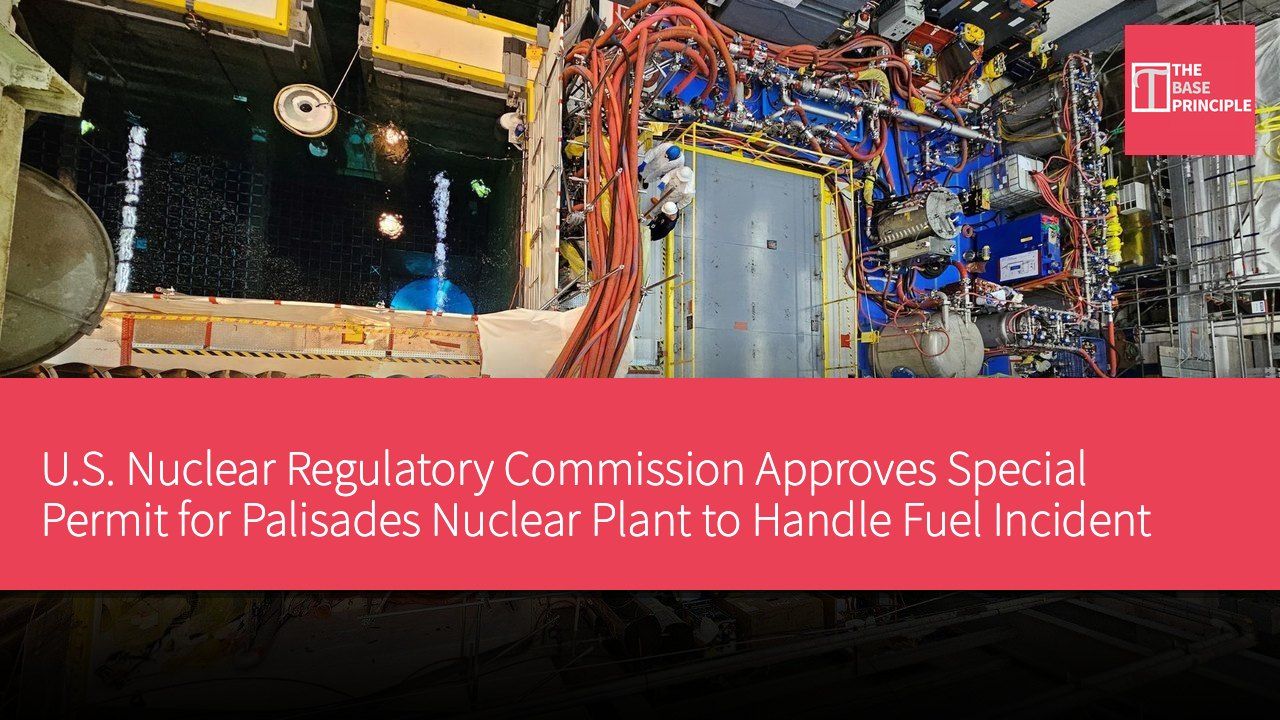
- Palisades Nuclear Plant has received special permission to handle a fuel incident.
- The incident caused a nuclear fuel assembly to tilt by up to 30 degrees, affecting normal operations.
- Holtec will use specialized equipment to move the fuel assembly and has received approval.
- The Nuclear Regulatory Commission believes the risks are within federal limits, allowing the request.
The Holtec Palisades Nuclear Plant, located near South Haven, Michigan, is set to historically restart operations, but it will also be remembered for another reason. The U.S. Nuclear Regulatory Commission has granted the plant a one-time permit amendment to use specialized equipment to handle a fuel assembly due to an incident on August 30 that caused the assembly to tilt by 30 degrees. The Palisades Nuclear Plant covers 432 acres and features a pressurized water reactor with a power output of up to 725 megawatts.
The plant, operated by Entergy, was shut down in 2022 and sold to Holtec for decommissioning and removal of radioactive waste. However, shortly after the acquisition, Holtec secured financial support to restart operations and successfully obtained a power purchase agreement to facilitate the restart plan. Fuel loading for the reactor began in early August, marking a significant milestone in the restart process.
However, for several weeks, the company did not disclose any information regarding the incident, which hindered the completion of the fuel loading. Why does Palisades need a waiver? During routine refueling operations, fuel assemblies are moved through an underwater transfer pipeline connecting the reactor cavity to the spent fuel pool. However, during the refueling operation at Palisades, one nuclear fuel assembly tilted from its upright position within the reactor vessel and remained at a 30-degree angle, with its bottom supported by the reactor core and the top resting against the core's shell. Although the cladding of the fuel rods and the reactor vessel remains intact, the assembly framework was affected by the damage, hindering the team's ability to lift it using standard equipment.
Holtec's Moving Plan
Holtec plans to use specially designed moving equipment to relocate the fuel assembly and utilize the facility's polar crane to lift the assembly from its tilted position and then move it onto a custom fuel transfer container placed within the reactor cavity. To this end, Palisades applied for a one-time waiver from the U.S. Nuclear Regulatory Commission, which has been approved, and Holtec must complete the work within 10 days.
The U.S. Nuclear Regulatory Commission describes this process as an "innovative fuel movement procedure," with workers planning to lift a 49,000-pound loading container from water that provides radiation shielding. Once drained, workers will move the container through an opening in the containment building to the existing rail system in the auxiliary building. Here, another crane will vertically rotate and lower the container into the spent fuel pool. The uniqueness of this operation lies in the fact that the fuel assembly will remain in the water for a period, and while shielded, it will not be completely sealed, posing a contamination risk if the fuel rods were to rupture.
Nuclear Regulatory Commission's Risk Assessment
After reviewing Holtec's calculations regarding the potential risks to workers from the incident, the Nuclear Regulatory Commission believes that exposure remains within federal limits, thus allowing the request in an emergency situation, as the fuel loading work has been stalled. An engineer who previously worked at Palisades questioned whether the Nuclear Regulatory Commission needed to make such a waiver to facilitate a faster restart of the facility. Holtec, however, stated that the entire operation will be conducted under surveillance, and if the footage shows a gap of more than two inches between the assembly and the container support, workers will stop and reassess their steps.
Challenges and Responses in the Nuclear Plant Restart Process
The special permit for the Palisades Nuclear Plant demonstrates the delicate balance between safety and efficiency in the nuclear industry. The tilt of the fuel assembly caused by the incident not only impacts the restart plan but also raises concerns about operational safety. Holtec's response, using specially designed equipment to handle the fuel, reflects how operational processes can be flexibly adjusted to ensure safety in the face of unexpected situations. The approval from the Nuclear Regulatory Commission highlights how decisions are made between risk assessment and facility restart in emergency situations, providing guidance for handling similar situations in the future.