
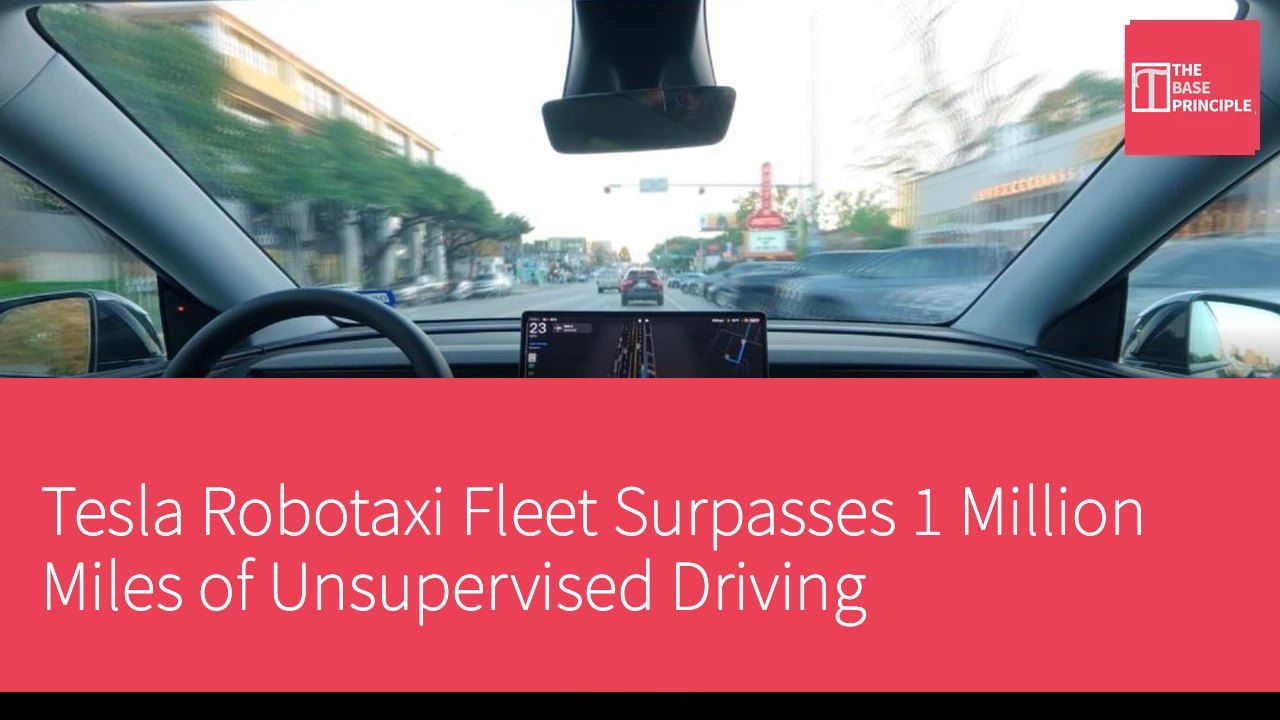
Tesla has reached a significant milestone in its autonomous driving program, with its Robotaxi fleet surpassing one million miles of unsupervised driving. The company announced the news at its Cybercab event in Austin on September 3, 2026. Tesla's AI Vice President, Ashok Elluswamy, told attendees he was pleased to report that the fleet had achieved one million miles of unsupervised Robotaxi driving, demonstrating its safety. This new total represents a significant increase from the 380,000 miles of unsupervised driving disclosed in the Q2 earnings update in late July 2026.
In roughly six weeks, the company added approximately 620,000 miles. This accelerated growth is attributed to Tesla's decision to remove in-car safety supervisors from most of its operations outside the San Francisco Bay Area.
| City | Unsupervised Driving Miles (miles) | Unsupervised Driving Miles (HKD) |
|---|---|---|
| Austin | 1,000,000 | Approximately HK$7,800,000 |
| Dallas | Not disclosed | Not disclosed |
| Houston | Not disclosed | Not disclosed |
| Miami | Not disclosed | Not disclosed |
| Orlando | Not disclosed | Not disclosed |
| Tampa | Not disclosed | Not disclosed |
Tesla first launched its Robotaxi service in Austin in June 2025, with safety drivers onboard at the time.
Later, the company began offering fully unsupervised rides and expanded to Dallas, Houston, Miami, Orlando, and Tampa. The San Francisco Bay Area remains an exception, with in-car safety supervisors still required under California's licensing regulations. The company has not yet released a city-by-city breakdown of the one million miles of unsupervised driving. This milestone comes as Tesla begins offering public Cybercab rides in Austin. The purpose-built vehicle has no steering wheel or pedals and is designed solely for autonomous ride-hailing. Production versions of the Cybercab have joined the existing fleet of modified Tesla vehicles already operating in the service.
Tesla's unsupervised driving miles are increasing at a double-digit weekly rate, despite its fleet size still being smaller compared to more established competitors. Waymo has accumulated over 200 million miles of fully autonomous, passenger-only miles. Tesla claims that its unsupervised operations had no major incidents in the period before the July update. The one million mile figure reflects Tesla's shift from supervised testing to a broader deployment of driverless services across multiple states. It also highlights the company's strategy of using existing Model Y vehicles and the new Cybercab to expand its network.
Whether the recent rapid growth can be sustained will depend on further city expansions, regulatory approvals, and the performance of the purpose-built Cybercab in everyday paid rides. Tesla has not specified how much of the latest mileage involves the new vehicle versus other vehicles in the fleet. This announcement underscores Tesla's progress toward a larger-scale Robotaxi network while also highlighting the gap in overall autonomous driving experience compared to longer-operating rivals.
Moving Toward 24/7 Autonomous Service
Tesla AI head Ashok Elluswamy said this week that 24/7 Robotaxi service is coming soon.
In response to a passenger who wished for Cybercab rides to operate 24/7, he wrote on X that this capability would arrive "in about a month" once "the next piece of tech to be merged in v15" is ready. The comment was made on September 4, the day after Tesla opened public Cybercab rides in Austin. This is the clearest near-term timeline yet given for unsupervised overnight operations. Tesla's paid Robotaxi network currently operates seven days a week in Austin, Dallas, Houston, Miami, Orlando, and Tampa from 6 am to 10 pm.
Elluswamy did not specify which feature, nor did he indicate whether the change would first apply to the purpose-built Cybercab, the existing Model Y fleet, or both. He also did not provide a city-by-city rollout list. However, the connection to Full Self-Driving v15 remains significant. Tesla describes v15 as an architecture with seven concurrent improvement tracks, with parameters roughly ten times those of earlier versions. Early versions of the software are already running on the Robotaxi fleet and contain about 40% of the planned improvements.
By July 2026, unsupervised fleets in six cities across two states had accumulated over 380,000 miles, and the company claims its safety record is impeccable, with no major incidents caused by the vehicles themselves. Tesla has repeatedly argued that a camera-based, end-to-end neural network, rather than additional sensors, is the core solution. 24/7 service will test this claim in low-light conditions while also improving vehicle utilization, a key variable in Robotaxi unit economics. The company has started using public Supercharger stations at night and is building dedicated Robotaxi charging stations.
Passengers have asked why the software needs to change if the vehicles can already drive in the dark. The practical answer seems to be reliability and scale: Tesla has been delaying large-scale expansion until more of the v15 stack is merged, saying it needs higher confidence before putting thousands of driverless vehicles on the streets 24/7. If the timeline Elluswamy outlined comes to pass, 24/7 service could begin in at least some markets by October 2026. This would mark a shift from daytime-limited trials to a service that can operate anytime, anywhere, including the currently untouched late-night hours.
Conclusion
As Tesla continues to advance its Robotaxi network and moves toward 24/7 autonomous service, the company's position as a leader in technological innovation is further solidified. Through continuous technological advancements and strategic deployments, Tesla is not only making significant strides in the field of autonomous driving but also opening up new possibilities for future mobility. Tesla's spirit of innovation, growth potential, and positive impact on the market set it apart in the highly competitive autonomous driving landscape.