
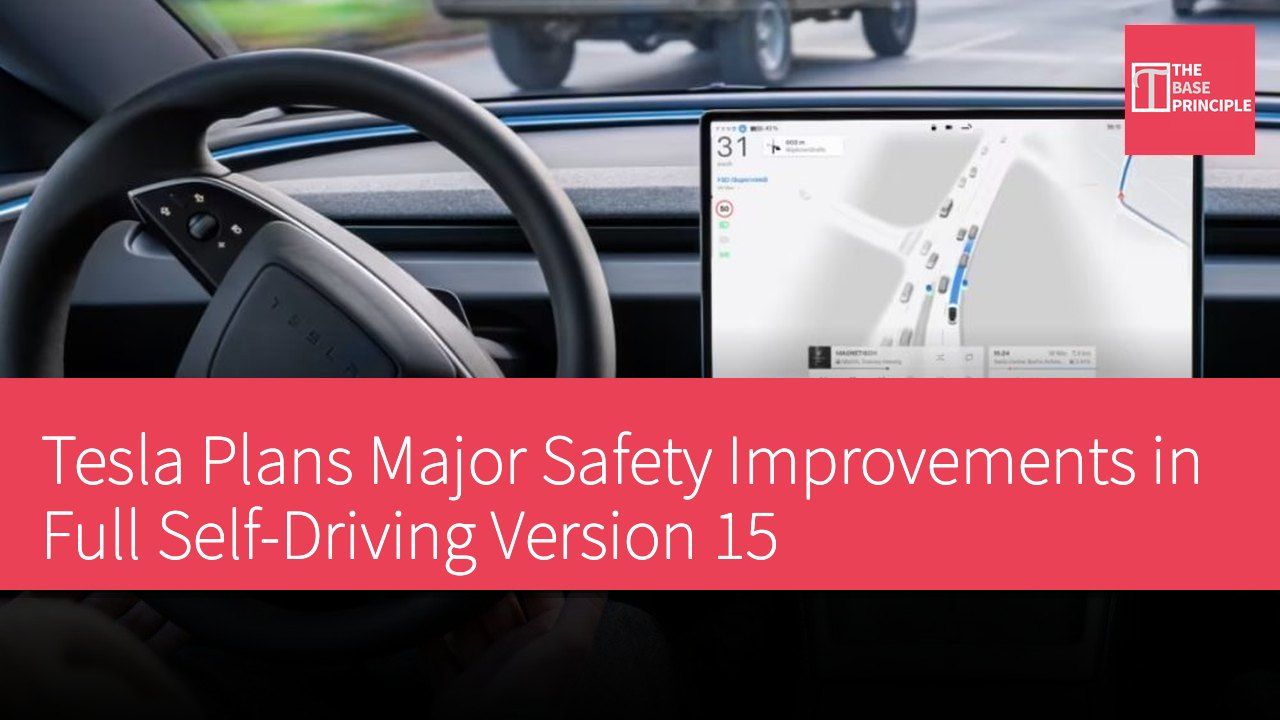
- Tesla will introduce important safety features in FSD version 15.
- Elluswamy says improvements will be made in hazard prediction and reaction time.
- v15 software is already being used in unmanned operations.
- FSD's safety significantly outperforms manual driving, reducing collision numbers.
Tesla is planning to release Full Self-Driving (FSD) version 15, which will be the company's next major FSD deployment and will include significant safety and accident-avoidance features. Ashok Elluswamy, head of Tesla's AI division, previewed what the company calls the next leap in full self-driving technology this week using an incident where a near-miss was avoided. Responding to a car owner's post about their vehicle swerving to avoid another car exiting a parking lot, Elluswamy expressed relief for the owner's safety and noted that "earlier hazard prediction, faster reaction times, and overall significantly improved safety and collision-avoidance capabilities" will come with the rollout of FSD v15.
Elluswamy tweeted: "Glad you're safe. Earlier hazard prediction, faster reaction times, and overall significantly improved safety and collision-avoidance capabilities will be part of the next major upgrade (v15)." This comment comes as Tesla continues to view software as the primary avenue for safety upgrades. The internally described v15 is seen as a larger architectural advancement, featuring larger neural networks and tighter connections between prediction and control.
Safety Features of Full Self-Driving Version 15
The company has begun using early versions of v15 software in some unmanned taxi operations while rolling out safety features like automatic collision avoidance to existing customers' vehicles, allowing the driving system to intervene even when the driver is in manual control. Tesla is launching a new FSD version with a host of safety features added.
Tesla's telemetry data is the cornerstone of its safety argument. In its recent North American Vehicle Safety Report data, vehicles operating with FSD (supervised mode) drove approximately 5.1 million to 5.7 million miles between major collisions (defined as airbag-deployment events). Tesla's estimate for the same period for the US average is about 699,000 miles per comparable collision. This is the comparison Tesla often frames, roughly a seventh of the major collision numbers. A tighter comparison uses the same Tesla fleet.
FSD Safety Data
Manually driven vehicles with active safety features like automatic emergency braking still record a major collision once every 2.1 million miles. Relative to this benchmark, FSD's advantage shrinks to about 2.4 to 2.7 times fewer severe collisions, a comparison that independent researchers consider more accurate.
Data released in Europe in 2026 also points in the same direction: Tesla reports that in the Netherlands, FSD is 3.5 times safer than manual driving, and in five approved countries, it reduces collision numbers by 4.1 times compared to manually driven Teslas with active safety enabled, covering over 100 million kilometers of driving. These figures have not yet resolved all controversies. The National Highway Traffic Safety Administration's (NHTSA) standing general order still shows that Tesla dominates US Level 2 driving assistance collision reports, partly because its fleet's assisted mileage far exceeds that of competitors.
Critics also point out that Tesla's "US average" mixes collision definitions and driving modes. Even so, Tesla's same-fleet comparisons, along with lower rates of automatic emergency braking and harsh maneuvers when FSD is enabled, are the evidence Elluswamy cites to claim that v15 will further advance prediction and collision-avoidance technology. This claim is not to suggest that the software has eliminated risk, but rather that each major version aims to widen the gap between the system and unassisted human drivers.
Tesla FSD Technology's Progress and Challenges
Tesla continues to advance in the development of full self-driving technology, particularly with the upcoming v15 version, which promises higher safety and collision-avoidance capabilities. Although data shows that FSD is safer than manual driving, critics remain concerned about the interpretation and definition of the data. This reflects the challenges of transparency and trust that come with the advancement of autonomous driving technology. Tesla must address external skepticism while promoting its technology to ensure consumer confidence and market acceptance.