
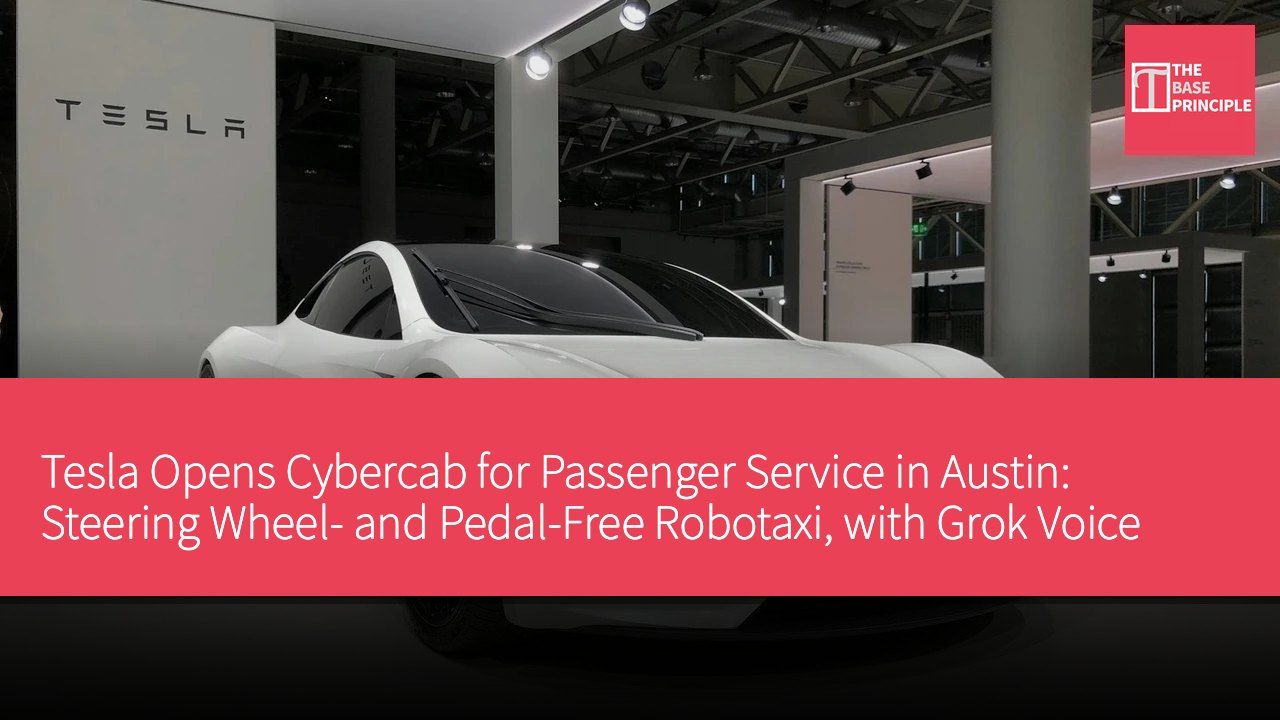
Tesla hosted a Cybercab launch event in Austin, Texas, and has since begun offering rides in a limited area through its Robotaxi service. The Cybercab is a two-seat electric vehicle designed specifically for autonomous driving, featuring no steering wheel or pedals, and relies on Tesla Full Self-Driving (FSD) software for operation. The cabin experience emphasizes control via xAI's Grok voice assistant.
Cybercab: A Robotaxi Without Manual Controls
According to public reports, the official Cybercab launch event took place in Austin on September 3, 2026. Subsequently, Tesla announced it would offer rides in "limited areas of Austin" and that bookings could be made through the existing Robotaxi app. Key product features include:
- Two-seat design with no steering wheel, pedals, or side mirrors
- FSD fleet software as the core of autonomous driving
- Cabin interface dominated by a large touchscreen (for navigation, doors, seats, etc.)
- Key features highlighted include entertainment connectivity (e.g., streaming, gaming) and upcoming/planned Starlink connectivity
The U.S. road safety regulator has also stated it will assess the related autonomous driving passenger service arrangements. Public rides are still limited to specific areas and do not equate to a nationwide rollout.
Grok Onboard: Voice-Controlled Cabin
Tesla's Robotaxi official account later emphasized that passengers can "Talk to Grok to control your Cybercab." Public demonstrations and reports indicate that passengers can use natural language to control air conditioning, YouTube/music, and more, reducing reliance on touch controls. Some reports also mention the ability to initiate commands hands-free with "Hey Grok." This experience extends Grok's role in Tesla vehicles following the 2026 Summer Update—from a chat assistant to actual cabin control.
| Item | Public Statement |
|---|---|
| Wake-up | "Hey Grok" hands-free/App button (depending on software version) |
| What it can do | Climate, calls, music/streaming, some cabin settings, etc. |
| Hardware requirement (production cars) | Reports indicate AMD Ryzen vehicle computer needed; older Intel vehicle computers may not be supported |
| Cybercab current status | Austin-limited passenger service; whether the voice stack is available in every public vehicle has not been officially confirmed for each vehicle |
Additionally, community testing indicates that the success rate of Grok voice commands in production Tesla vehicles is just over 60%, showing that the experience is still evolving. In terms of the roadmap, some analysts suggest that Tesla intends to make Grok a conversational "supervisory layer" for FSD (e.g., changing the destination or parking with a single sentence), but currently, this should be considered a plan rather than a fully shipped feature.
How to Understand This Launch
The Cybercab combines "no driver control interface" with "Grok cabin assistant": the former is the hardware form of autonomous driving, while the latter is the software layer for passenger-vehicle communication. For consumer technology readers, the key point is not just another electric vehicle, but that Grok is transitioning from a mobile/X platform assistant to becoming the operating interface inside a Robotaxi.