
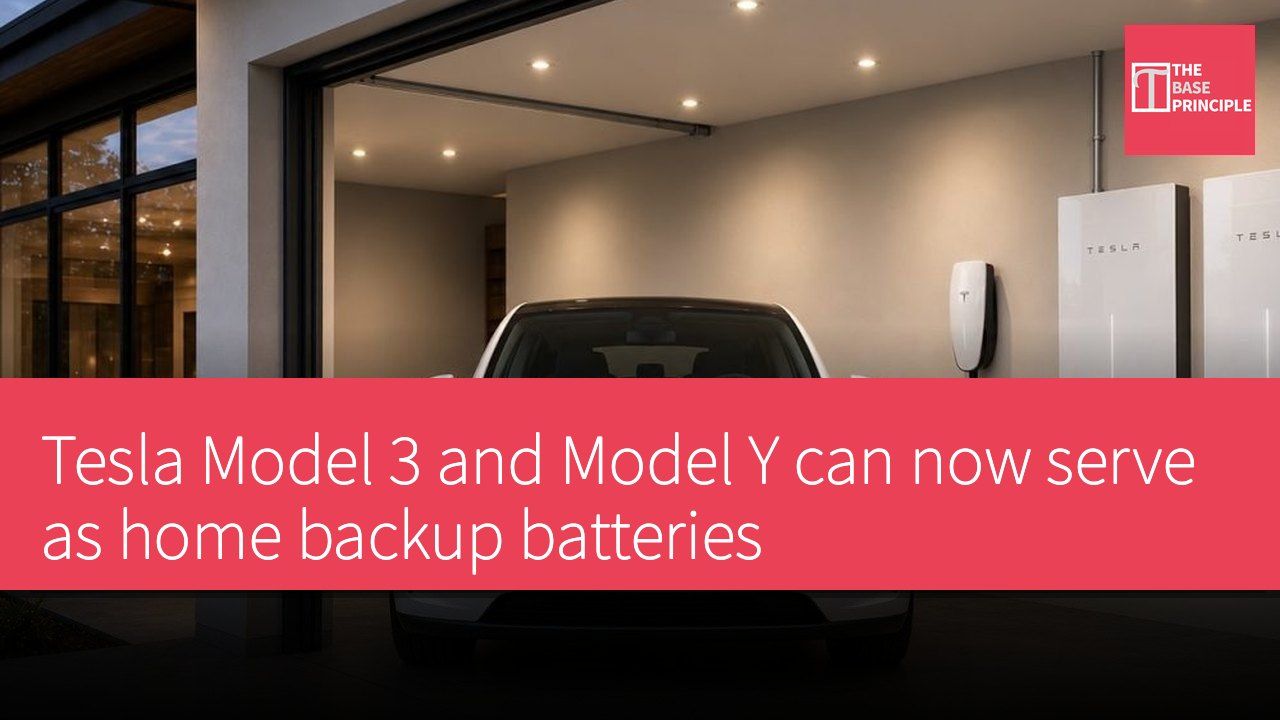
- Tesla announces Model 3 and Model Y can serve as home backup batteries.
- Previously only the Cybertruck had this capability, now expanded to other models.
- Households need no additional equipment to use Powershare functionality.
- Tesla's bidirectional charging capability is compatible with Powerwall 3.
Tesla has turned its two best-selling models into home backup batteries. Tesla Energy announced Tuesday that Powershare Home Backup is now available for the new Model 3 and Model Y vehicles paired with Powerwall 3, stating the car can "extend your home backup power for more than 2 days." Minutes later, Tesla's main account reposted the news with broader promotion: "With Powerwall 3, every Tesla can now serve as your home's backup battery."
Until this week, only the Cybertruck could power a home, and that capability only worked with Powerwall 3 as of last month, after years of ambitious targets.
Powershare Feature Details
Tesla's updated Powershare page states that every Model 3 and Model Y ordered in the U.S. or Puerto Rico starting October 1, 2026 will have access to the feature. Some earlier vehicles also qualify, but not all. Owners can check in the touchscreen's software settings, then select "Additional Vehicle Information" — eligible vehicles will display "Powershare Support: Enabled." According to Electrek, bidirectional charging on these two models runs through an inverter Tesla calls PCS2 Lite, and the company has not disclosed when that component entered production on each model.
The home side is simpler. Households that already have a Powerwall 3 and a Wall Connector 3 or Universal Wall Connector need no additional equipment; Tesla says compatibility will be enabled via a software update.
Home Power Support Capability
When the grid goes down, the Powerwall and the EV will operate together to deliver up to 11.52 kW of continuous power. Tesla's "more than two days" estimate is based on a household using 30 kWh per day and assumes the vehicle is at 90% state of charge. The standard-range model can support two days, while the Cybertruck can provide more than three days of power. Notably, support for Powerwall 2 and Powerwall+ is listed as "coming soon."
The Model S and Model X are not included, and the Grid Support program that allows Cybertruck owners in Texas to send power back to the grid during peak demand for bill credits is not available for the Model 3 or Model Y.
The rollout also aligns with what Elon Musk said more than three years ago. At Tesla's Investor Day in March 2023, Musk said: "I think very few people will want to use bidirectional charging unless you have a Powerwall." Tesla has now delivered that capability on its volume models. The Powerwall pairing was more difficult for the Cybertruck. Tesla told owners in December 2025 that Powershare with Powerwall functionality had been delayed to mid-2026, and chief engineer Wes Morrill explained that
two devices capable of forming a home microgrid must negotiate who leads during an outage, which involves coordination across multiple hardware generations. Once that work was completed for the Cybertruck, Tesla was able to extend it to the Model 3 and Model Y within a month.
Ford and GM have offered home backup power on their EVs for years, but both require additional inverters and backup hardware. Tesla's version relies on equipment many Powerwall 3 owners already have mounted on their walls. The Powershare feature for these two models also shipped as part of software update 2026.38.3, which simultaneously began rolling out Halloween Mode.
Impact of Tesla Expanding Home Backup Power
Tesla's conversion of the Model 3 and Model Y into home backup batteries demonstrates further development in its energy solutions. This not only enhances owners' electricity flexibility but also creates a tighter ecosystem between Tesla's electric vehicles and its energy product, Powerwall. Compared with other automakers, the move highlights Tesla's competitive advantage in the home energy market because it enables bidirectional charging without additional equipment. The feature's launch also aligns with Elon Musk's long-term vision, underscoring Tesla's continued efforts in technology integration.