
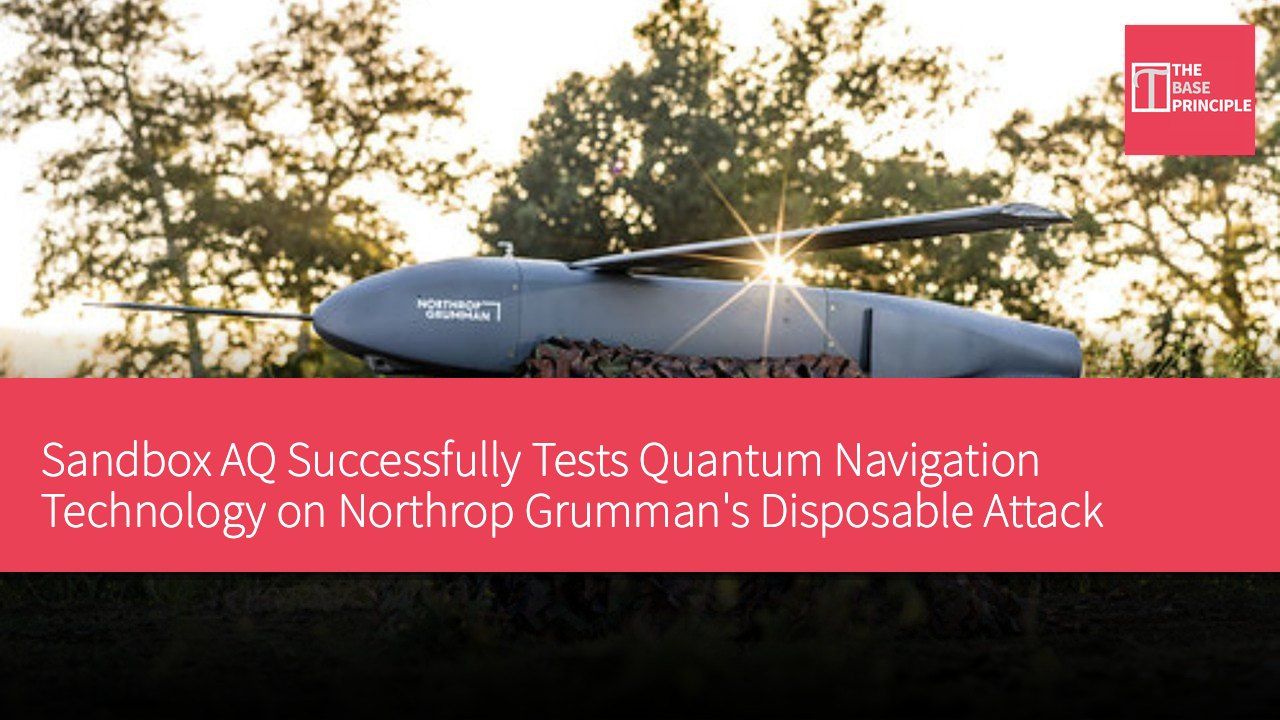
- Sandbox AQ successfully tested quantum navigation technology MagNav on a drone.
- MagNav uses quantum sensors to measure Earth's magnetic field, eliminating the need for satellite signals.
- AQNav is compatible with existing navigation systems and suitable for various aviation platforms.
- AQNav can be quickly integrated into existing systems, enhancing mission performance.
Sandbox AQ, a company focused on the intersection of artificial intelligence and quantum technology, has successfully tested its quantum sensor-based magnetic navigation technology (MagNav) on Northrop Grumman's Lumberjack unmanned aerial vehicle system. This marks the first time MagNav has been tested on a disposable drone like Lumberjack, and it was integrated with its visual navigation system. Lumberjack is a one-way attack drone developed by Northrop Grumman in just 14 months to address the growing demand for disposable drones in combat scenarios.
Navigation Needs in GPS-Denied Environments
The ongoing conflict in Ukraine and recent events in Western Asia have highlighted the utility of small, disposable aerial systems capable of operating in GPS-denied environments or under jamming conditions. Given the U.S. military's heavy reliance on the Global Positioning System (GPS) for navigation and precision strikes, jamming these signals could significantly degrade their combat effectiveness. To address this issue, the U.S. military has been working on integrating quantum-based systems into navigation technologies.
Interesting Engineering has extensively covered these attempts and their successes in both aerial and maritime environments. However, this marks the first application of this technology on a disposable drone. How does MagNav work? It uses an ultra-sensitive quantum sensor to measure local variations in Earth's magnetic field and compares this data with pre-prepared magnetic anomaly maps to determine the sensor's exact location, all without the need for satellite signals. Because this process is passive, the system cannot be spoofed or jammed, making it highly reliable.
Advantages of AQNav Technology
Sandbox AQ's MagNav technology platform, AQNav, operates in various weather conditions, is not limited by terrain, and is compatible with existing navigation systems, making it highly suitable for aviation platforms.
Max Schuster, Program Manager for Northrop Grumman's Lumberjack project, said in a press release, "Combining AQNav with Northrop Grumman's expertise in unmanned aircraft and open mission systems will ensure our joint forces have operationally proven navigation capabilities in the most contested environments." AQNav uses a software-based architecture designed to integrate with current and future defense systems. The architecture processes sensor data in a hardware-agnostic manner and applies physics-based models to determine position and provide continuous navigation.
It can also run on existing onboard computing infrastructure and supports open architecture interfaces, allowing for easy integration into various platforms.
Additionally, AQNav offers two deployment paths. One is a full-stack performance-optimized solution built natively on the platform architecture, or it can run as a standalone software solution developed specifically for existing architectures. Luca Ferrara, Sandbox AQ's Navigation General Manager, said in a press release, "Through Northrop Grumman's Lumberjack, our engineers were able to install AQNav software into the existing system in less than an hour, providing this disposable platform with the MagNav capability to enhance mission performance."
AQNav has been validated in tests with commercial aviation entities such as Airbus and Boeing, and the U.S. Air Force has tested it on C-17 Globemaster III and C-130J Super Hercules transport aircraft. Ferrara concluded, "Using our MagNav technology and expertise in drone platforms, the flight tests with Northrop Grumman further demonstrate that our AQNav software can be easily integrated into unmanned systems at the speed and scale required by leading defense organizations."
The Strategic Significance of Quantum Navigation Technology
As the importance of drones in modern warfare continues to grow, navigation technology capable of operating in GPS-denied environments is becoming increasingly critical. Sandbox AQ's MagNav technology not only improves the navigation accuracy of drones but also maintains reliability when encountering signal interference, which is crucial for military operations. The U.S. military's efforts to integrate quantum navigation systems reflect forward-thinking about future combat needs. The rapid integration capability of AQNav also provides greater flexibility and application potential for future unmanned systems.