
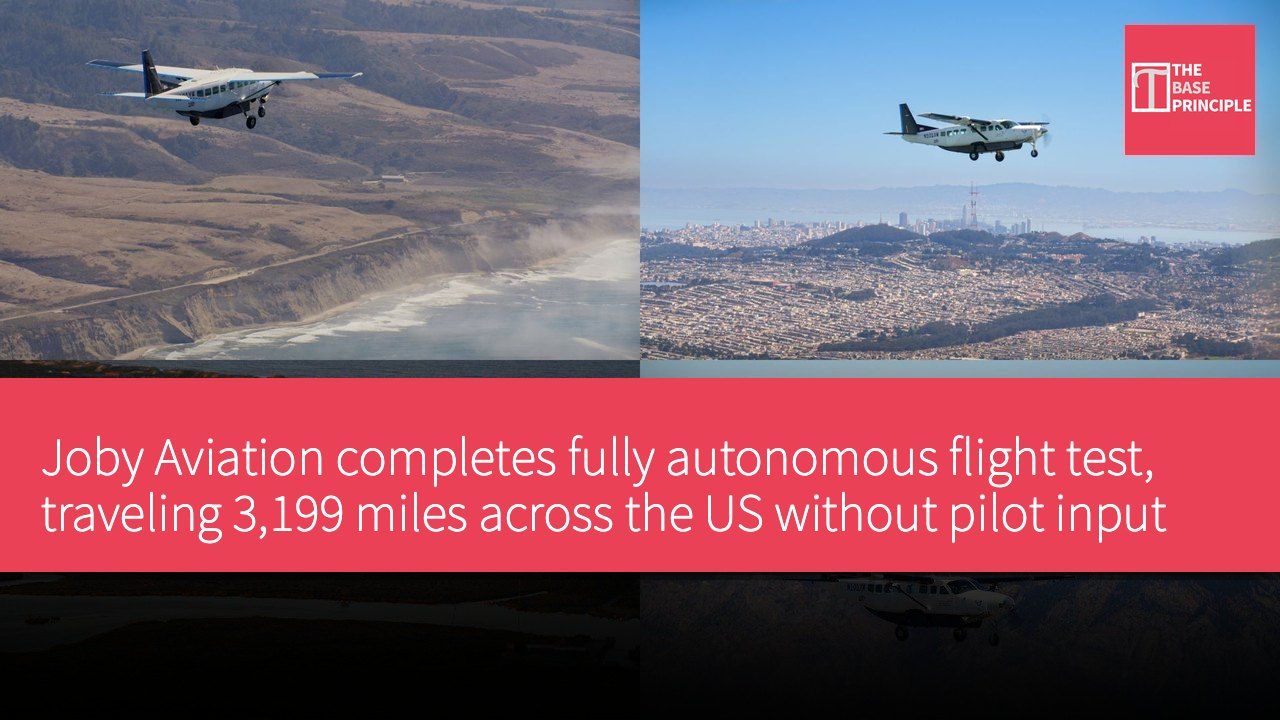
- Joby Aviation has completed an autonomous flight test spanning 3,199 miles.
- A safety pilot was on board during the flight but did not operate the control system.
- The autonomous system was able to reroute in adverse weather conditions.
- Joby's aircraft could be applied to fields such as commercial cargo and medical logistics.
Joby Aviation has completed a 3,199-mile (approximately 5,149-kilometer) autonomous flight, a major test of its aircraft control technology. The company used a modified Cessna Caravan for the journey, ultimately landing at the Outer Banks of North Carolina. Throughout the trip, a safety pilot was on board but did not operate the aircraft's control system. Joby managed the aircraft remotely from facilities in California and South Carolina. The aircraft flew autonomously during the mission's critical phases, including taxi, takeoff, navigation and landing.
Remote operators monitored the flight from up to 2,323 miles (approximately 3,735 kilometers) away. The eastward journey is part of Joby's 2026 Electric Sky Tour, and the route also gave engineers a chance to test the system across different airspaces and operating conditions.
Challenges for autonomous flight
Autonomous flight faces the challenges of real airspace, and one important test took place at Phoenix Deer Valley Airport in Arizona. This busy general aviation airport offered a more demanding environment than controlled demonstration areas. Joby also said its aircraft encountered severe weather and thunderstorms along the way. Its autonomous system was able to reroute when it had never previously visited the destination airport. This capability is critical, because autonomous aircraft must handle changing conditions beyond carefully scripted test flights. Airports, weather patterns and surrounding traffic can all shift during a mission.
The aircraft also stopped at Fort Worth Alliance Airport in Texas, where Joby demonstrated how autonomous aircraft could eventually support cargo operations at large logistics hubs. At Shaw Air Force Base in South Carolina, the aircraft took part in a demonstration focused on military operations. The company sees potential applications across multiple sectors, including commercial cargo, emergency response and defense logistics.
Potential applications of autonomous flight
After arriving in North Carolina, the aircraft performed a low-altitude pass near the First Flight memorial at Kitty Hawk. The site holds special significance in aviation history: it is where Orville and Wilbur Wright made their first powered flight in 1903. Joby's aircraft then landed at Dare County Regional Airport. The North Carolina leg also connected autonomous flight with regional medical logistics. The mission supported the North Carolina Department of Transportation's eLIFT-NC program, which studies the transportation of medical supplies across the state. Joby says autonomous aircraft could ultimately serve communities that lack efficient access to larger transportation networks.
Smaller airports can serve as convenient launch points for point-to-point cargo missions.
Joby's autonomous flight program has now logged more than 400 flights and 800 hours of autonomous flight testing, covering both controlled and uncontrolled airspace. The company acquired its current autonomous division from Xwing in 2024. Joby has since tested the technology in several US military exercises. In one Air Force Agile Flag exercise, the system delivered replacement parts 24 hours faster than traditional logistics. Another exercise demonstrated remote operations between Hawaii and Guam, spanning nearly 4,000 miles (approximately 6,437 kilometers).
Joby founder and CEO JoeBen Bevirt said that autonomous flight can broaden access to aviation while reducing risk to pilots. The aircraft now faces another test on its westward return leg, with Joby planning stops in Raleigh, the Washington area, Louisville, Wichita, Oklahoma City, Salt Lake City and Portland.
Future outlook for autonomous technology
Joby Aviation's autonomous flight test marks a significant advance in aviation technology, demonstrating the ability of autonomous systems to adapt in complex environments. This not only expands the possibilities for aviation access, but also opens up new solutions for future commercial cargo and medical logistics. As the technology continues to develop, these autonomous aircraft could become a key to addressing transportation challenges in remote regions and play an important role in emergency response and defense logistics.