
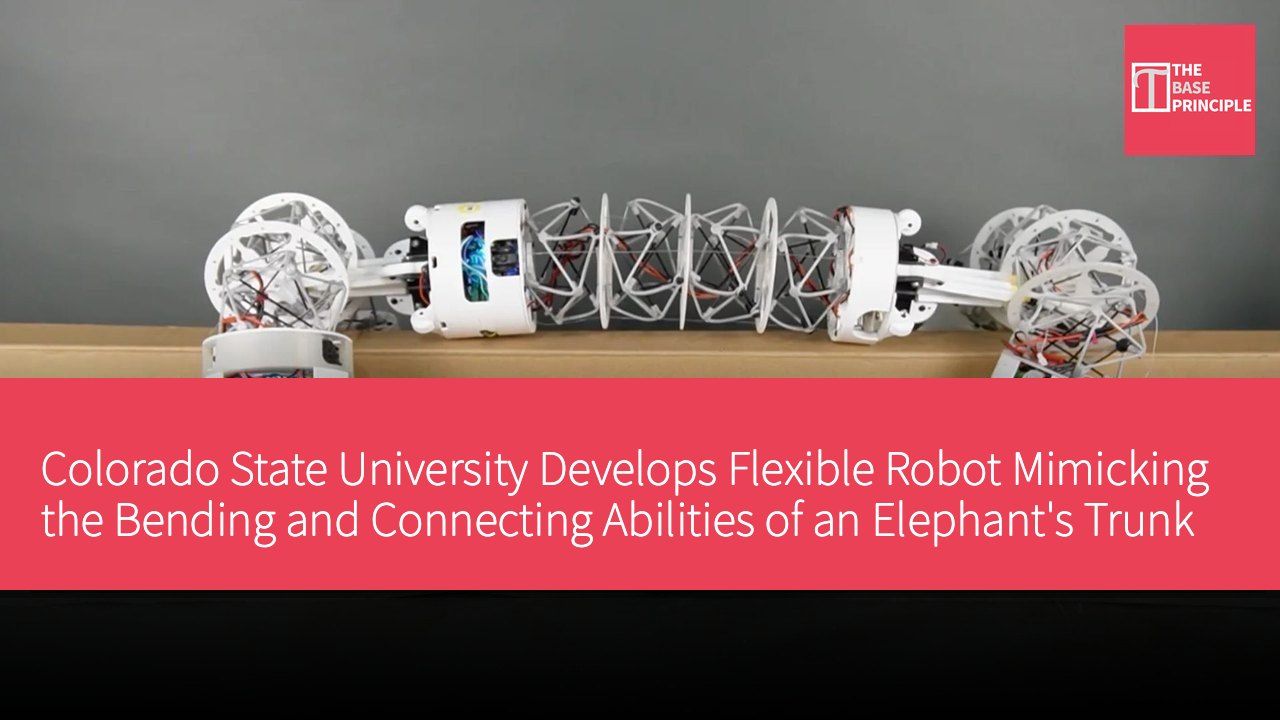
- The robots mimic the trunk of an elephant, featuring bending and grasping capabilities.
- The new design addresses the limitations of traditional modular robots.
- The robots can operate independently or be assembled into larger configurations.
- Future efforts will focus on enhancing autonomy and operational speed for various tasks.
The research team at Colorado State University has developed a flexible robot inspired by the trunk of an elephant, capable of bending, grasping objects, and connecting with other machines. These robots utilize a structural design known as tensegrity, which links rigid rods together through taut cables instead of using fixed joints. This structure allows them to fold, bend, and change shape while using grasping claws at both ends of their tubular bodies to manipulate objects or attach to other robots. This technology could ultimately enable robotic teams to support space exploration and other complex tasks.
Addressing the Limitations of Modular Robots
This system combines a flexible body with mechanical claws, allowing individual robots to operate independently or assemble into larger configurations. This technology addresses a limitation of existing modular robots, as traditional modular robots typically use rigid components, restricting their ability to adapt to different environments and tasks. The researchers aim to combine the flexibility of flexible robots with the reconfigurability of modular robotic systems. The tensegrity design used by these new robots links rigid rods together through a network of taut cables instead of being permanently fixed. This arrangement enables the robot's body to bend, stretch, fold, and change shape while maintaining structural integrity.
The jointless, tentacle-like body has claws at both ends for grasping objects and connecting with other robots. Unlike traditional robotic arms that rely on fixed joints to control movement, these tubular machines have flexible bodies that can continuously deform. They are also equipped with mechanical grasping claws at both ends, capable of grasping objects and connecting with other robots. The dual-claw design is central to the system's modular design. An individual robot can use its claws to attach, forming larger structures without relying on magnetic connections. This mechanical attachment method also helps reduce alignment issues when multiple units connect.
Once connected, these robots can form different configurations, including chains, loops, and branching structures. Each arrangement offers different movement and operational possibilities, allowing the collective to adjust its physical structure based on task requirements.
The researchers demonstrated that individual robotic units can perform operations and movements independently, while connected groups can coordinate their movements to transport objects. These machines also showcased multi-modal movement, capable of navigating diverse environments using different movement strategies. Another capability is loco-manipulation, which combines movement and object handling. These robots do not need to rely on separate mechanisms to navigate terrain and manipulate objects; instead, they can utilize their flexible bodies and grasping claws to perform both functions simultaneously. Their bending ability may also help them lift and transport loads of varying sizes.
Future Directions and Applications
The research team has tested these robots in laboratory and real-world scenarios, including natural landscapes. These experiments explored how different configurations support coordinated object handling, transport, and movement over challenging terrain. According to the team, developing this system required overcoming several engineering challenges, particularly in selecting motors. The actuators need to be compact enough to fit inside the robots while providing sufficient power and reliability to support various movements. The team also tested multiple structural configurations to determine the performance of these machines in practical trials. Although demonstrations have been conducted, these robots are not yet fully autonomous.
Currently, they still require human operators for most tasks, although researchers have demonstrated that two units can independently locate each other and establish connections.
Future development will focus on enhancing autonomy, increasing operational speed, and enabling them to collaborate with humans under less supervision. Researchers also envision deploying larger teams of robots, potentially involving dozens or hundreds of interconnected units. This robotic collective could travel to designated locations and then rearrange into configurations suitable for specific operations. Potential applications include manufacturing, space exploration, and rescue missions, where robots may need to navigate unpredictable environments, manipulate objects, and adapt to changing demands. Researchers state that by combining flexible tensegrity structures with mechanical docking mechanisms, the system offers an alternative that provides a foundation for multifunctional robotic teams capable of altering their physical arrangements and modes of movement to address different tasks, compared to robots based on fixed geometries.
Item Specifications Structural Design Tensegrity Movement Capability Multi-modal movement Grasping Method Dual-claw design
Impact of Flexible Robots on Future Missions
The development of this technology marks a significant advancement in robotic design, particularly in terms of flexibility and adaptability. Traditional robots are often limited by rigid structures, making it difficult to respond to dynamic environments and task requirements. Through tensegrity design, these new robots can move flexibly in diverse environments and perform object manipulation, thereby enhancing their potential applications in space exploration, manufacturing, and rescue missions. As autonomy and operational speed improve, these robots will be able to collaborate more effectively to tackle complex challenges.