
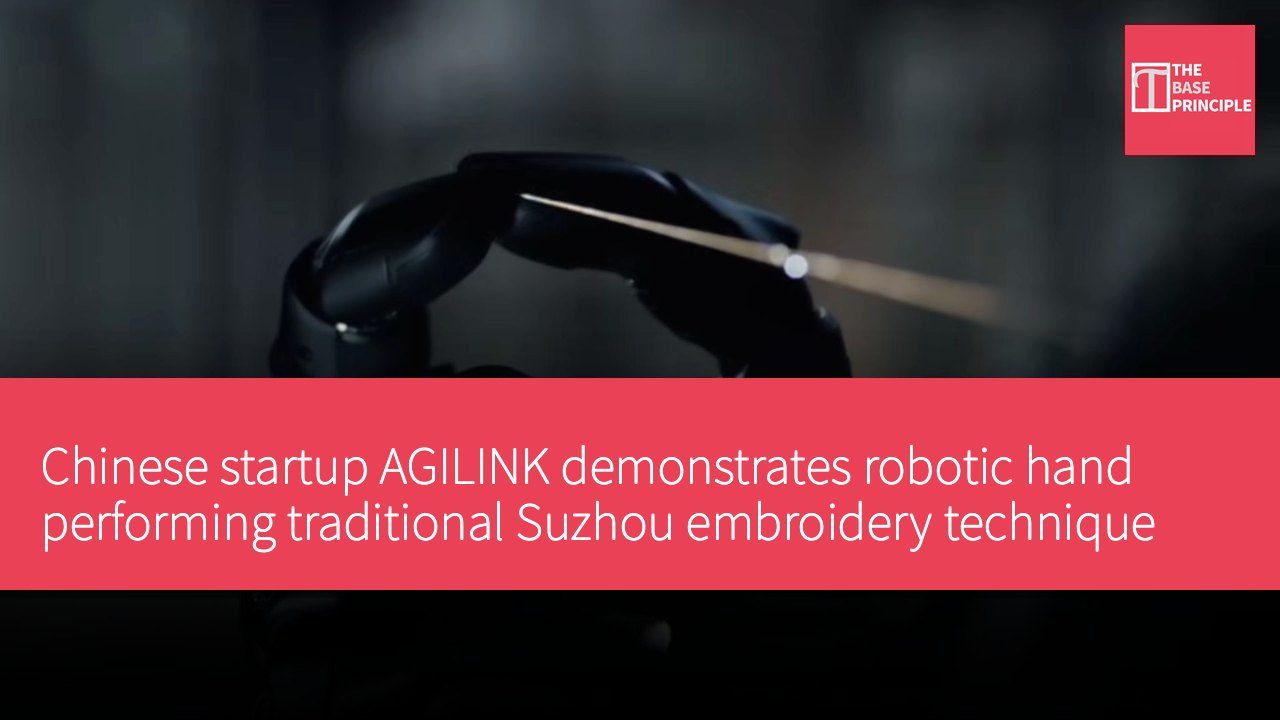
- AGILINK demonstrates robotic hand performing traditional Suzhou embroidery techniques.
- OmniHand 3 Ultra robotic hand possesses capability for precise manipulation of silk thread.
- Training process combines teleoperation data and reinforcement learning.
- Robotic hand can handle materials difficult to manipulate with rigid robots.
Chinese robotics startup AGILINK demonstrates its robotic hand using silk thread to perform basic embroidery techniques. The demonstration includes splitting silk thread into 16 finer strands, threading a needle, stretching fabric into a frame, and performing initial stitching. The company's OmniHand 3 Ultra robotic hand uses coordinated finger movements to maintain tension while separating and manipulating these delicate threads. This demonstration highlights the challenges of using robotic hands to precisely manipulate thin, flexible materials.
AGILINK, a sub-brand of Chinese robotics company AgiBot, has demonstrated its OmniHand 3 Ultra dexterous robotic hand performing the techniques required for traditional Suzhou embroidery. In the demonstration, the robotic hand was trained to separate silk threads, thread a needle, stretch fabric onto an embroidery frame, twist thread, and perform stitching. Suzhou embroidery demands precise manipulation of silk thread, as it bends, slips, and changes shape with minute variations in applied force. In the demonstration, an embroidery master taught the robot how to handle the material, with one key step being splitting the main silk thread into 16 finer strands.
Robotic hand manipulation techniques
The robot uses one finger to separate these threads while the remaining fingers maintain tension.
During twisting, the fingers must maintain contact with the silk thread while allowing the thread to rotate during the twisting process. Threading a needle and stitching require additional control over position, force, and finger coordination. "Silk thread has no fixed shape; the force applied by the fingers determines its shape. Therefore, embroidery is a test of hardware and control: a fully direct-drive hand with 21 active degrees of freedom, and visual-tactile sensors on each fingertip that can read contact through surface deformation," the company stated in its video description. AGILINK notes that the training process combines teleoperation data and reinforcement learning.
In the final task, the robot performed a continuous motion involving twisting then picking up the thread. Because the thread landed in a different position each time, the task required the robot to adjust its movements rather than follow a fixed sequence.
The OmniHand 3 Ultra is roughly the size of a human hand, weighing 1.9 lbs (630 grams). It uses a direct-drive architecture with motors connected directly to joints rather than using tendons or intermediate transmission mechanisms. Reportedly, the hand can stably grip 6.6 lbs (approx. 3 kg) and lift up to 17.6 lbs (approx. 8 kg). Its open/close speed is approximately 0.3 seconds, with positional repeatability of approximately 0.008 inches (approx. 0.2 mm). Tactile sensing is another part of the system, with each fingertip using a vision-based sensor to detect changes in contact surface deformation.
According to AGILINK, these sensors can measure force in three dimensions and detect deformations as small as 0.08 mm. The palm is also equipped with 300-point contact sensors.
Design advantages of dexterous hand
The combination of mechanical design, tactile sensing, and software control enables the hand to handle materials that are difficult to manipulate with rigid robotic grippers. Silk thread is a particularly challenging case because its shape and position can change during contact. AGILINK uses this embroidery demonstration to show how its dexterous hand performs tasks requiring constant adjustment of force and finger position. This approach differs from robotic systems designed primarily for repetitive industrial operations, where objects and movements are relatively predictable. Other companies are also developing dexterous robotic hands with different design priorities.
LinkerBot's Linker Hand L30 Pro uses five tendon-driven fingers, with a design focus on speed and repeatable movements. Boston Dynamics, meanwhile, takes a different approach; its latest Atlas hand uses four digits, aimed at industrial applications such as handling drills and welding tools.
Item Specification Weight 1.9 lbs (approx. 630 grams) Grip capacity 6.6 lbs (approx. 3 kg) Max lifting capacity 17.6 lbs (approx. 8 kg) Open/close speed Approx. 0.3 seconds Positional repeatability Approx. 0.008 inches (approx. 0.2 mm) Deformation detection capability Detects down to 0.08 mm
Innovation challenges of AGILINK robotic hand
The application of AGILINK's OmniHand 3 Ultra robotic hand in traditional embroidery techniques demonstrates the potential of robotics in fine manipulation. The precise control of silk thread required during the embroidery process demands dexterity and sensitivity from the robot, placing high demands on robotic design and control systems. By combining tactile sensing and reinforcement learning, AGILINK's robotic hand can adjust its movements in constantly changing environments, a capability with significant implications for future industrial and artistic applications.